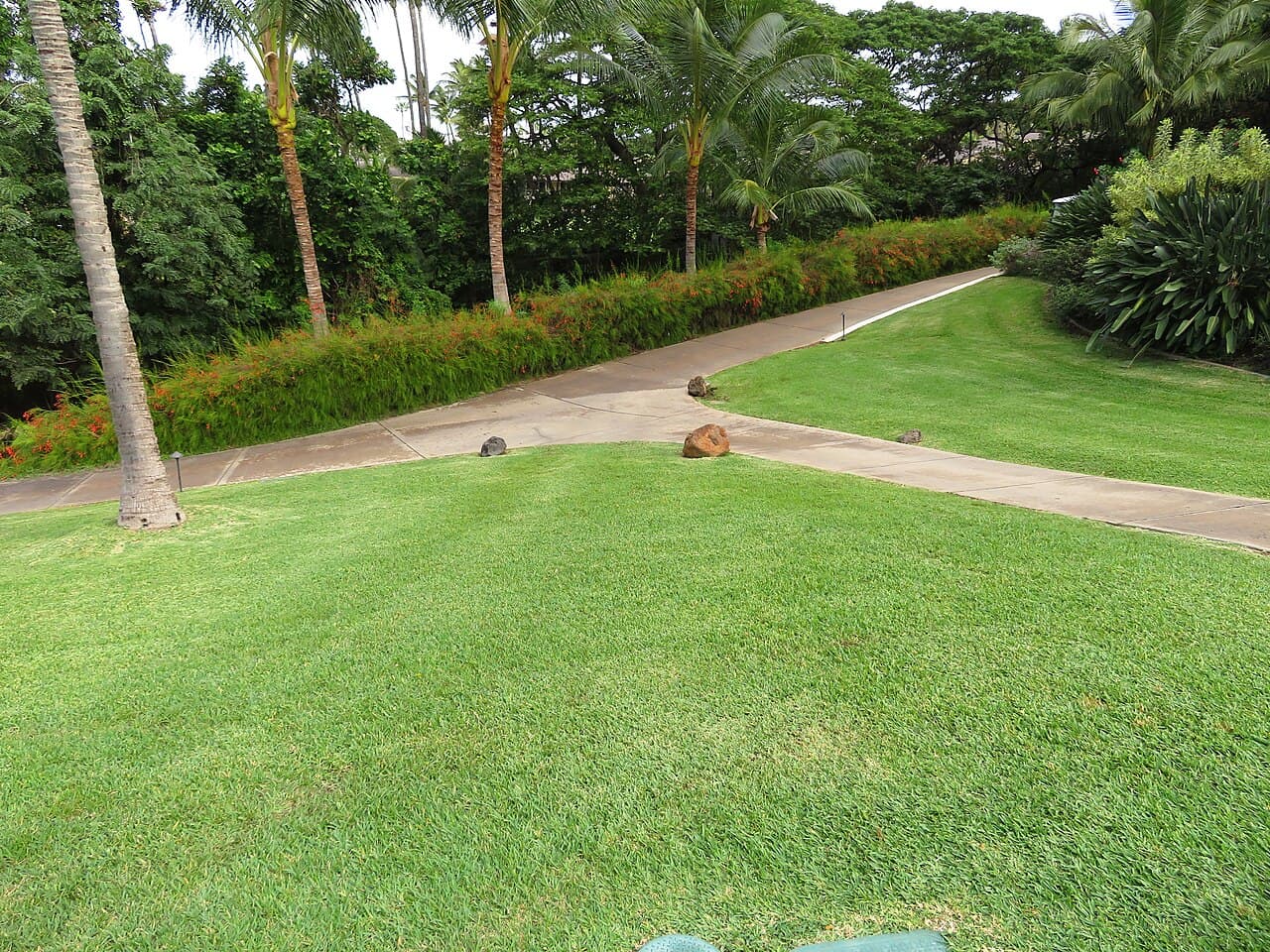
Check the label before you spray
Many lawn weed killers can injure St. Augustine, especially in hot weather or while it is greening up in spring. Use only products whose label says they are safe on St. Augustine grass, and follow the label’s temperature limits.
How to identify St. Augustine Grass
St. Augustine makes a thick, coarse lawn of wide, flat blades with rounded tips. Stout runners creep over the soil surface and root at each joint, and it has no underground rhizomes. Color ranges from light green to blue-green depending on variety, and dwarf types such as Seville are finer and lower-growing. It turns brown when it goes dormant in winter.
- Wide, blunt blades
- Blades are flat and broad, often a quarter inch or more across, with a rounded, boat-shaped tip instead of a sharp point.
- Pinched collar
- The leaf narrows sharply where the blade joins the sheath. The ligule there is only a very short fringe of hairs.
- Thick surface runners
- Stout, flattened stolons run over the soil and root at the joints. Dig down and you will find no underground rhizomes.
- Folded new leaf
- The youngest leaf is folded in half inside the sheath, not rolled.
- Seedhead
- A short, thick spike with the seeds sunk into its sides.
- Color
- Most lawns are medium to dark green. CitraBlue and Bitterblue have a blue-green cast, and Palmetto is a lighter green.
Photo: Forest and Kim Starr · CC BY 2.0 · via Wikimedia Commons
Not sure it's St. Augustine Grass?
Snap a close-up of a few blades — our free AI identifies your grass in seconds. No app needed.
Plugs & repair supplies for St. Augustine Grass
St. Augustine Grass isn't sold as reliable seed, so bare patches are fixed with plugs or sod.
Paid links. As an Amazon Associate, MeasureLawn earns from qualifying purchases.

SodPods St. Augustine CitraBlue Grass Plugs
St. Augustine plugsGrass plugs; plant 12 inches apart

St. Augustine Seville Sod Plugs
St. Augustine plugsGrass plugs; plant 12 inches apart

Scotts Turf Builder Starter Food for New Grass
For new grassBeginner friendly
Scotts Turf Builder Lawn Soil (1.5 cu ft)
Fills bare spotsBeginner friendlyEnriched lawn soil for topdressing and leveling. Contains fertilizer.
How to fix bare patches in St. Augustine Grass
- 1Find the cause before you patch. Check the edge of the damaged area for chinch bugs, and lift a runner: short, black, rotten roots point to take-all root rot.
- 2Skip the seed. St. Augustine seed is not commercially available, so patches get sod pieces or plugs, ideally of the same variety.
- 3Cut out the dead grass, loosen the top few inches of soil and rake it level so new sod sits flush with the lawn around it.
- 4Lay sod cut to fit, or set plugs about a foot apart; closer plugs fill faster. Late spring and early summer give the patch the longest run before winter.
- 5Keep the patch moist every day at first, then taper off as it roots, which usually takes two to three weeks for sod.
- 6Hold off on weed killers and fertilizer until the new grass has rooted and been mowed a few times.
When to plant or repair St. Augustine Grass
Best time: May–June. Also workable: April, July–August.
- Grows from
- Sod, plugs or sprigs
- Soil temperature
- Above 55°F for several weeks; late spring is best
St. Augustine seed is not commercially available, so plan on sod, plugs or sprigs. Sod covers the ground at once; plugs cost less but take longer to spread.
In Australia or New Zealand? The seasons flip — shift these months by six, or see the Southern Hemisphere lawn calendar.
St. Augustine Grass care at a glance
- Mowing height
- 3–4 in
- Water
- 1.25 inches per week
- Sun
- Full sun to partial shade (4–6 hours of sun minimum)
- Soil pH
- 6.0–7.0
- Fertilizer
- 2 lb nitrogen per 1,000 sq ft a year
- Growth habit
- Stolons
- Texture
- Coarse
- USDA zones
- 8-11
How it holds up
Mowing height by season
| Spring | Summer | Fall | Winter |
|---|---|---|---|
| 3"–3.5" | 3.5"–4" | 3"–3.5" | Dormant |
Varieties you'll see
Want these turned into a month-by-month schedule for your yard? Build a free lawn plan.
St. Augustine Grass pros and cons
Strengths
- Generally the most shade-tolerant warm-season lawn grass
- Grows into a dense mat that crowds out many weeds
- Establishes quickly from sod
- Handles heat and humidity well
- Some salt tolerance, which helps in coastal lawns
Weaknesses
- The least cold-hardy of the common warm-season grasses
- Not grown from seed, so every new lawn or repair means sod, plugs or sprigs
- Does not hold up well to heavy foot traffic
- Less drought-tolerant than bermuda
- No rhizomes, so scalping or heavy damage is slow to recover
- Sensitive to many lawn weed killers, especially in heat or during spring green-up
Problems to watch for
Where St. Augustine Grass grows best
St. Augustine is the classic lawn grass of Florida, the Gulf Coast and much of Texas, and it reaches up the coast into the Carolinas. It is the least cold-hardy of the main warm-season grasses, so it drops out quickly inland and to the north, where cold-tolerant Raleigh is the safest choice. In Australia the same species is sold as buffalo grass, including the popular Sir Walter variety.
A common lawn choice in
Commonly confused with
Centipede blades are narrower and paler, with small hairs along the edges near the base. St. Augustine blades are noticeably wider with smooth, blunt tips, and its runners are thicker.
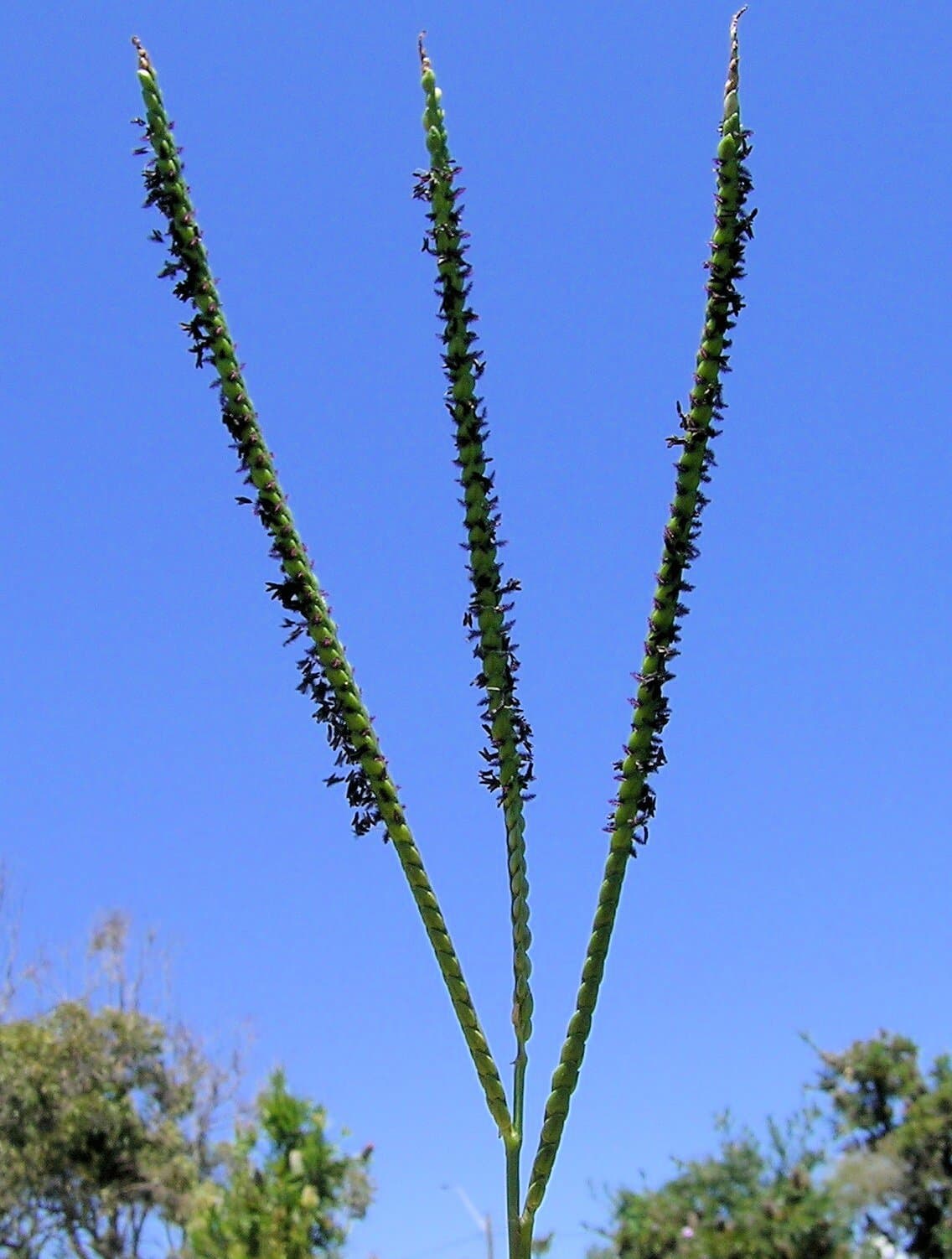
Bahia spreads by thick underground rhizomes and sends up seed stalks topped with two spikes in a V shape. St. Augustine spreads by surface runners, and its seedhead is a short, thick spike.
Only the name overlaps. Australian buffalo is St. Augustine, but US buffalograss is a different plant: a native Great Plains grass with narrow, bluish-gray blades.
Know your grass? Put it to work →
Get a free 12-month plan built for St. Augustine Grass
Measure your yard on a satellite map in 30 seconds. We'll build a care schedule for st. augustine grass in your climate — mowing height, fertilizer, seed and weed control, with exact product amounts.
Measure my lawn — it's free →St. Augustine Grass FAQ
Can you grow St. Augustine grass from seed?
No. St. Augustine seed is not commercially available, so new lawns and repairs use sod, plugs or sprigs. Sod gives the fastest cover. Plugs cost less but take longer to spread, so plant them in late spring and keep them watered through their first summer.
Will St. Augustine grass grow in shade?
Yes, better than other common warm-season lawn grasses, but it still needs at least 4 to 6 hours of sun a day. Shade tolerance varies by variety: Floratam struggles in shade, while Palmetto, Seville and CitraBlue handle it better. Under dense tree canopy even St. Augustine thins out, and mulch or shade-loving plants may be the better answer.
Is St. Augustine grass the same as buffalo grass?
In Australia, yes. Australians sell St. Augustine as buffalo grass, so Australian buffalo varieties such as Sir Walter are this same species. In the US, buffalograss is a completely different plant, a fine-bladed native prairie grass of the Great Plains. Check for the scientific name Stenotaphrum secundatum when buying.
What causes brown patches in St. Augustine grass?
The usual causes are chinch bugs, large patch disease and take-all root rot. Chinch bug damage shows up in hot, dry summer weather, often in sunny spots next to driveways and sidewalks. Large patch forms circular patches with yellow to orange edges in spring and fall. Take-all root rot leaves thin, yellowing areas with short, black, rotted roots.
How cold-hardy is St. Augustine grass?
It is the least cold-hardy of the common warm-season lawn grasses. Hard winters can kill it outright near the northern edge of its range. Raleigh is the most cold-tolerant common variety, while Floratam and Seville are cold-sensitive. Plant early in the season so new grass has as long as possible to root before the first frost.
Other warm-season grasses
Sources
- Texas A&M AgriLife Extension: St. Augustinegrass Lawn Management (EHT-144)
- UF/IFAS Extension: St. Augustinegrass for Florida Lawns (ENH5)
- Clemson HGIC: St. Augustinegrass Yearly Maintenance Program
- NC State TurfFiles: St. Augustinegrass
- Western Australian Herbarium (Florabase): Stenotaphrum secundatum
- Queensland DPI eResearch Archive: Characterization of commercial cultivars and naturalized genotypes of Stenotaphrum secundatum in Australia (2009)
- NC State Extension: Carolina Lawns
- Sir Walter specification: Sir Walter (Stenotaphrum secundatum)
- Texas A&M Plant Disease Handbook: St. Augustine Decline, Centipede Mosaic
More free lawn tools:
Every lawn grass•Photo grass identifier•Grass seed calculator•Weed guide•Lawn care calendar