Fertilizer Calculator: How Much Does Your Lawn Need?
Enter your lawn size and the numbers on your fertilizer bag — we'll tell you exactly how many pounds and bags to buy, and the spreader setting to use. The rule of thumb: 1 pound of nitrogen per 1,000 sq ft per feed.
Spreaders to apply it evenly
Paid links. As an Amazon Associate, MeasureLawn earns from qualifying purchases.

Chapin 8700G TurfPro Chest-Mount Spreader
Beginner friendlyRecommended for lawns under 5,000 sq ft. Hands-free chest-mount design for easy spreading of fertilizer seed and granular products.
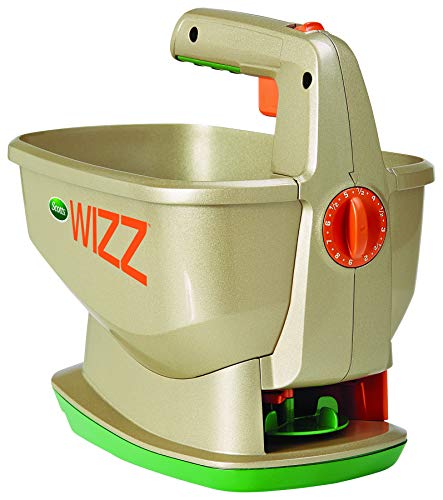
Scotts Wizz Battery-Powered Handheld
Beginner friendlyBattery-powered handheld spreader for spot-seeding and small lawns under 4,000 sq ft.
How to work out how much fertilizer you need
Fertilizer is sized by nitrogen — the first of the three NPK numbers on the bag. Turf wants about 1 lb of actual nitrogen per 1,000 sq ft per application. Because a bag is only part nitrogen, you spread more product than that to hit the target:
Total product = (lawn area ÷ 1,000) × product per 1,000
Bags = total product ÷ bag weight, rounded up
Example: a 16-4-8 fertilizer is 16% nitrogen, so you need ~6.25 lb of product per 1,000 sq ft. On a 5,000 sq ft lawn that's ~31 lb — one 50-lb bag.
Fall feeding and winterizer
The fall feed matters more than the spring one. Cool nights and warm soil push a cool-season lawn into root growth, so what you put down in September through November is stored and spent on next spring's green-up. Switch the calculator above to Fall / winterizer and it swaps in real winterizer analyses and caps the rate at 1 lb of nitrogen per 1,000 sq ft.
Ignore the word on the front of the bag and read the analysis. The value of a late feed is the nitrogen the plant takes up while its roots are still working, which is why the first number is the one you size on. University turf trials have repeatedly failed to show a winter-hardiness benefit from the extra potassium on soils that already test adequate, so the third number is a soil-test decision rather than a seasonal ritual — and the middle number should generally be zero, because many states restrict phosphorus on established lawns unless a soil test shows a need.
Time it to your last mow of the year, with 4-inch soil temperature falling through the low 50s — uptake stops in the low 40s, and anything spread after that is sitting on the surface waiting to run off. What winterizer actually does covers the timing triggers and who should skip it entirely.
Measure your lawn — just the real mowable area — free on satellite imagery in 2 minutes, then your fertilizer numbers are exact.
Measure my lawn free →Fertilizer questions, answered
How much fertilizer do I need per 1,000 sq ft?
The standard is 1 pound of actual nitrogen per 1,000 sq ft per application. The amount of product that takes depends on the first NPK number: divide 1 by that number as a decimal. A 16-4-8 fertilizer (16% N) needs about 6.25 lb of product per 1,000 sq ft; a 32-0-4 needs about 3.1 lb.
How many bags of fertilizer do I need?
Work out the total pounds of product (lawn area ÷ 1,000 × pounds-per-1,000), then divide by the bag weight and round up. For example, 5,000 sq ft with a 16-4-8 fertilizer needs ~31 lb of product — one 50-lb bag, or three 12.5-lb bags.
What do the three fertilizer numbers (NPK) mean?
They are the percentages of Nitrogen, Phosphorus and Potassium by weight. A 16-4-8 bag is 16% nitrogen, 4% phosphorus, 8% potassium — the rest is filler and other nutrients. Nitrogen (the first number) is what drives green growth and what you size your application around. Phosphorus (the middle number) is restricted on established lawns in many states unless a soil test shows a need or you are seeding new grass, which is why most lawn fertilizers now read 0 in the middle.
Can I apply too much fertilizer?
Yes. Exceeding about 1 lb of nitrogen per 1,000 sq ft in a single feed of quick-release fertilizer can burn the lawn (brown streaks). Slow-release products are more forgiving. When in doubt, apply less and feed again in 4–6 weeks.
What fertilizer should I use in the fall?
"Winterizer" is a marketing term, not a formula, so read the analysis rather than the name. What a late-season feeding actually does is supply nitrogen while the roots are still active — buy for the first number. Common fall analyses are 32-0-10, 24-0-6 and 10-0-20. University turf trials have repeatedly failed to show a winter-hardiness benefit from the extra potassium on soils that already test adequate, so treat the third number as a soil-test decision rather than a seasonal ritual, and expect the middle number to be zero because many states restrict phosphorus on established lawns. Cool-season lawns (fescue, bluegrass, ryegrass) get the most out of a fall feed; warm-season lawns should skip a late nitrogen feed and wait for spring green-up.
How much winterizer do I need per 1,000 sq ft?
Size it the same way as any other feed — on nitrogen. A 32-0-10 winterizer is 32% nitrogen, so 1 lb of nitrogen per 1,000 sq ft takes about 3.1 lb of product; a 10-0-20 takes about 10 lb. Keep a late-fall feed at or under 1 lb of nitrogen per 1,000 sq ft: more than that pushes soft growth into frost. Watch the potash that rides along with it — 10 lb of a 10-0-20 also puts down 2 lb of potash per 1,000 sq ft, roughly double the usual single-application ceiling, so choose a lower-potash analysis unless a soil test shows potassium is low. A potassium-only product such as 0-0-25 has no nitrogen at all, so it is sized on potash and is only worth applying against a soil test.