How to Read a Fertilizer Label: NPK Numbers Explained
Those three numbers on every fertilizer bag control how your grass grows. Here is what N-P-K really means - and how to pick the right bag in 30 seconds.
What do the three numbers on a fertilizer bag actually mean?
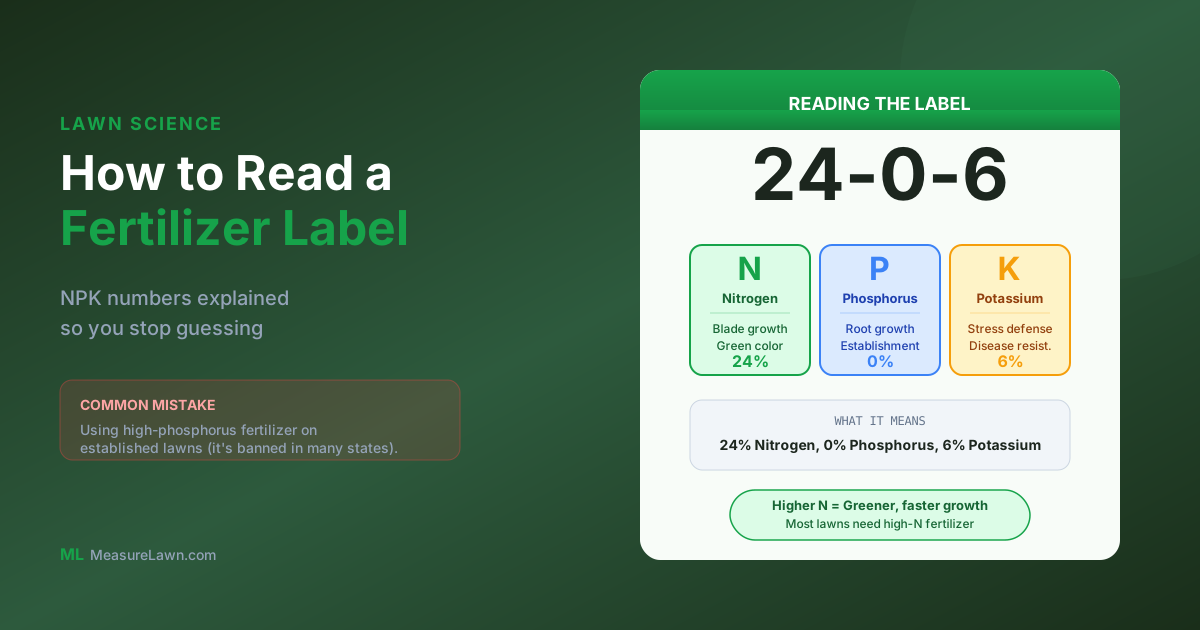
Every bag of lawn fertilizer displays three numbers in large text: something like 16-4-8, 24-25-4, or 32-0-10. These numbers represent the percentage of three essential nutrients in the fertilizer by weight. The first number is nitrogen (N), the second is phosphorus (P), and the third is potassium (K)—which is why it's called the NPK ratio.
Think of NPK as the nutritional label on a food package. Just like you know that a cereal has 12 grams of protein per serving, NPK tells you exactly what percentage of each nutrient your lawn is getting. A 16-4-8 fertilizer contains 16% nitrogen, 4% phosphorus, and 8% potassium. The remaining 72% is filler—inert ingredients that help distribute the nutrients evenly.
The ratio matters because different nutrients do completely different jobs. It's not like "more is better" across the board. A spring fertilizer and a fall fertilizer have completely different NPK ratios because your lawn has different needs at different times of year. By understanding what each letter represents, you'll stop buying random products and start buying exactly what your lawn actually needs.
Top-rated products for a greener lawn
All dosed by square foot — measure your lawn first for the exact bag count.

Scotts Turf Builder WinterGuard 32-0-10
Beginner friendly
Scotts Turf Builder Starter Food for New Grass
Beginner friendly
Simple Lawn Solutions Fall Lawn Booster 3-18-18
Beginner friendlyAs an Amazon Associate, Measure Lawn earns from qualifying purchases.
What does nitrogen (N) do for your lawn?
Nitrogen is the powerhouse nutrient that makes grass green and thick. It's responsible for blade growth and that lush color homeowners love. When you want your lawn to look healthy and vibrant, you're really asking for more nitrogen.
Here's how nitrogen works: it's a core component of chlorophyll and amino acids, which are the building blocks of plant tissue. When you apply nitrogen, your grass plants put that nutrient directly into leaf growth. That's why you'll see visible greening within 7-10 days of a nitrogen application. Cool-season grasses (like fescue, bluegrass, and perennial rye) are nitrogen-hungry plants—they want it spring and fall. Warm-season grasses (like Bermuda, zoysia, and St. Augustine) want it more in summer.
The catch: nitrogen is highly soluble, which means it leaches through soil quickly. A quick-release nitrogen application shows results fast but only feeds for days or weeks. That's why you need multiple applications throughout the year, and why premium slow-release products make such a difference in your results.
Nitrogen deficiency shows up immediately. Your lawn looks pale, growth slows, and weeds move in because weak grass can't compete. But oversupply creates problems too—too much nitrogen causes excessive growth that makes your lawn soft and susceptible to disease, particularly fungal diseases like brown patch.
What does phosphorus (P) do for your lawn?
Phosphorus is the root-building nutrient. While nitrogen makes blades grow upward, phosphorus develops the root system downward. You can't see it happening above ground, but strong roots are everything—they're what makes your lawn survive drought, heat stress, and traffic.
Phosphorus is especially important for new lawns and overseeding because developing roots need it to establish quickly. That's why starter fertilizers always have a higher P number. A typical new lawn formula might be 24-25-4—high nitrogen for fast blade growth, but even higher phosphorus to build a foundation that lasts. Once grass is established, phosphorus becomes less critical because the root system is already developed.
Phosphorus becomes important again in spring—it supports the transition from dormancy and helps the root system wake up and expand. It's also relevant in summer for heat-stressed grasses and in fall when you're trying to encourage deeper roots for winter hardiness.
The challenge with phosphorus: it moves slowly through soil and can build up over time if you keep adding it. Many lawns actually have adequate or excess phosphorus already, particularly if they've been treated repeatedly over years. Soil testing reveals your actual phosphorus level, which prevents wasteful over-application. Excess phosphorus also contributes to algae blooms in waterways, so it's not just a waste issue—it's an environmental concern.
What does potassium (K) do for your lawn?
Potassium is the stress-tolerance nutrient. It strengthens cell walls, improves disease resistance, and helps grass survive heat, cold, drought, and foot traffic. Think of potassium as the immune system booster for your lawn.
Potassium shows up in high amounts during fall and winter formulas because cool-season grasses need it to harden off for dormancy and survive freezing temperatures. A winter formula might be 32-0-10 or 10-0-20—very high potassium, low or no nitrogen (which would trigger new tender growth that freezes easily). Warm-season grasses need potassium in late summer to prepare for dormancy and to strengthen disease resistance during their peak growth season.
Potassium also plays a role in disease resistance. Lawns with adequate potassium are less susceptible to fungal diseases and can recover faster from damage. It improves cell structure, making grass blades thicker and more resistant to mowing stress, insect damage, and environmental stress.
Unlike nitrogen, potassium doesn't leach as quickly. It does accumulate in soil over time, but deficiency is common in sandy soils where potassium washes through quickly. A pale, weak-looking lawn with poor disease resistance that bruises easily when traffic crosses it might be showing potassium deficiency. Soil testing pinpoints whether you actually need more potassium or whether you're already adequate.
What NPK ratio should you use for each season?
The best NPK ratio changes with the season because your lawn's needs change. A formula that's perfect for spring will actually harm your lawn in fall.
Spring: Use a balanced or slightly nitrogen-heavy formula like 16-4-8 or 18-24-12. Your lawn is waking up from dormancy, blades are growing, and roots need some support. Spring is the first of two peak growth seasons for cool-season grasses, so moderate nitrogen makes sense. Apply in early spring when soil is at least 50°F and grass is actively growing.
Early Summer: Drop to a lower nitrogen formula like 13-5-5. Your lawn is approaching heat stress, and excessive nitrogen creates soft growth that's vulnerable to heat damage and fungal disease. Many lawn care programs skip fertilizer in mid-to-late summer entirely to avoid encouraging tender new growth during the plant's dormant season.
Fall: Switch to high-potassium, low-nitrogen formulas like 32-0-10 or 10-0-20. This is the second peak growth season for cool-season grasses, and potassium hardens them off for winter while disease resistance improves. Fall fertilizer applications show results most dramatically—many homeowners report their best-looking lawn in late fall or early spring because of strong potassium feeding in September-October.
Winter: No fertilizer application. Your cool-season grass is dormant. For warm-season grasses in the South, fall feeding is your winter preparation.
What's the difference between slow-release and quick-release fertilizer?
Slow-release and quick-release fertilizers deliver the same nutrients, but the timing couldn't be more different. Quick-release fertilizer dissolves immediately when it hits soil moisture, feeding your lawn fast. Slow-release releases nutrients gradually over weeks or months, providing steady nutrition.
Quick-Release Fertilizers: These are water-soluble formulas that dissolve instantly. Your lawn greens up within 3-7 days. They're inexpensive, effective for immediate results, and perfect if you're in a crisis mode with a pale lawn that needs urgent color. The downside: they release all their nutrients at once, so they're only feeding for days or weeks. You'll see the results fade after 2-3 weeks, requiring frequent applications. They're also prone to burning—applying too much can damage grass because the high concentration of salts damages plant cells.
Slow-Release Fertilizers: These use polymer coatings or organic forms that break down gradually over 6-8 weeks (or sometimes longer). A single application feeds consistently through an entire season. They don't burn your lawn because the nutrient concentration is never too high at once. They're more expensive upfront, but you use less product overall because you're not reapplying constantly.
For a healthy, low-stress lawn, slow-release is better. You apply less frequently, get more consistent results, and avoid the risk of burning. For immediate color correction or emergency greening before an event, quick-release is your tool.
Many premium formulas combine both—quick-release for immediate color and slow-release for lasting effect. A 16-4-8 that's half quick-release and half slow-release gives you green in days and feeding that lasts 6 weeks.
How do you calculate how much fertilizer to actually apply?
This is where most homeowners fail. They eyeball it, sprinkle some on, and hope for the best. But fertilizer math is straightforward once you know the formula.
Here's the key number: the application rate. This is how many pounds of product you apply per 1,000 square feet of lawn. Most bags list this on the back. For example, a common rate is 3.5 lbs per 1,000 square feet.
Once you know the application rate and your lawn's square footage, you can calculate total product needed:
(Application rate ÷ 1,000) × Your lawn's square footage = Total lbs needed
Let's work through a real example. Say you have a 7,200 square foot lawn, and your fertilizer label says the application rate is 3.5 lbs per 1,000 square feet:
(3.5 ÷ 1,000) × 7,200 = 25.2 lbs of fertilizer needed
This is where precision matters. If you apply too little, you're underfeeding and wasting money on weak results. If you apply too much, you're burning the lawn and wasting product.
Spreader settings complicate this further. Your spreader has a numbered dial (often 1-10) that opens the hopper and distributes product at different rates. Different spreaders deliver different amounts at the same dial setting. The solution? Walk at the manufacturer's recommended pace and overlap your passes slightly to ensure even coverage.
Why does your lawn's square footage change everything about fertilizer math?
Your lawn's actual square footage is the single most important number in fertilizer application. It's the difference between feeding your lawn exactly what it needs and either starving it or burning it.
Many homeowners guess their lawn size—"Oh, it's probably around 5,000 square feet"—and then apply based on that guess. If the actual lawn is 7,000 square feet, they're significantly underfeeding. If it's 3,500 square feet, they're overapplying.
Professional lawn care companies measure every lawn before applying fertilizer. They use tools, satellite imagery, or walk-off measurements to get exact square footage. The reason is simple: every bag of fertilizer is designed to cover a specific area at a safe application rate. Going off-label—applying more than recommended per 1,000 sq ft—risks burning. Applying less than recommended produces weak results.
More importantly, your lawn's square footage determines the total nutrient load. A 10,000 sq ft lawn needs twice the nitrogen as a 5,000 sq ft lawn to reach the same growth response. Understanding your lawn's actual size lets you scale products correctly.
Most homeowners discover their lawn is smaller or larger than they thought when they actually measure. A rectangular lawn is easy—multiply length by width. An irregular-shaped lawn requires breaking it into rectangles and triangles, or using satellite measurement tools. Mobile apps now let you trace your lawn boundary on a map and get instant square footage.
Ready to measure your lawn?
Get a free, AI-customized lawn care plan with exact product quantities for your property.
Measure My Lawn — It's Free →