Lawn Size Calculator: Measure Your Lawn in 2 Minutes (No Tape Measure)
Trace your lawn on real satellite imagery, exclude your house, driveway and flower beds, and get exact square footage to the foot. Accurate to within 1–3% of a professional survey — and 100% free.
Knowing your lawn's exact square footage is the foundation of every lawn care decision. Too much fertilizer burns your grass. Too little seed leaves bare patches. The wrong amount of pre-emergent lets weeds through. Every product bag lists application rates per 1,000 square feet — so if you don't know your number, you're guessing.
Below we compare five ways to measure your lawn, from high-tech satellite tools to walking it yourself with a tape measure — so you can pick the method that works for you.
Key Takeaways
- A satellite lawn calculator is the fastest and most accurate method for most homeowners
- Always measure lawn area (grass only), not your entire yard or lot size
- Subtract your house, driveway, patio, and flower beds from the total property area
- Wrong measurements waste money — a 20% error on a 5,000 sq ft lawn means buying products for 1,000 sq ft you don't have
- You only need to measure once unless you change your landscaping
Why Accurate Lawn Measurement Matters
Every lawn care product — fertilizer, grass seed, pre-emergent herbicide, lime, weed killer — is dosed per 1,000 square feet. Get your lawn size wrong, and you're either wasting money or getting poor results. Here's what happens with inaccurate measurements:
Too much fertilizer
Nitrogen burn turns your lawn brown and can kill grass entirely. Recovery takes weeks. You'll spend more money fixing the damage than you would have on the fertilizer itself.
Too little seed
Thin coverage means patchy results and wasted effort. The gaps fill with weeds instead of grass, and you end up reseeding the same area twice.
The real cost of guessing
A homeowner who overestimates by just 20% on a 5,000 sq ft lawn buys products for 6,000 sq ft — wasting $50-100+ per season on fertilizer and seed alone. Over a few years, that's hundreds of dollars.
The good news: measuring your lawn accurately takes less than 5 minutes with the right method, and you only have to do it once.
5 Lawn Measurement Methods Compared
Not all measurement methods are created equal. Here's how the five most common approaches stack up:
| Method | Accuracy | Time | Cost | Best For |
|---|---|---|---|---|
| Satellite Calculator | 97-99% | 2 min | Free | Any lawn shape or size |
| Tape Measure | 90-95% | 30-60 min | $10-20 | Small, rectangular lawns |
| Measuring Wheel | 92-96% | 20-40 min | $25-50 | Large open areas |
| Walking / Pacing | 80-85% | 10-20 min | Free | Quick rough estimate |
| Google Earth (manual) | 85-90% | 10-15 min | Free | Simple shapes only |
Method 1: Satellite Lawn Calculator (Recommended)
A satellite lawn calculator lets you measure your lawn from your computer or phone — no going outside, no tape measure, no math. You trace your lawn on a satellite image and get exact square footage instantly.
This is the method we recommend for most homeowners. You can use the free measure my lawn tool in your browser — it's fast, accurate to within 1-3% of a professional survey, and works for any lawn shape, including complex, irregular properties that would be a nightmare to measure by hand.
- Your home address
- A phone, tablet or computer with a browser
- About two minutes — no tape measure, no ladder, no maths
Enter your address
Check you can see the whole property
- Trees can overhang the lawn edge — the grass usually continues underneath.
- If the imagery looks out of date, the boundaries rarely move; measure what is there now.
Trace the edge of your lawn
Cut out everything that isn’t grass
Read your lawn size
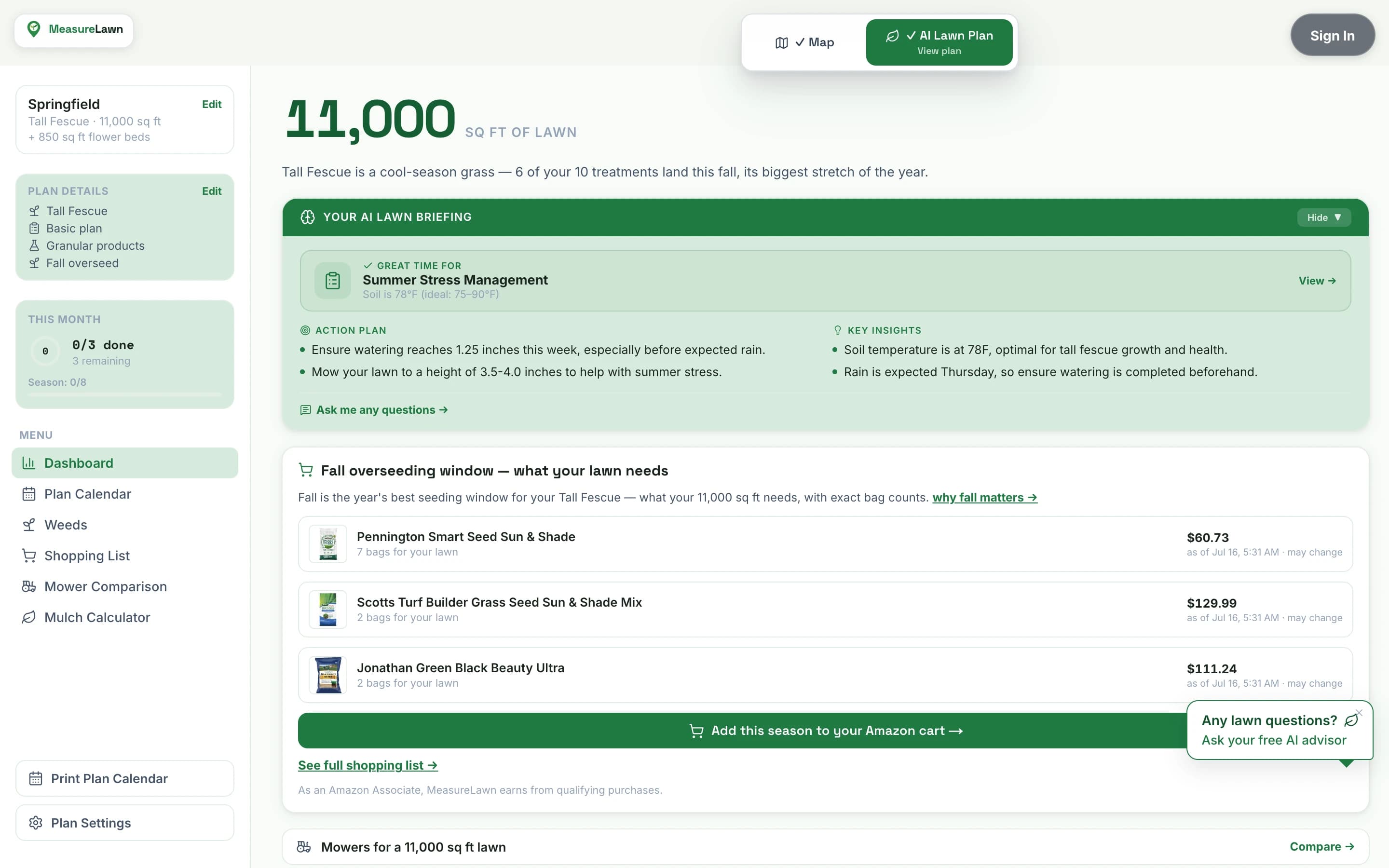
From here, Measure Lawn can turn that number into a complete 12-month care plan, with product quantities worked out for your lawn size, grass type and climate zone.
Try it yourself — it takes less than 2 minutes
Measure My Lawn — FreeMeasure lawns for a living? There's a pro version that turns this same satellite measurement into an instant-quote widget for your company website — see MeasureLawn Pro lawn care software.
Method 2: Tape Measure
The classic approach. A 100-foot tape measure costs $10-20 at any hardware store and works well for small, rectangular lawns. Here's how to do it:
For rectangular lawns:
- Measure the length of your lawn in feet
- Measure the width
- Multiply length x width = square footage
- Example: 80 ft x 60 ft = 4,800 sq ft
For L-shaped or complex lawns:
- Break your lawn into rectangular sections
- Measure each rectangle separately (length x width)
- Add all the rectangles together for total area
For triangular sections:
Measure the base and height, then use: Area = (base x height) / 2
Limitations
Tape measuring gets tedious and error-prone for large or irregularly shaped lawns. You also need a helper to hold the other end of the tape for long distances, and it's difficult to account for curved edges. Accuracy drops significantly with complex shapes.
Method 3: Measuring Wheel
A measuring wheel (also called a surveyor's wheel) is a wheeled tool you push along the ground. It counts rotations and displays the distance walked. They cost $25-50 and are available at most hardware stores.
- Walk the length of your lawn with the wheel, note the distance
- Walk the width, note the distance
- Multiply length x width for rectangular areas
- For irregular shapes, walk the perimeter and break into sections
Measuring wheels are most practical for large, open properties where a tape measure would be cumbersome. They struggle with tight spaces around landscaping, fences, and garden beds.
Method 4: Walking / Pacing
The quickest low-tech method. The average adult stride is about 2.5 feet. Count your steps across the length and width, multiply each by 2.5, then calculate the area.
- Calibrate first: Walk a known 20-foot distance and count your steps. Divide 20 by your step count to get your personal stride length
- Walk the length of your lawn, counting steps. Multiply by your stride length
- Walk the width, same process
- Multiply length x width for square footage
Accuracy warning
Pacing is typically only 80-85% accurate. A 15-20% error on a 5,000 sq ft lawn means you could be off by 750-1,000 sq ft — enough to significantly under or over-apply products. Use this for rough estimates only, not for calculating product quantities.
Method 5: Google Earth
Google Earth has a built-in ruler and polygon tool that lets you measure distances and areas on satellite imagery. It's free but requires more manual effort than a dedicated lawn calculator.
- Open Google Earth (web or desktop)
- Search for your address
- Use the ruler tool to measure distances, or the polygon tool to trace an area
- Note: You'll need to manually subtract non-grass areas (house, driveway, etc.)
The key limitation of Google Earth is that it doesn't have a concept of exclusions. You can draw one polygon, but subtracting your house, driveway, and other features requires separate calculations and manual math. A dedicated lawn calculator like Measure Lawn automates this entire process — our lawn measuring tool page explains how the exclusion approach works.
Skip the tape measure and math
Trace your lawn on satellite imagery and get exact square footage in under 2 minutes.
Measure My Lawn — FreeHow to Measure an Irregular-Shaped Lawn
Most lawns aren't perfect rectangles. Curved garden beds, angled driveways, odd lot shapes, and mature trees create complex boundaries that are hard to measure with traditional methods.
The break-it-into-shapes method (manual)
If you're using a tape measure, break your lawn into a combination of rectangles, triangles, and semi-circles:
- Rectangle: Length x Width
- Triangle: (Base x Height) / 2
- Circle: 3.14 x Radius x Radius
- Semi-circle: (3.14 x Radius x Radius) / 2
Measure each shape separately and add them together. Subtract any non-grass shapes (house, driveway, etc.) from the total.
The satellite method (easier)
With a satellite lawn calculator, irregular shapes are just as easy as rectangles. You trace the actual outline of your lawn — curves, angles, and all — and the tool calculates the exact area of your polygon mathematically. No shape-splitting, no formulas, no rounding errors.
This is the single biggest advantage of satellite measurement over manual methods. A lawn with 12 curves and 3 garden beds that would take 45 minutes to measure by hand takes 2 minutes with a satellite calculator.
What to Do After You've Measured Your Lawn
Once you know your exact lawn size, you can calculate precise product quantities for everything:
Fertilizer
Fertilizer is applied per 1,000 sq ft. If the bag says "apply 4 lbs per 1,000 sq ft" and your lawn is 5,000 sq ft, you need exactly 20 lbs. Full fertilizer calculator guide →
Grass Seed
Overseeding rates vary by grass type — Kentucky Bluegrass needs 2-3 lbs per 1,000 sq ft, while Bermuda needs 1-2 lbs. Your lawn size determines exactly how many bags to buy. Overseeding guide →
Pre-Emergent Herbicide
Pre-emergent must cover every square foot evenly — gaps let crabgrass and weeds through. Knowing your exact area ensures complete, even coverage. Pre-emergent timing guide →
Mulch
Mulch is calculated by flower bed area, not lawn area. Our tool measures both separately. Mulch calculator →
Save time with an AI lawn care plan
Instead of calculating each product manually, Measure Lawn generates a complete 12-month lawn care plan with exact quantities for every treatment — based on your lawn size, grass type, and location. One measurement, all the math done for you.
The tool you'll want once you start applying products
A broadcast spreader is the difference between an even, professional-looking application and a patchy mess. These are the picks we recommend to get started.


5 Common Lawn Measurement Mistakes
1. Measuring your lot size instead of lawn size
Your lot (the whole property) includes your house, driveway, walkways, and patio. Your lawn is just the grass. If your lot is 10,000 sq ft but your house takes up 2,000 and your driveway takes up 800, your lawn is only 7,200 sq ft. Applying fertilizer for 10,000 sq ft wastes 39% of your product.
2. Forgetting to subtract the house
The most common mistake. People measure their whole yard perimeter and multiply — but the house is sitting in the middle of it. Always subtract your home's footprint (not its living area — the footprint is what matters for lawn measurement).
3. Using the lot size from your deed or tax records
Your property deed and county tax records list your total lot size. This is your whole property, not your lawn. A 0.25-acre lot (10,890 sq ft) might only have 6,000 sq ft of actual grass once you subtract structures and hardscaping.
4. Rounding too aggressively
Rounding "about 5,000 sq ft" when your lawn is actually 4,200 sq ft means buying 19% more product than you need. Use precise measurements — that's the whole point.
5. Measuring only the front yard
Your front and back lawn both need treatment. Make sure you measure the total grass area of your entire property, not just the part visible from the street.
Frequently Asked Questions
How big is my yard?
The fastest way to find out: type your address into a free satellite measuring tool, trace your lawn on the imagery, and get exact square footage in about 2 minutes. As a benchmark, the median US lawn measures roughly 8,200 sq ft in our measured study — and only about three-quarters of a typical lot is lawn once the house, driveway, and beds are subtracted. County parcel records list your total lot size, but lawn products are dosed by lawn area, so measure the grass itself.
How do I measure my lawn without going outside?
Use a free satellite lawn calculator. Enter your address, trace your lawn on the satellite image from your computer or phone, and get exact square footage. The entire process takes under 2 minutes, and you never need to leave your chair.
How accurate is satellite lawn measurement?
Satellite lawn measurement is typically accurate to within 1-3% of professional ground surveys. The satellite imagery from Google Maps is high resolution, and polygon-based area calculation is mathematically exact. For lawn care product calculations, this level of accuracy is more than sufficient — and often more accurate than manual tape measure methods.
What is the average lawn size in the US?
In our own measured study of more than a thousand US properties, the median lawn is roughly 8,200 square feet — and only about three-quarters of a typical lot is lawn at all once the house, driveway and beds are subtracted. The widely repeated 10,871 sq ft figure comes from subtracting an average house size from an average lot size, which counts driveways and patios as grass. See the measured lawn size study for the current figures and state-by-state medians.
How do I measure my lawn for fertilizer?
First, measure your lawn's square footage. Then check your fertilizer bag for the application rate (listed per 1,000 sq ft). Divide your lawn size by 1,000, then multiply by the rate. Example: 5,000 sq ft lawn, fertilizer rate of 4 lbs per 1,000 sq ft → 5 x 4 = 20 lbs needed. Read our complete fertilizer guide for detailed calculations.
How do I measure an irregularly shaped lawn?
With a tape measure, break the lawn into rectangles, triangles, and semi-circles, measure each one, and add the areas together. With a satellite calculator, just trace the actual outline of your lawn — no matter how irregular — and get the area instantly. The satellite method is faster and more accurate for complex shapes.
Can I measure my lawn with my phone?
Yes. Measure Lawn works on any smartphone browser — no app download required. Enter your address, trace your lawn on the satellite image using your finger, and get your square footage. It works on iPhone, Android, and tablets.
What's the difference between yard size and lawn size?
Your yard (or lot) includes everything on your property — house, driveway, patio, flower beds, pool, and lawn. Your lawn is just the grass area. When buying fertilizer, seed, or weed control, you need your lawn size, not your yard size. Using your full lot size leads to over-purchasing products by 20-40% in most cases.
How much does it cost to have your lawn professionally measured?
A professional land survey typically costs $300-$800+ depending on property size and location. For lawn care purposes, a free satellite calculator provides the same level of accuracy needed for fertilizer, seed, and product calculations — saving hundreds of dollars.
How do I measure a sloped or hilly lawn?
For lawn care product calculations, use the flat (plan-view) area — which is what satellite measurement captures. Fertilizer, seed, and pre-emergent application rates are based on horizontal coverage area, not the surface area of slopes. So satellite measurement gives you the correct number even for hilly properties.
How often should I re-measure my lawn?
Only when you make significant landscaping changes — adding a patio, expanding a flower bed, removing trees, or building an addition. If nothing has changed, your measurement stays accurate indefinitely. Most homeowners measure once and use the same number for years.
Ready to measure your lawn?
Join thousands of homeowners who've measured their lawn in under 2 minutes. Free, accurate, no tape measure needed.
Measure My Lawn — It's Free