How Much Fertilizer Do I Need? Free Calculator & Exact Math
Stop guessing and stop wasting money. The exact math, plus a free calculator, for the precise amount of fertilizer your lawn needs by size and N-P-K.
You're standing in the fertilizer aisle staring at a bag of Scotts Turf Builder that says "covers 5,000 sq ft." You think your lawn is "about that size." You buy one bag, spread it, and hope for the best.
Three weeks later, half your lawn is dark green and the other half is pale and thin. Or worse — you bought two bags, doubled up on the overlap areas, and now you have brown burn streaks across your yard that'll take a month to recover.
Both scenarios happen because of the same mistake: you didn't know your actual lawn size.
What's the Formula for Calculating How Much Fertilizer You Need?
Calculating fertilizer quantity is elementary math:
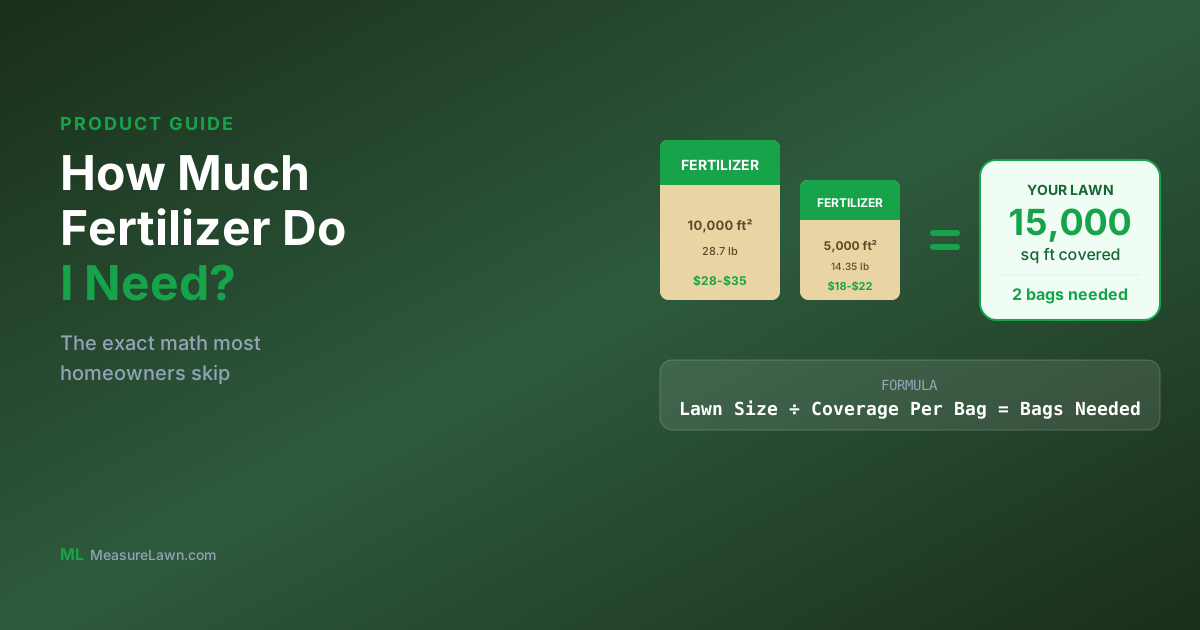
Bags needed = Your lawn size (sq ft) ÷ Coverage per bag (sq ft) — then round up.
A lawn that measures 7,200 square feet using a product that covers 5,000 square feet per bag needs 2 bags (7,200 ÷ 5,000 = 1.44, rounded up to 2). You'll have some extra coverage, which is fine — slight overlap is better than gaps.
For products that list an application rate (like "2.87 lbs per 1,000 sq ft"), you can get even more precise:
Total product needed = (Lawn size ÷ 1,000) × Application rate
Then divide by the bag weight to find how many bags. A 7,200 square foot lawn needing 2.87 lbs per 1,000 sq ft requires about 20.7 lbs of product. If the bag is 16 lbs, you need 2 bags.
The math is easy. The hard part is the input: your actual lawn size.
In practice, this means a homeowner with a north-facing shaded lawn often needs slightly different dosing than someone with full-sun turf, because shade typically reduces vigor and nutrient uptake rates. Similarly, if your lawn has recently experienced stress (drought, disease, or heavy foot traffic), some experts recommend applying a light starter dose first, waiting two weeks, then applying the full dose. This prevents shocking weakened turf with too much nitrogen at once. High-quality digital scales at your local garden center can help you verify bag weights if you're aiming for maximum precision — premium bags sometimes contain slightly more product than the label suggests.
Top-rated products for a greener lawn
All dosed by square foot — measure your lawn first for the exact bag count.

Scotts Turf Builder WinterGuard 32-0-10
Beginner friendly
Scotts Turf Builder Starter Food for New Grass
Beginner friendly
Simple Lawn Solutions Fall Lawn Booster 3-18-18
Beginner friendlyAs an Amazon Associate, Measure Lawn earns from qualifying purchases.
Why Does Estimating "About 5,000 Square Feet" Cost You Money?
The difference between 5,000 and 7,500 square feet is the difference between one bag and two bags of most products. That's not a rounding error — it's a 50% difference in what you need.
Under-applying fertilizer by 30% doesn't give you 70% of the results. Nitrogen doesn't distribute evenly across a yard when you don't have enough — the spreader runs out before you finish, leaving entire sections untreated. Those untreated sections stay pale, grow slowly, and become prime real estate for weeds.
Over-applying is worse. Excess nitrogen burns grass, causing brown streaks or dead patches that take 2–4 weeks to recover. Nitrogen runoff also pollutes groundwater and local waterways. You're not just wasting money — you're creating problems.
Regional case studies show this vividly. A homeowner in Ohio with a 6,500 sq ft lawn who estimated 5,000 sq ft would apply about 25% too little fertilizer across the season. Their lawn edges stay thin and pale, inviting crabgrass and dollar spot disease. Meanwhile, a homeowner in Texas with the same 6,500 sq ft who buys two full bags instead of 1.3 bags will burn sections where bags overlap, creating uneven coloration that takes until fall to fully recover. The financial impact varies regionally, but underestimating typically costs 15-25% more in weed control and disease treatment down the line.
How Do You Calculate Your Actual Lawn Size Without Overestimating?
Here's what trips people up: your property size is not your lawn size.
Your property might be 12,000 square feet. But subtract the house footprint (1,500 sq ft), driveway (600 sq ft), patio (200 sq ft), garden beds (400 sq ft), and walkways (150 sq ft), and your actual turf area is closer to 9,150 square feet.
Buying fertilizer for 12,000 square feet when you have 9,150 square feet of grass means you're over-purchasing by 30% every single application, multiple times per year. Over a season with 3–4 fertilizer applications, that adds up to an entire extra bag you didn't need.
The inverse is true for people who underestimate. If you think you have 5,000 square feet but actually have 7,500, you're chronically under-feeding your lawn — and blaming genetics or soil when the real issue is just not enough product.
Many homeowners successfully measure by dividing their yard into rectangles and triangles, then calculating each section separately. For irregular shapes (curved beds, circular patios, kidney-shaped pools), the trapezoid method works well: measure the top width, bottom width, and depth, then multiply (top + bottom) / 2 × depth. Don't forget vertical surfaces like sloped banks or terraced areas if you plan to fertilize them. Some homeowners also account for hardscape shadows — areas under dense tree canopy might only receive 40% of the sunlight a full-sun area gets, potentially requiring slightly lighter feeding to prevent thatch buildup.
How Do NPK Ratios Change How Much Fertilizer Product You Actually Need?
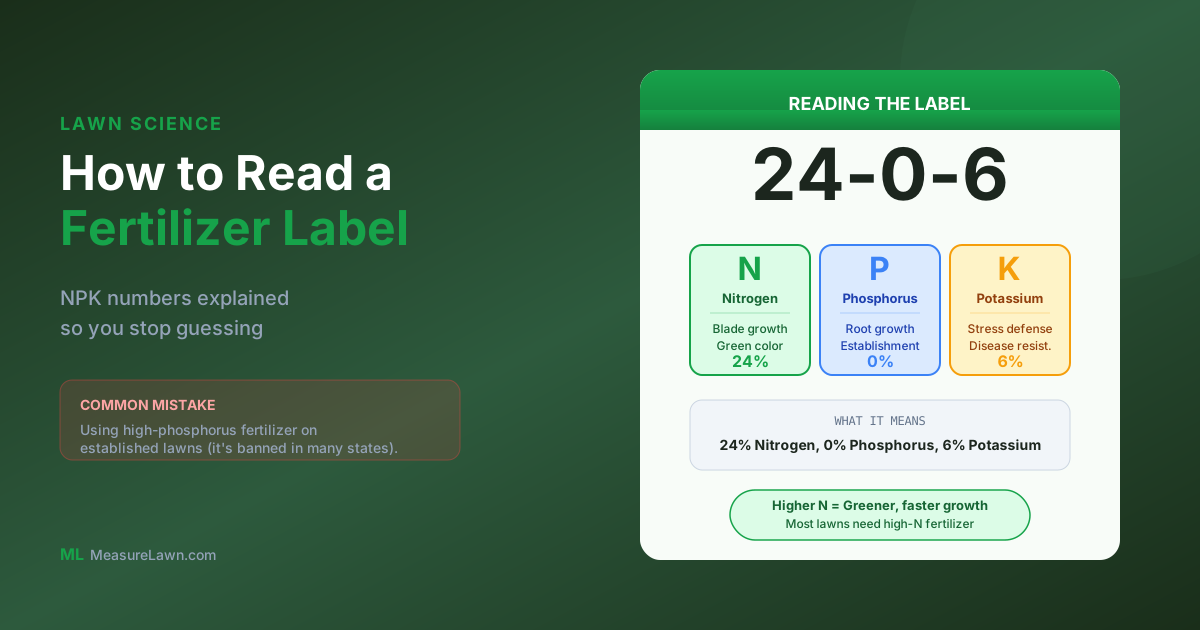
NPK stands for Nitrogen, Phosphorus, and Potassium — the three numbers on every fertilizer bag (like 16-4-8). These ratios tell you the percentage of each nutrient by weight.
A 16 lb bag of 16-4-8 fertilizer contains about 2.56 lbs of actual nitrogen (16% of 16 lbs). When agronomists say "apply 1 lb of nitrogen per 1,000 square feet," they mean 1 lb of actual N — not 1 lb of fertilizer product.
For a 7,000 square foot lawn wanting 1 lb N per 1,000 sq ft, you need 7 lbs of actual nitrogen. Using a 16-4-8 product, that's about 44 lbs of total product (7 ÷ 0.16). If each bag is 16 lbs, you need 3 bags.
This math gets complicated fast, which is why most people just follow the "covers X sq ft" label and call it a day. That works fine — as long as your lawn size number is accurate.
A practical shortcut: if you know your lawn size accurately, stick with products from the same brand across the season. Scotts' 16-4-8 spring fertilizer and 32-0-4 fall formula are formulated to work together at their labeled rates. Switching between brands means recalculating ratios for each application. Additionally, slow-release products (with PCU or sulfur coatings) behave differently than quick-release formulas — slow-release stays active longer but delivers nutrients gradually, so you may need slightly more product volume to achieve the same peak feeding intensity.
Do All Grass Types Need the Same Amount of Fertilizer Each Year?
Not all grass types need the same amount of fertilizer per year. Kentucky Bluegrass wants about 3 lbs of nitrogen per 1,000 square feet annually, spread across 3–4 applications. Centipede grass needs only 0.5 lbs — over-fertilizing Centipede actually causes decline.
Cool-season grasses (Bluegrass, Fescue, Ryegrass) get their primary feeding in spring and fall, when they're most active. Warm-season grasses (Bermuda, Zoysia, St. Augustine) are fed in late spring and summer.
Each application's product quantity depends on your lawn size. A Bermuda lawn owner in Georgia with 8,000 square feet of turf has fundamentally different product needs than a Kentucky Bluegrass lawn in Ohio with 4,500 square feet.
The regional breakdown is stark: a Bermuda lawn in Phoenix needs 2-3 lbs of annual nitrogen for desert conditions, while the same Bermuda in humid Georgia needs 3-4 lbs. Conversely, a tall fescue lawn in Denver (cooler climate, lower humidity) may thrive on 2.5 lbs annually, while tall fescue in humid Tennessee needs 3.5 lbs to maintain density and disease resistance. Buffalo grass and other drought-adapted warm-season varieties sometimes thrive on as little as 1.5 lbs annually — over-feeding them actually promotes shallow rooting and disease. When you move to a new region or inherit a property with an unfamiliar grass type, ask your local cooperative extension office what the recommended nitrogen rate is specifically for your climate and grass combination.
What's the Smartest Way to Choose Between Different Fertilizer Bag Sizes?
Many popular fertilizer brands now sell multiple bag sizes. Scotts Starter Food comes in bags covering 1,000, 5,000, and 14,000 square feet. Scotts WinterGuard comes in 4,000, 5,000, and 12,000 square foot options.
The smart move is buying the combination of sizes that gets closest to your lawn size without going under. For a 9,000 square foot lawn buying WinterGuard, one 12,000 sq ft bag is better (and often cheaper per square foot) than two 5,000 sq ft bags.
But you can only make that decision if you know your lawn is 9,000 square feet.
Price per square foot varies significantly by bag size and brand. A 12,000 sq ft Scotts bag often costs $15-18, working out to $1.25-1.50 per 1,000 sq ft. Two 5,000 sq ft bags might cost $8 each ($16 total), working out to $1.60 per 1,000 sq ft. For a 9,000 sq ft lawn, buying one 12,000 sq ft bag saves $2-3 per application, or $8-12 across a four-application spring-summer-fall cycle. Over multiple years, accurate sizing compounds those savings. Also check for end-of-season clearance sales — late fall and early spring are ideal times to stock up on fertilizer for next season if you have storage space.
Ready to Stop Guessing and Get Your Exact Fertilizer Quantities?
The fertilizer calculation is the easiest part of lawn care. The hard part — the part most people skip — is getting an accurate lawn measurement.
MeasureLawn gives you that number in under 2 minutes — 100% free, no account needed. Pull up your address on satellite imagery, trace around your actual grass areas, and get a precise square footage. From there, we calculate the exact quantity of every product in your personalized plan — how many bags of spring fertilizer, how many bags of pre-emergent, how many pounds of seed for overseeding.
No more guessing at the hardware store. No more buying "about the right amount." No more burn streaks from over-applying or thin patches from under-applying.
Ready to measure your lawn?
Get a free, AI-customized lawn care plan with exact product quantities for your property.
Measure My Lawn — It's Free →