How to Identify Crabgrass in Your Lawn (And Kill It Before It Spreads)
Crabgrass is one of the most frustrating weeds homeowners face each spring, and once it takes hold, it spreads rapidly and chokes out your healthy grass. The good news? If you know what to look for and when to act, you can stop crabgrass before it ever becomes a problem. This guide will teach you exactly how to identify crabgrass, understand why it keeps coming back, and use the right strategy—pre-emergent herbicides—to keep your lawn crabgrass-free year after year.
What does crabgrass actually look like vs normal grass?
Crabgrass is unmistakable once you know what to look for, but many homeowners confuse it with regular turf grass at first glance. The key difference lies in the growth pattern and leaf structure.
Normal lawn grass grows upright in a neat, uniform tuft. It has fine, delicate blades that taper to a point. If you're growing cool-season grasses like fescue, bluegrass, or perennial ryegrass, the blades are thin and densely packed together.
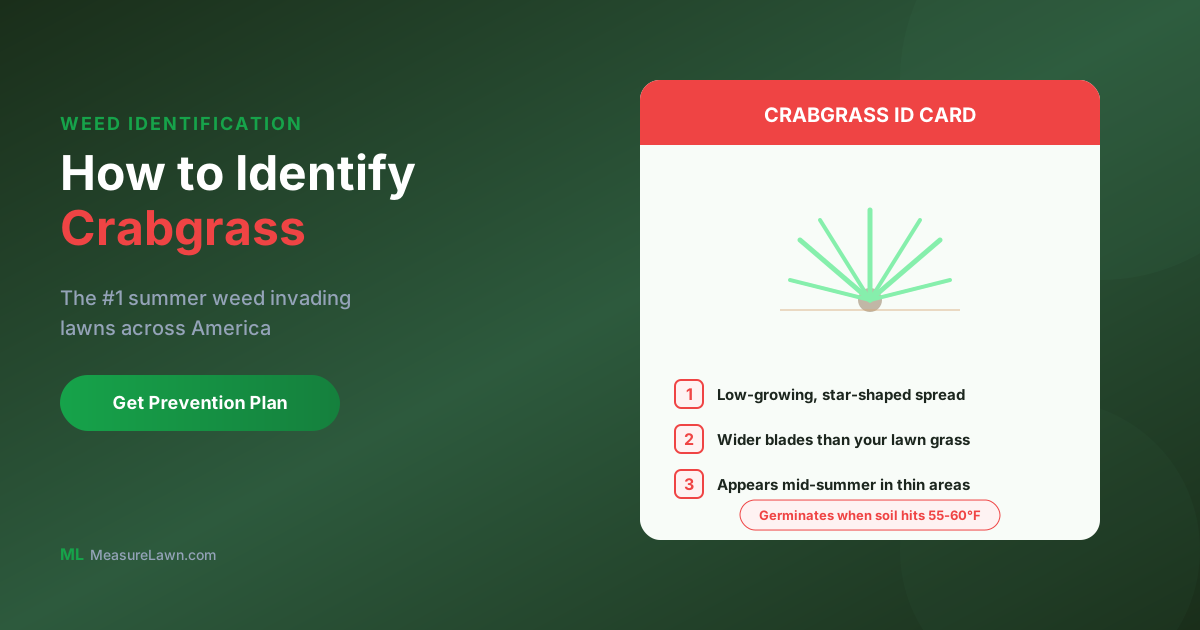
Crabgrass, by contrast, grows in a star or wheel pattern radiating from a central point, almost like spokes on a wheel. This distinctive growth habit is where the name comes from—the spread-out, multi-armed appearance resembles a crab. The leaves are broader and coarser than your normal lawn grass, and they grow horizontally or at extreme angles rather than upright. A single crabgrass plant can produce dozens of stems sprouting from a central hub.
The color is another telltale sign. Crabgrass often appears slightly lighter green or yellowish compared to your turfgrass, especially in the early growing season. If you notice isolated patches of lighter-colored grass with that characteristic star pattern, you're almost certainly looking at crabgrass.
Here's a practical identification tip: Get down on your hands and knees and look at the growth pattern. If it radiates outward in all directions from a central point and looks like it's trying to dominate and smother your grass, it's crabgrass. If it's growing in tight, upright clumps, it's probably your regular lawn grass.
Measure My Lawn — It's Free → to get an accurate lawn size for herbicide calculations.
Best pre-emergent products
Timing is everything — check the windows above before you apply.

Scotts Halts Crabgrass & Grassy Weed Preventer
Beginner friendly
The Andersons Barricade Professional-Grade Granular
Beginner friendly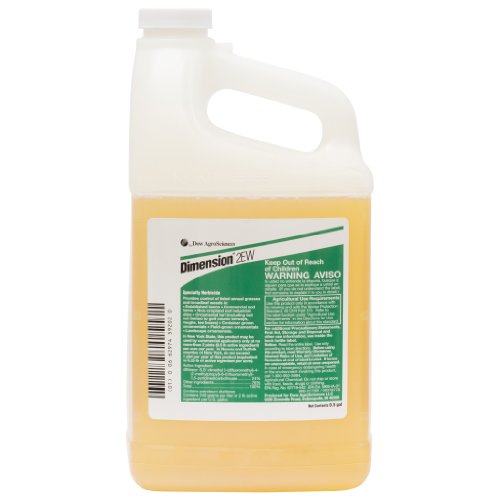
Dimension 2EW (Dithiopyr)
Liquid concentrate; 64 oz half gallon; mix with water and spray
As an Amazon Associate, Measure Lawn earns from qualifying purchases.
Why does crabgrass keep coming back every year?
Crabgrass returns reliably every year because of its aggressive lifecycle and billions of dormant seeds. Understanding why it's so persistent is the first step to breaking the cycle.
Each summer, mature crabgrass plants produce thousands of seeds. These seeds fall onto your lawn, soil, and neighboring areas throughout late summer and fall. Here's the critical part: these seeds don't germinate immediately. Instead, they enter dormancy over winter and wait in your soil, sometimes for several years. Seeds can remain viable in the soil for three to five years or even longer, creating a persistent seed bank that will continue generating new plants.
When spring arrives and soil temperatures begin to warm, crabgrass seeds start to germinate. This is why timing is so important—crabgrass is a warm-season annual grass that germinates when soil conditions are just right. If you allow it to germinate even once, you're guaranteeing future problems.
Another reason crabgrass returns is that it's perfectly adapted to poor conditions where your lawn grass struggles. If your lawn has thin coverage, compacted soil, poor drainage, or inadequate fertility, crabgrass will move in and establish easily. Bare spots and thin areas are like open real estate for crabgrass seeds—there's nothing competing with them.
Additionally, if you've never controlled the seed bank in your soil, you're essentially fighting the same battle every year. This is precisely why pre-emergent herbicides are so valuable. They prevent germination before crabgrass even has a chance to emerge, stopping the cycle before it starts.
When does crabgrass germinate (soil temp trigger 55-65°F)?
Timing is everything with crabgrass control, and soil temperature is the trigger that governs everything.
Crabgrass begins to germinate when soil temperature reaches the right range. Smooth crabgrass (the most common variety in northern regions) germinates when soil temperatures are consistently between 55 and 65°F. Large or hairy crabgrass (found more in the South and Midwest) germinates at slightly warmer temperatures, between 60 and 70°F.
Here's the practical implication: In the northern states like New York, Pennsylvania, New Jersey, Connecticut, and Massachusetts, this germination window typically occurs in mid to late spring, often around late April to early May. In the Midwest states like Illinois, Indiana, Ohio, Michigan, and Wisconsin, germination happens around late April to early May as well. In the South—Texas, Oklahoma, Arkansas, Georgia, North Carolina, South Carolina, Virginia, and Florida—germination occurs earlier, often in late March to April, because soil temperatures warm faster.
This is why pre-emergent herbicides must be applied before soil temperatures reach this critical range. If you wait until crabgrass is already sprouting, pre-emergent won't work—the seeds have already germinated. You need to apply pre-emergent when soil temperatures are consistently in the 40-50°F range, which is typically 7-14 days before the soil reaches 55°F.
Most lawn care professionals and homeowners track soil temperature as their signal to apply pre-emergent. Some use soil thermometers, but tracking local soil temperature reports is often more reliable. The magic number to watch for: when nighttime temperatures stay above 50°F for several consecutive nights, soil temperature is likely in the pre-emergent application window.
Measure My Lawn — It's Free → and get real-time soil temperature alerts to know exactly when to apply pre-emergent in your region.
What's the difference between smooth and large/hairy crabgrass?
While all crabgrass is problematic, there are distinctions between the two main types, and understanding these differences helps you identify what you're dealing with.
Smooth Crabgrass is the most common variety in cooler northern climates. It has narrower leaves and is less hairy than its large cousin. Smooth crabgrass germinates at 55-65°F soil temperature and is typically the first crabgrass to emerge in spring across the Northeast and upper Midwest. It tends to be slightly less aggressive than large crabgrass but is still highly competitive and will take over thin areas quickly.
Large Crabgrass (also called hairy crabgrass) is larger overall and has broader, coarser leaves with a noticeably hairy or bristly texture. You can see fine hairs on the leaf blades if you look closely. It germinates at 60-70°F soil temperature, so it typically emerges slightly later than smooth crabgrass. Large crabgrass is more aggressive, grows faster, and produces more seeds per plant. It's extremely common in the Midwest and South.
From a control perspective, both types are managed the same way: pre-emergent herbicide before germination, or post-emergent herbicide after they've already emerged. The distinction matters mainly for identification and understanding which variety is most likely to be a problem in your specific region.
Can you kill crabgrass after it's already growing?
Yes, but it's much harder and more expensive than preventing it from germinating in the first place.
Once crabgrass has emerged and established in your lawn, you have a few options:
Post-emergent herbicides can kill crabgrass that's already growing. Products like Tenacity (containing mesotrione) are effective post-emergent options that many homeowners use. The challenge is timing—post-emergent herbicides work best on young, tender crabgrass plants. Once they're large and well-established, they become more herbicide-resistant, and you may need to apply multiple treatments.
Hand-pulling is possible but often impractical on a large lawn. Crabgrass has shallow roots compared to your lawn grass, so pulling is sometimes effective if the soil is moist and you get the whole plant. However, pulling tends to create bare spots, and you might miss the plant's base, allowing it to regrow.
The major drawback with post-emergent treatments is that they're reactive rather than preventive. You've already allowed the weed to germinate and occupy space in your lawn, competing with your grass and producing seeds. Even if you successfully kill the visible plants, their seeds have likely already dropped to soil, perpetuating the problem for years to come.
This is why the lawn care industry universally recommends pre-emergent prevention: it's far more cost-effective, requires less labor, and actually stops the problem before it starts rather than trying to fix it after the fact.
How do you prevent crabgrass permanently?
Permanent crabgrass prevention requires a two-pronged strategy: reducing the existing seed bank and preventing new seeds from germinating and maturing.
Pre-emergent herbicides are the cornerstone of crabgrass prevention. These herbicides create a chemical barrier in the soil that prevents crabgrass seeds from germinating. They must be applied before germination occurs—typically in early spring when soil temperatures are in the 40-50°F range. Pre-emergent herbicides don't kill existing plants; they prevent seeds from sprouting, which is why timing is so critical.
Common pre-emergent products include:
- Scotts Halts (active ingredient: pendimethalin) — a reliable, affordable option available at most hardware stores
- Andersons Barricade (active ingredient: prodiamine) — a professional-grade product known for extended residual activity
- Dimension (dithiopyr) — another effective option that provides both pre-emergent and early post-emergent activity
The second strategy is lawn health and density. A thick, healthy lawn with dense turf coverage naturally crowds out weeds, including crabgrass. Crabgrass thrives in thin areas, bare spots, and compacted soil. By maintaining a thick lawn through proper fertilization, adequate watering, and appropriate mowing height, you make your lawn inhospitable to crabgrass.
Reducing the seed bank requires consistency. If you prevent germination for several consecutive years with pre-emergent herbicide, the crabgrass seeds remaining in your soil will eventually age and lose viability. Most sources suggest that after 3-5 years of consistent pre-emergent use with no new seed production, the crabgrass seed bank is substantially reduced.
The key to permanent prevention is making this an annual practice. Skip pre-emergent application for even one year, and you risk new seed germination and re-establishing the problem.
How does knowing your lawn size help with crabgrass control?
Lawn size is the foundation of any effective crabgrass control strategy because herbicide products are dosed based on square footage.
Pre-emergent and post-emergent herbicides come with application rates specified on their labels, typically expressed as "X ounces or grams per 1,000 square feet." If you don't know your exact lawn size, you're guessing at dosage.
Applying too little means the herbicide barrier is incomplete, and crabgrass may germinate in areas with insufficient coverage. Underdosing also reduces effectiveness.
Applying too much is wasteful and can sometimes cause turf damage, particularly with certain post-emergent herbicides.
When you know your lawn size precisely, you can:
- Calculate the exact amount of pre-emergent needed for thorough coverage
- Determine how many bags or containers of product to purchase
- Budget accurately for your lawn care program
- Apply post-emergent herbicide at the correct rate for your specific lawn area
- Track product costs per square foot to optimize spending
For example, if your lawn is 8,000 square feet and a pre-emergent product recommends 1.2 pounds per 1,000 square feet, you need 9.6 pounds total. Without knowing your lawn size, you might buy one bag (which is often sold in standard sizes) and either overapply to a smaller area or underapply to a larger one.
Measure My Lawn — It's Free → to get your precise lawn size, then receive exact product quantities for pre-emergent and post-emergent crabgrass control tailored to your lawn and region.
What Are the Key Takeaways for Crabgrass Control?
Crabgrass is beatable, but only with the right strategy and timing. Identify crabgrass by its distinctive star or wheel growth pattern and broader leaves compared to your lawn grass. Understand that it germinates when soil temperatures hit 55-65°F (smooth varieties) or 60-70°F (large varieties), which varies by region and season. The key to success is pre-emergent prevention applied before germination occurs, not post-emergent rescue treatments after the fact.
Most affected states where crabgrass is a significant problem include the Northeast (New York, Pennsylvania, New Jersey, Connecticut, Massachusetts), the Midwest (Illinois, Indiana, Ohio, Michigan, Wisconsin), the South-Central region (Texas, Oklahoma, Arkansas), and the Southeast (Georgia, North Carolina, South Carolina, Virginia, Florida).
By applying pre-emergent herbicide at the right time, maintaining a thick, healthy lawn, and preventing new seeds from maturing, you can break the crabgrass cycle and enjoy a weed-free lawn year after year.
Ready to measure your lawn?
Get a free, AI-customized lawn care plan with exact product quantities for your property.
Measure My Lawn — It's Free →