Soil Testing for Lawns: The $15 Test That Could Save You Hundreds on Products
You've spent hundreds on fertilizer, lime, and treatments, and your lawn still isn't thriving. The culprit? You're probably fertilizing blind. A $15 soil test reveals what your lawn actually needs instead of what you're guessing it needs. Most homeowners would cut their product spending in half if they knew their soil's actual pH and nutrient levels. Here's how to test your soil and use those results to stop wasting money.
Why does your soil's pH matter more than the fertilizer you buy?
This is the fundamental truth that most homeowners miss: your fertilizer application doesn't matter if your soil pH is wrong. You can dump nitrogen on your lawn all season and watch it stay yellow because pH locks nutrients out.
What pH Does: pH measures how acidic or alkaline your soil is on a scale of 0-14. A pH of 7 is neutral. Below 7 is acidic (sour soil), above 7 is alkaline (sweet soil). Lawn grasses—both cool-season and warm-season types—prefer slightly acidic soil in the 6.0-7.0 range.
Why pH Matters: At the right pH, nutrients dissolve in soil water and become available to grass roots. The grass roots can absorb them and grow. Outside that ideal range, nutrients remain locked in soil mineral compounds—physically present but unavailable to plants. You're literally feeding the soil chemistry instead of the grass.
If your soil pH is below 6.0 (acidic), iron, manganese, and aluminum become overly available and can actually harm the plant. Nitrogen, phosphorus, and potassium become less available. Your grass yellows (iron deficiency chlorosis), growth slows, and disease resistance drops. You can apply fertilizer for a year and see minimal improvement because the nutrients can't be used.
If your soil pH is above 7.5 (alkaline), iron becomes locked up. Your grass shows iron deficiency—yellow blades with green veins. Phosphorus and potassium also become less available. Micronutrients like zinc and manganese are locked out.
The most common scenario: an acidic soil (pH 5.5) where the homeowner applies nitrogen fertilizer for color. The nitrogen doesn't move well at that pH, growth is slow, and the homeowner buys more fertilizer thinking they haven't applied enough. This cycle continues for years, wasting money.
How do you actually get your soil tested?
Testing your soil is easier than most homeowners think. You have multiple options depending on budget and accuracy needs.
Cooperative Extension Testing: Your local cooperative extension office provides professional soil testing for $10-15. This is the most reliable option. Contact your county extension (search "[your county] cooperative extension soil testing") and follow their instructions. Usually, you'll submit a soil sample in a provided container with a form. Results come back in 1-2 weeks with detailed nutrient levels, pH, organic matter content, and recommendations specific to your region and grass type.
The beauty of extension testing: it's accurate, inexpensive, and the recommendations are science-based without any conflict of interest to sell you products. Your extension recommends lime only if you actually need it, not to maximize product sales.
Home Test Kits: Brands like Luster Leaf Rapitest, Earthfarer, and others sell home kits for $15-25 at garden centers. These include a soil probe, color-coded chart, and simple testing chemicals. Results are less precise than extension testing, but they give a ballpark reading of pH and macronutrients (nitrogen, phosphorus, potassium). Home kits work for a quick screening, especially if you just want to know "is my pH way off?"
Premium Laboratory Testing: Services like Brookside Labs and Logan Labs offer comprehensive testing ($30-60) including pH, macronutrients, micronutrients (zinc, copper, iron, etc.), organic matter percentage, cation exchange capacity, and recommendations. This level of detail is useful for problem lawns that need precision correction.
Collection Method Matters: No matter which test you choose, sample collection is critical. Most extension offices recommend taking 5-8 small soil cores from different areas of your lawn, mixing them together, and submitting a composite sample. This prevents one bad area from skewing your whole-lawn results. Collect samples 3-4 inches deep (where grass roots feed most). Avoid recently limed or fertilized spots—test representative lawn areas.
Test in fall or spring before major treatment applications. Testing after you've just applied lime gives false alkaline readings. Testing days after fertilizer application gives false nutrient readings.
What do soil test results tell you?
A soil test report shows several key pieces of information. Understanding what you're looking at helps you use the data correctly.
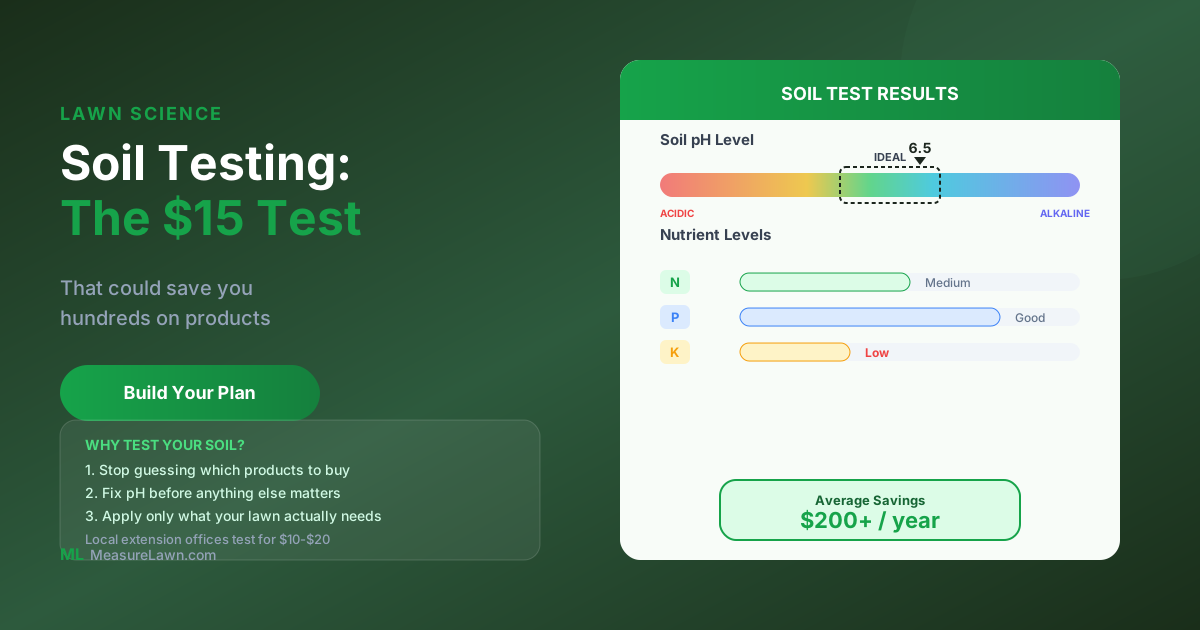
pH: The test shows your soil's pH number. Ideal for lawns is 6.0-7.0. Below 6.0 is acidic (needs lime). Above 7.5 is alkaline (needs sulfur).
Macronutrients—Nitrogen (N), Phosphorus (P), Potassium (K): The test usually shows levels as parts per million (ppm) or in categories like "low," "medium," "high."
- Nitrogen: Reported in ppm, typically categorized as deficient (under 20 ppm), adequate (20-40 ppm), or high (over 40 ppm). Nitrogen is the nutrient most likely to need supplementation.
- Phosphorus: Usually measured in ppm, with adequate levels around 20-30 ppm for lawns. Most established lawns don't need additional phosphorus unless testing shows deficiency.
- Potassium: Adequate level is typically 100-150 ppm. Many soils are adequate in potassium, but sandy soils often need supplementation.
Organic Matter Percentage: Shows the percentage of decomposed plant material in your soil. Lawns benefit from 3-5% organic matter. Below 2% indicates poor soil structure and low water/nutrient retention. Organic matter percentage improves through years of topdressing with compost or quality topsoil.
Secondary Nutrients (Calcium, Magnesium, Sulfur): Some test reports include these. Lime provides calcium, so a test showing low calcium in acidic soil (low pH) indicates the need for lime.
Micronutrients (Iron, Zinc, Manganese, Boron, Copper): Comprehensive tests include these. Micronutrient deficiencies are usually revealed by visible symptoms (iron deficiency yellowing) and corrected through foliar sprays rather than soil application.
Recommendations: The test report provides recommendations for amendments and product quantities. These are crucial—they tell you exactly how much lime, sulfur, or fertilizer to apply based on your lawn's size and test results.
What pH does your lawn grass need?
Most lawn grasses—cool-season and warm-season—thrive in a slightly acidic soil, pH 6.0-7.0. This narrow range is why pH testing matters so much.
Cool-Season Grasses (Kentucky bluegrass, perennial ryegrass, tall fescue, fine fescues) have a slightly broader pH tolerance, thriving anywhere from pH 5.5-7.5, but perform best at 6.0-7.0. Below pH 5.5, nutrient availability drops sharply, and toxic aluminum and manganese levels rise.
Warm-Season Grasses (Bermuda, zoysia, St. Augustine, Bahiagrass) prefer pH 6.0-7.0, though Bahiagrass tolerates slightly more acidic conditions (5.5-6.5). Bermuda and zoysia are more intolerant of high pH above 7.5.
Soil Specific Concerns:
- Sandy Soils: More susceptible to pH swings. Acidic sandy soils stay acidic; alkaline sandy soils stay alkaline. Regular testing (every 2-3 years) helps monitor pH drift.
- Clay Soils: More buffered against pH change. Once at target pH, clay soils stay stable longer. Testing every 3-4 years is often sufficient.
- Newly Constructed Lawns: Subsoil used during grading often has poor pH. Initial testing is essential for new lawns.
The reason pH matters so much: at pH 6.0-7.0, all essential nutrients dissolve into soil water at reasonable concentrations. Below pH 5.5, phosphorus and potassium become less available while iron, manganese, and aluminum become problematic. Above pH 7.5, iron becomes locked up—the primary cause of yellowing lawns in alkaline regions.
How do you fix acidic soil (low pH)?
Acidic soil (pH below 6.0) is corrected with lime. Lime is calcium carbonate (or magnesium-containing dolomite lime), which raises pH by neutralizing excess hydrogen ions.
Lime Product Options:
Agricultural Limestone (Calcitic Lime): The standard choice, containing calcium carbonate. Pennington Fast Acting Lime is a common brand, available at most garden centers for $31-37 per 50-lb bag, covering 5,000 square feet. "Fast acting" means more finely ground, so it works faster than standard agricultural lime (which can take months to fully dissolve).
Application Rate: Depends on how much you need to raise pH. A general guideline: apply 6 pounds of lime per 1,000 square feet to raise pH by approximately 0.5-1.0 points, depending on soil type and buffering capacity. For a 7,200 square foot lawn that needs pH raised by 1.0 point, you'd calculate: (6 × 7.2 = 43.2 lbs of lime needed).
Soil test recommendations are more precise. The test tells you exactly how much lime to apply based on your current pH, target pH, and soil type.
Application Timing: Apply lime in fall or early spring when soil is moist. Lime works fastest in cool, moist conditions. Avoid applying during hot, dry summers when lime moves through soil slowly. Lime takes 2-4 months to fully dissolve and show results. That's why fall application is ideal—you apply in September, lime works through fall and winter, and by spring the pH shift is complete.
Dolomite vs. Calcitic Lime: Dolomite lime contains magnesium in addition to calcium. Use dolomite if soil test shows low magnesium; otherwise, calcitic lime is fine.
Spreading: Use a broadcast spreader for even distribution, the same spreader you use for fertilizer. Apply in overlapping passes to ensure complete coverage.
How do you fix alkaline soil (high pH)?
Alkaline soil (pH above 7.5) is corrected with sulfur, which lowers pH by increasing acidity.
Sulfur Application Rate: Ground elemental sulfur is the standard. Apply 10-15 pounds per 1,000 square feet to lower pH by approximately 0.5-1.0 points (varies by soil type). For a 7,200 square foot lawn needing pH lowered by 1.0 point, you'd need roughly 72-108 lbs of sulfur.
Soil test recommendations specify exact amounts. Don't guess—follow the test recommendation.
Application Timing: Apply in fall or spring. Sulfur works slowly—6-12 months to show full results—because it must be oxidized by soil bacteria into sulfuric acid. Cool-season timing (fall or early spring) is ideal. Avoid summer application when you're in a hurry for results; sulfur won't deliver fast enough.
Finding Sulfur Products: Ground sulfur is less commonly stocked than lime at garden centers but is available online and at specialty agricultural suppliers. It's usually inexpensive ($0.50-1.00 per pound). Larger volumes (50-100 lbs) are often cheaper per pound than smaller bags.
Spreading: Broadcast spreader works for sulfur, same as fertilizer. Ensure even distribution. Some sulfur products are pelletized for spreader application; others are powder and harder to spread evenly.
Iron for Symptom Relief: While sulfur adjusts pH long-term, yellowing from iron deficiency in alkaline soil can be addressed faster with a liquid iron foliar spray (chelated iron). You spray the lawn to provide immediate iron while sulfur works on the underlying pH problem.
How often should you test your soil?
Testing frequency depends on your soil type, climate, and lawn maintenance practices.
First Time: Always test before major corrections. If you know your pH is off or you're building a new lawn, test immediately.
Established Lawns in Stable Conditions: Test every 3-4 years if your soil is clay-based (naturally buffered) or every 2-3 years if your soil is sandy (pH drifts faster). This schedule catches pH drift before it becomes a problem.
Problem Lawns: If you're correcting pH or have a history of nutrient issues, test annually for the first 2-3 years to verify corrections are working and adjustments have taken effect.
After Major Amendment: If you've applied significant lime or sulfur, retest 6-12 months later to confirm the amendment worked as planned. Occasionally soil pH doesn't shift as much as predicted (usually due to high buffering capacity), and a follow-up application may be needed.
After New Topsoil: New lawns built with imported topsoil should be tested before overseeding or sodding. Topsoil pH varies wildly depending on its source.
Seasonal Variation: pH doesn't change dramatically season-to-season in the same lawn, so you don't need seasonal testing. Fall or spring (consistent timing) gives comparable results year to year.
How does soil data improve your lawn care plan?
Soil test data transforms your lawn care from guessing to precision. Instead of applying the same fertilizer every season because "that's what you're supposed to do," you apply what your lawn actually needs.
pH-Driven Adjustments:
A low-pH lawn (5.0-5.5) stops using expensive fertilizer until pH is corrected. Lime first, then nutrition. No point in feeding if nutrients are locked up.
A high-pH lawn (above 7.5) focuses on iron foliar sprays for color correction while addressing the underlying pH problem with sulfur. Regular nitrogen fertilizer helps less when iron deficiency is the real issue.
Nutrient-Driven Decisions:
If the test shows low phosphorus, you use a high-phosphorus product (like 24-25-4) instead of your usual formula. If phosphorus is adequate, you skip the high-phosphorus product and save money.
If potassium is adequate, you don't over-apply just because fall formulas often contain high potassium. A 10-0-20 might be overkill; a 10-0-10 might be smarter.
Organic Matter Strategy:
Organic matter at 2% indicates poor soil structure and water retention. Your plan focuses on fall topdressing with quality compost, repeated over 2-3 years to build organic matter. Meanwhile, you increase watering frequency because low-organic soil doesn't hold water.
Organic matter at 4-5% indicates good soil structure. Focus shifts to maintenance nutrient applications without organic amendment.
Micronutrient Supplements:
If iron, zinc, or manganese testing shows deficiency, you add a targeted micronutrient product. If tests show adequate levels, you skip expensive micronutrient sprays.
Budget Prioritization:
Armed with soil data, you stop buying products and start buying solutions. You might spend $50 on lime that solves a $200 fertilizer problem. You skip the expensive slow-release nitrogen because your soil test shows nitrogen is already adequate.
Ready to measure your lawn?
Get a free, AI-customized lawn care plan with exact product quantities for your property.
Measure My Lawn — It's Free →