Spring Lawn Care Checklist
Every task, in the right order, triggered by soil temperature — not calendar dates. Works for cool-season and warm-season grasses across all US zones.
Use soil temperature, not the calendar. The right time for each task depends on your soil temp, not the month. A soil thermometer costs $10 and removes all the guesswork. As a rough guide: Deep South is 4–6 weeks ahead of the North. Transition zone splits the difference.
Southern Hemisphere? In Australia, New Zealand, and South Africa spring runs September–November — follow this checklist then, reading "April" as "October." In March–May (your autumn), switch to the fall lawn care checklist. Not sure what type of grass you have? Australian Buffalo, Couch, and Kikuyu are all warm-season grasses.
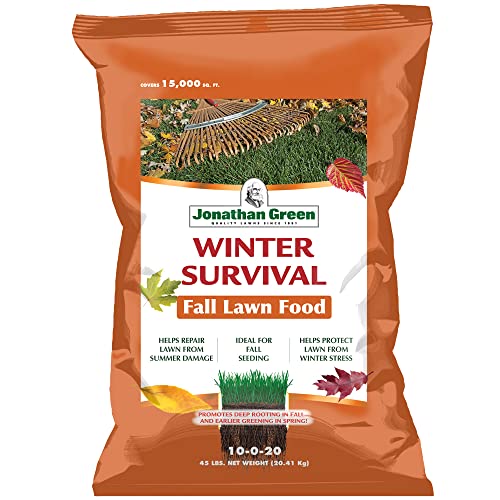
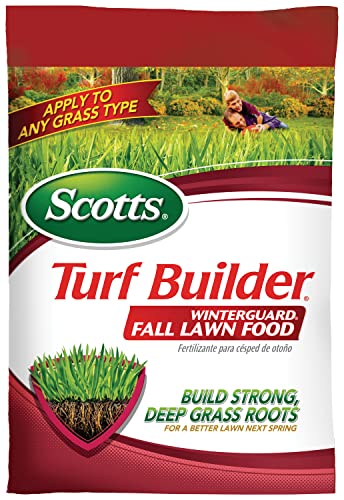
October's top pick: Fall feed
This month's top pick — most spring lawns need this right now.
Paid links. As an Amazon Associate, MeasureLawn earns from qualifying purchases.

Phase 1 — Wake Up Your Lawn
Soil temp 32–45°F · Deep South: Jan–Feb · North: Mar–Apr
Rake out dead leaves, matted grass, and winter debris
Prevents smothering and encourages air circulation. You can rake before the ground is fully thawed — raking frozen grass is fine.
Dethatch if the thatch layer exceeds ½ inch
Thatch over ½ inch blocks water and nutrients. Use a dethatching rake or power dethatcher. Cool-season lawns: early spring or fall. Warm-season: wait until after green-up.
Tip: Press a screwdriver into the lawn — if the spongy brown layer above the soil is more than ½ inch, dethatch.
Test soil pH
Most grasses prefer pH 6.0–7.0. A $15 test kit from a garden center is accurate enough. For a full nutrient panel, send a sample to your state extension office ($15–25).
Apply lime if pH is below 6.0 (cool-season) or 6.5 (St. Augustine/Centipede)
Lime takes 2–3 months to change soil pH, so apply early. Pelletized lime is easiest to spread. Calcitic lime is standard; dolomitic lime adds magnesium if your soil is deficient.
Inspect for winter damage: snow mold, vole tunnels, ice damage
Snow mold appears as circular gray or pink patches. Gently rake affected areas to open the matted grass. Vole tunnels (surface runways) usually recover on their own once the grass starts growing.
Tune up your mower
Sharpen blades (dull blades tear grass rather than cut it cleanly), change the oil, replace the air filter, and check the spark plug. Do this before you need it — not during peak mowing season.
Phase 2 — Pre-Emergent Window
Soil temp 45–55°F · Deep South: Feb–Mar · North: Apr–May
Apply pre-emergent herbicide for crabgrass prevention
Apply when soil reaches 50–55°F for 3 consecutive days. A common visual cue: apply when forsythia bushes are in full bloom. Granular pre-emergent (Scotts Crabgrass Preventer, Barricade, etc.) is easiest for most homeowners.
Tip: Do NOT overseed the same area — pre-emergent prevents all seeds from germinating, including grass seed.
Turn on irrigation and check for leaks or broken heads
Run each zone for 2 minutes and walk it. Mark any broken or stuck heads. Repair before spring watering starts. Flush your backflow preventer.
Begin mowing when grass reaches 3–4 inches
Set your mower to the highest setting for the first few mows. Never cut more than one-third of the blade height in a single session.
Spot treat winter annual weeds (chickweed, henbit, hairy bittercress)
These broadleaf weeds are already established from fall. Hit them with a selective post-emergent herbicide (2,4-D or triclopyr) before they set seed and spread.
Phase 3 — Feed and Green Up
Soil temp 55–65°F · Deep South: Mar–Apr · North: Apr–May
Apply first fertilizer of the season (cool-season grasses)
Use a balanced slow-release fertilizer. For Kentucky Bluegrass and Tall Fescue: 0.5–1 lb actual nitrogen per 1,000 sq ft. Avoid high-nitrogen fast-release fertilizer in spring — it causes excessive top growth and weakens root systems heading into summer.
Tip: Spring is a light feeding for cool-season grasses. Their main feeding is in fall.
Overseed bare and thin patches (only if you did NOT apply pre-emergent)
Loosen the soil surface, spread seed at half the normal rate, and keep moist for 2–3 weeks. For cool-season grass, fall is actually better for overseeding — consider waiting.
Edge lawn borders, driveway margins, and planting beds
A sharp edge improves curb appeal and prevents grass from creeping into beds. A steel edger gives cleaner results than a string trimmer.
Increase mowing frequency as growth picks up
Once per week is typical in spring. Mow cool-season grasses at 3–4 inches. Mulch-mowing returns nutrients to the soil — no need to bag unless there is excessive clipping buildup.
Phase 4 — Late Spring Maintenance
Soil temp 65°F+ · Deep South: Apr–May · North: May–Jun
Apply post-emergent for broadleaf weeds (dandelions, clover, plantain)
Selective broadleaf herbicides (2,4-D, MCPP, dicamba — sold as "Weed-B-Gon" or "Trimec") are safe for most grass types. Spray when weeds are actively growing and no rain is expected for 24 hours.
Tip: Do not apply in temperatures above 85°F or to newly seeded areas.
Begin a regular watering schedule — 1 inch per week total
Water deeply and infrequently: 2–3 sessions per week rather than daily shallow watering. Early morning watering (before 9am) minimizes evaporation and disease. A tuna can in the lawn is a simple gauge — stop when it's full.
Check for grub damage (irregular brown patches that lift like a carpet)
Spongy, easily-lifted dead grass with white C-shaped larvae underneath. If you find more than 5 grubs per square foot, apply a grub control product. Preventive treatments (imidacloprid) go down in early summer.
Mow at the correct height for your grass type
Bermuda: 0.5–1.5 in. Zoysia: 1–2 in. St. Augustine: 3–4 in. Centipede: 1.5–2 in. Kentucky Bluegrass: 2.5–3.5 in. Tall Fescue: 3–4 in. Perennial Ryegrass: 2–3 in.
Mower not worth another tune-up?
Before mowing season ramps up is the best time to upgrade — this season's expert picks across push, self-propelled, robotic, and ride-on.
Paid links. As an Amazon Associate, MeasureLawn earns from qualifying purchases.
Warm-season grasses only (Bermuda, Zoysia, St. Augustine, Centipede)
Wait for green-up before any work
Do not dethatch, fertilize, or heavily aerate until warm-season grasses have fully greened up (at least 50% of the lawn is green). Working a dormant warm-season lawn can stress it severely.
Scalp the lawn at green-up (Bermuda and Zoysia only)
Mow at the lowest setting once the grass is at least 50% green. This removes brown dormant material and lets sunlight reach the crown to speed green-up. Bag the clippings.
Apply first fertilizer at green-up (soil temp 65°F+)
Warm-season grasses need more nitrogen than cool-season. Apply 1 lb actual nitrogen per 1,000 sq ft at green-up, then monthly through summer. Use slow-release nitrogen for even feeding.
Apply second pre-emergent for goosegrass (soil temp 55–60°F)
Goosegrass germinates later than crabgrass. A second pre-emergent application 6–8 weeks after the first targets goosegrass, a common summer annual in the South.
When to start by region
| Region | Pre-emergent | First fertilizer | Overseed window |
|---|---|---|---|
| Deep South (FL, Gulf Coast) | Mid-Jan – Feb | Feb – Mar* | Oct – Nov (rye) |
| South (TX, GA, SC, NC) | Feb – early Mar | Mar – Apr* | Oct – Nov (rye) |
| Transition Zone (VA, KS, MO) | Late Mar – Apr | Apr (cool) / May (warm)* | Sept – Oct |
| Mid-Atlantic & Midwest | Early–mid Apr | Mid Apr – May | Sept – Oct |
| North (MN, WI, ME, NY) | Late Apr – May | May | Aug – Sept |
* Warm-season grass (Bermuda, Zoysia, St. Augustine) — fertilize at green-up only, not before.
Frequently asked questions
Skip the guesswork
Get a personalized spring plan for your actual lawn
Enter your address — AI detects your grass type and climate zone, then builds a 12-month schedule with exact product quantities for your lawn area. No sign-up, no charge.
Build my lawn plan — it's free