Warning: serious property risk
These are native wildflowers, not invaders — wild asters are one of the year's last major nectar sources for bees and butterflies, host the Pearl Crescent butterfly, and their seed heads feed birds. White heath aster is state-listed as endangered in Tennessee. In a lawn they're mostly a symptom of thin turf and won't persist under good mowing anyway, so consider digging clumps into a flower bed — asters are sold as garden ornamentals — before reaching for the sprayer.
What Wild Asters (Frost and Heath) looks like
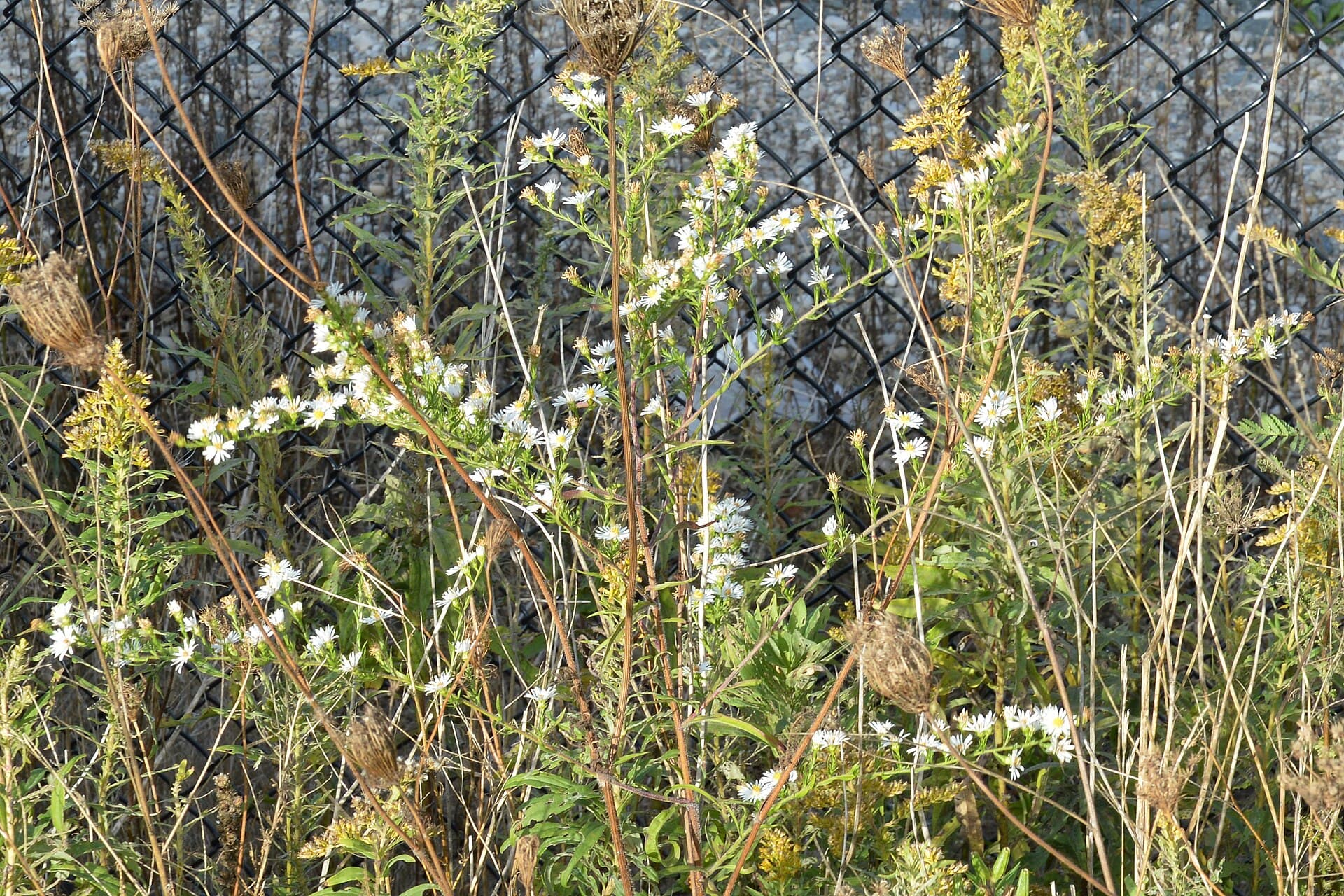
For most of the summer, wild asters hide in a lawn as low clumps of narrow, hairy, gray-green leaves on wiry stems that shrug off mowing — then they erupt in sprays of tiny white daisy-like flowers, about a half inch across with yellow centers: heath aster from as early as August, frost aster from late September, both running through November. They pick on thin, dry, sandy, low-fertility spots. The tell versus look-alike daisy fleabane: fleabane blooms in early summer, asters wait for late summer and fall — a little white daisy flowering in October is an aster. Frost aster and heath aster are genuinely hard to tell apart even for botanists, but genus-level ID is all you need since treatment is identical.
Photo: Wikimedia Commons
Not sure if it's Wild Asters (Frost and Heath)?
Snap a photo — our free AI compares it to wild asters (frost and heath) and tells you in seconds. No app needed.
Best approach: Spray or dig
Digging is the right default for this native — get the entire crown out, not just the topgrowth: frost aster regrows from a woody crown and heath aster resprouts from rhizomes, stolons and underground stems, so root fragments left behind can regrow. Dig when the soil is moist. Clumps divide and transplant readily, so a dug aster can go straight into a flower bed as a legitimate garden plant instead of the trash bag. Save spraying for larger infestations, timed to active growth — September before bloom, or spring regrowth — with a repeat pass 10 to 14 days later.
Best products for Wild Asters (Frost and Heath)
Formulated to kill wild asters (frost and heath) without wiping out your grass — see the timing and chemistry below.

Spectracide Weed Stop + Crabgrass Killer Concentrate (40 oz)
✓ Kills wild asters (frost and heath)Beginner friendlyFour active ingredients in one bottle - knocks out broadleaf weeds, crabgrass and nutsedge in a single pass, so you treat a mixed-weed lawn without buying three products.

BioAdvanced All-In-One Weed & Feed (22-0-4)
✓ Kills wild asters (frost and heath)Beginner friendly
Scotts Turf Builder Triple Action1
✓ Kills wild asters (frost and heath)Beginner friendlyPrevents crabgrass for up to 4 months, kills dandelion, clover and other listed broadleaf weeds, and feeds. Apply to wet grass, no more than twice a year. Not for St. Augustine. Its label allows centipede, but centipede does better with a stand-alone weed killer and a lighter feeding.
How much do you need?
Herbicide is dosed by lawn size. Pick your yard size for a quick estimate:
Stop guessing
Get the exact amount for your lawn
Measure your lawn on a satellite map in about 30 seconds, then use its exact square footage to choose the right number of packs.
Measure my lawn free →Prefer to read how satellite measurement works first? See the lawn measuring tool.
As an Amazon Associate, Measure Lawn earns from qualifying purchases.
When to treat Wild Asters (Frost and Heath)
Spray in spring or fall when temperatures are 60–80°F and the weed is actively growing. Avoid summer heat — stressed grass takes collateral damage.
Chemical treatment
Start with a three-way combo built on 2,4-D plus dicamba plus mecoprop (MCPP) — multi-active products are the consumer options that actually carry asters on the label (white heath and white prairie aster by name), and on an established perennial crown expect control-to-suppression with a repeat application 10 to 14 days later. Combos that add triclopyr sit in the tough-perennial tier and are the stronger pick on cool-season lawns, while carfentrazone or sulfentrazone in the mix adds fast visible burndown. Skip single-ingredient broadleaf sprays used alone — the woody crown regrows behind them. Spray while the plant is actively growing: September at or just before bloom, or on spring regrowth. Mind the grass: 2,4-D is not recommended on St. Augustinegrass, and centipedegrass, Kentucky bluegrass, fescues and Tifgreen/Tifdwarf bermudagrass all call for reduced rates; dicamba products should only go down at 80°F or below and must stay out of the root zone of trees and ornamentals; triclopyr is for cool-season lawns only — even low rates cause short-term injury to warm-season grasses, and it actively suppresses bermudagrass. On a St. Augustine or centipede lawn, the labeled route is a reduced-rate Southern-formulation carfentrazone combo, never a full-rate northern three-way. For an isolated clump, spot-spraying glyphosate kills it roots and all — along with a ring of lawn you will reseed. The single best aster chemistry, clopyralid, is commercial-turf-only: a licensed applicator can use it, but it is not labeled for residential lawns.
Non-chemical management
Asters colonize thin, dry, underfed turf — the fix is to remove the welcome mat. Overseed in fall, raise fertility, and irrigate the droughty sandy spots they favor; a dense sward keeps the wind-blown seed from ever establishing. Mow regularly from August through November to cut off the bloom and seed set — mowing never kills an established clump (it just persists as a low vegetative mat under the mower), but it stops the seed rain. Most new seed blows in from unmowed patches, ditches and meadow edges nearby, so tidy those before bloom too.
How to stop Wild Asters (Frost and Heath) coming back
Density is the whole program: aster seed rides the wind on tufts of white bristles and can only establish in thin, dry, sandy, low-fertility ground, so a thick, fed, watered lawn shuts it out. Keep everything on the property mowed from August (heath aster can bloom that early) through November so plants never set seed. No pre-emergent herbicide program is documented for asters in turf — don't count on a spring barrier to stop them.
Stop fighting weeds one by one →
Get your free 12-month AI lawn care plan
A thick, healthy lawn is the best weed killer there is. Measure your yard on a satellite map in 30 seconds — we'll build a personalized schedule (fertilizer, seed, mowing, weed control) so wild asters (frost and heath) doesn't come back.
Measure my lawn — it's free →FAQ
What does Wild Asters (Frost and Heath) look like?
For most of the summer, wild asters hide in a lawn as low clumps of narrow, hairy, gray-green leaves on wiry stems that shrug off mowing — then they erupt in sprays of tiny white daisy-like flowers, about a half inch across with yellow centers: heath aster from as early as August, frost aster from late September, both running through November. They pick on thin, dry, sandy, low-fertility spots. The tell versus look-alike daisy fleabane: fleabane blooms in early summer, asters wait for late summer and fall — a little white daisy flowering in October is an aster. Frost aster and heath aster are genuinely hard to tell apart even for botanists, but genus-level ID is all you need since treatment is identical.
What's the best way to kill Wild Asters (Frost and Heath)?
Spray or dig. Digging is the right default for this native — get the entire crown out, not just the topgrowth: frost aster regrows from a woody crown and heath aster resprouts from rhizomes, stolons and underground stems, so root fragments left behind can regrow. Dig when the soil is moist. Clumps divide and transplant readily, so a dug aster can go straight into a flower bed as a legitimate garden plant instead of the trash bag. Save spraying for larger infestations, timed to active growth — September before bloom, or spring regrowth — with a repeat pass 10 to 14 days later.
Is Wild Asters (Frost and Heath) hard to get rid of?
Wild Asters (Frost and Heath) is rated moderate to control. Consistent treatment over a season usually does the job.
How do I stop Wild Asters (Frost and Heath) coming back?
Density is the whole program: aster seed rides the wind on tufts of white bristles and can only establish in thin, dry, sandy, low-fertility ground, so a thick, fed, watered lawn shuts it out. Keep everything on the property mowed from August (heath aster can bloom that early) through November so plants never set seed. No pre-emergent herbicide program is documented for asters in turf — don't count on a spring barrier to stop them.
Other broadleaf weeds
See every weed we cover:
Full weed guide•Photo identifier•Lawn care calendar•Free lawn care plan•Best mowers by size