Warning: serious property risk
Spotted knapweed is a declared noxious weed in at least 15 states — Minnesota legally requires control, and in Washington it is a quarantine-listed Class B weed that is illegal to buy or sell — so check your state's noxious weed list; removing it can be a civic and even legal obligation, not just a lawn-care choice. Wear gloves and long sleeves when handling it, as it can irritate skin. Bees do visit the flowers, but it drives out native plant communities — if pollinators are your concern, replace it with native asters or goldenrod, which feed them without the invasion.
What Knapweed (Spotted) looks like
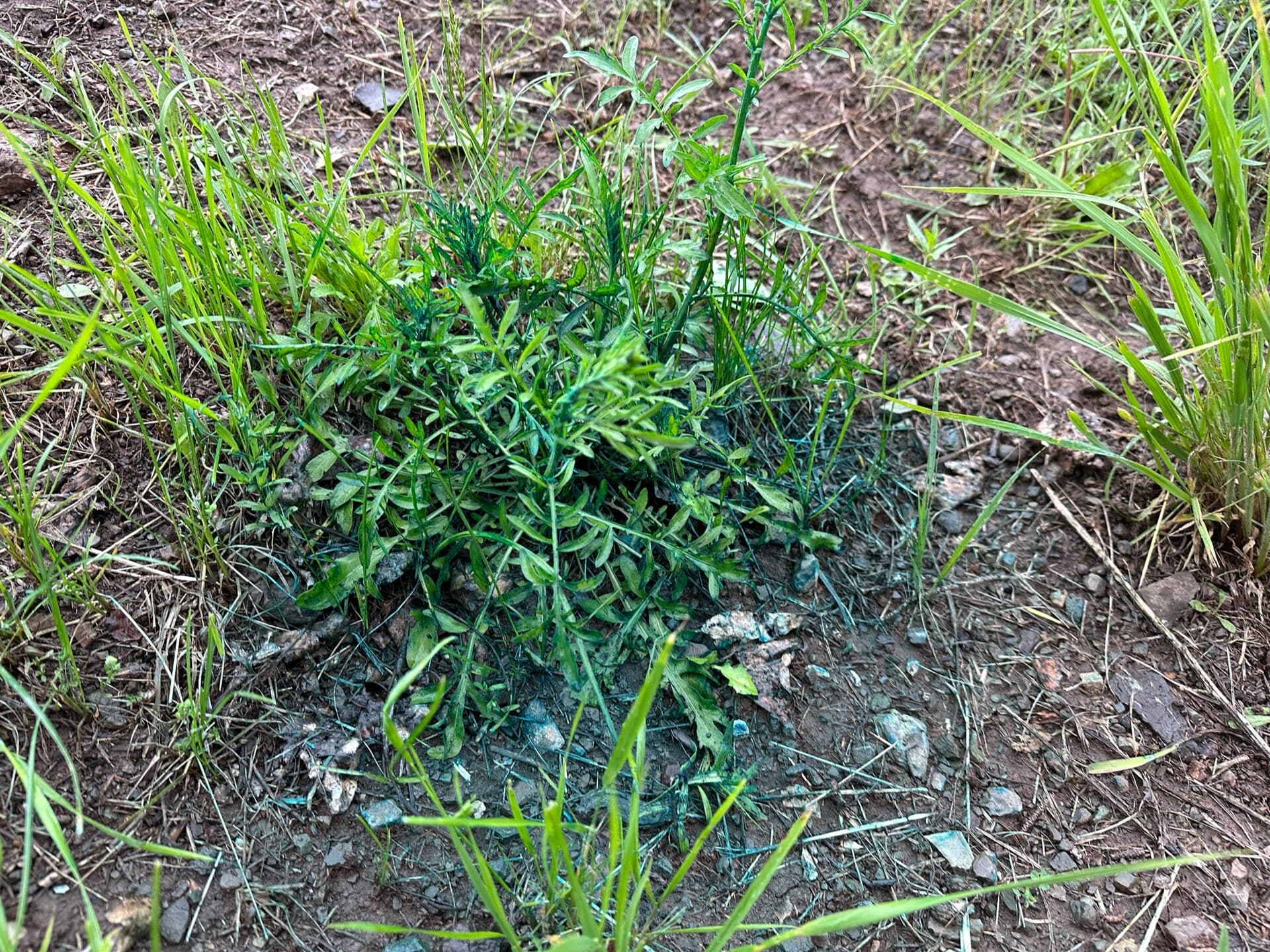
Starts as a flat, gray-green rosette 1–8 inches across of deeply lobed, rough-hairy leaves — like a dandelion crossed with a small thistle, but with no spines anywhere — then bolts into wiry, many-branched stems 2–4 feet tall carrying small (0.3–0.6 inch) pink-to-purple thistle-like flowers from June into fall. The giveaway is at the base of each flower head: bracts fringed with black tips, like rows of dark upside-down Vs, that make the head look spotted — garden bachelor's button (cornflower) is a related Centaurea but has bigger blue flowers and no black-fringed bracts. Around lawns it favors thin, dry, gravelly ground — driveway margins, curb strips, new-construction soil — and in mowed turf it persists as low rosettes and can even flower below mower height.
Photo: Wikimedia Commons
Not sure if it's Knapweed (Spotted)?
Snap a photo — our free AI compares it to knapweed (spotted) and tells you in seconds. No app needed.
Best approach: Spray or dig
For a handful of plants, digging is the best first move — but wear gloves and long sleeves, because spotted knapweed can be a skin irritant for some people. Dig when the soil is moist and loose and remove as much of the long taproot as possible to keep the plant from growing back; it regrows from the root crown, and lateral root shoots can pop up new rosettes right beside the parent. Pull before seed set, and bag any flowering or seeding heads for the trash — never compost them. Mowing is not removal: cut plants re-sprout and flower the same season, even below mower height.
Best products for Knapweed (Spotted)
Formulated to kill knapweed (spotted) without wiping out your grass — see the timing and chemistry below.

Hi-Yield Triclopyr Ester (8 oz)
✓ Kills knapweed (spotted)Triclopyr is the strongest broadleaf-specific herbicide available to homeowners. When 2,4-D products fail on creeping charlie or wild violet, triclopyr gets the job done.

BioAdvanced All-In-One Weed & Feed (22-0-4)
✓ Kills knapweed (spotted)Beginner friendly
Scotts Turf Builder Triple Action1
✓ Kills knapweed (spotted)Beginner friendlyPrevents crabgrass for up to 4 months, kills dandelion, clover and other listed broadleaf weeds, and feeds. Apply to wet grass, no more than twice a year. Not for St. Augustine. Its label allows centipede, but centipede does better with a stand-alone weed killer and a lighter feeding.
How much do you need?
Herbicide is dosed by lawn size. Pick your yard size for a quick estimate:
Stop guessing
Get the exact amount for your lawn
Measure your lawn on a satellite map in about 30 seconds, then use its exact square footage to choose the right number of packs.
Measure my lawn free →Prefer to read how satellite measurement works first? See the lawn measuring tool.
As an Amazon Associate, Measure Lawn earns from qualifying purchases.
When to treat Knapweed (Spotted)
Spray in spring or fall when temperatures are 60–80°F and the weed is actively growing. Avoid summer heat — stressed grass takes collateral damage.
Chemical treatment
Herbicides work best on the rosette stage, and fall is the prime window — fall applications beat spring on overwintering rosettes, with early bolting in spring the second-best shot. On cool-season lawns (Kentucky bluegrass, fescue, ryegrass), triclopyr is the go-to selective consumer option; never use it on warm-season grasses, where it injures even at low rates and suppresses bermudagrass. A 2,4-D + dicamba + mecoprop (MCPP) three-way is the other lawn-safe route. Be honest about both: consumer selectives rate only somewhat effective on knapweed — expect suppression rather than a one-pass kill, and plan on repeating every season until the roughly seven-year seedbank runs out. Mind the warm-season caveats: 2,4-D is not recommended on St. Augustinegrass and goes on centipedegrass and Tifgreen/Tifdwarf bermuda only at low rates, and dicamba three-ways are used on St. Augustine only at low rates and never above 80°F. Glyphosate spot-treatment kills knapweed outright — it is one of the few actives with documented good control — but it takes the surrounding grass with it, so reseed or resod the spot; on a warm-season lawn, digging plus a glyphosate spot-treat and patch repair is the practical answer. The genuine knapweed silver bullets — aminopyralid, clopyralid, picloram, imazapyr and aminocyclopyrachlor — are professional pasture and right-of-way chemistry: picloram is restricted-use requiring a certified applicator and clopyralid isn't labeled for residential lawns, so for a dense infestation, hire a licensed applicator.
Non-chemical management
A dense, irrigated, fertilized lawn is itself the control — spotted knapweed invades open, dry, disturbed ground like dry meadows, stony hills and roadsides, not healthy turf. Overseed thin dry areas, water droughty edges, and fix bare gravelly strips along driveways and curbs before it finds them. Never rely on mowing: mowed plants re-sprout and flower in the same season, and can flower below mower height. It reproduces almost exclusively by seed — about 1,000 seeds per plant, up to 25,000 on big ones, viable around seven years in soil — so the whole game is preventing seed set every single year; clean your mower after cutting an infested patch, because seeds ride on mower decks, shoes, animals and hay.
How to stop Knapweed (Spotted) coming back
No turf pre-emergent is documented against knapweed, so prevention is seedbank starvation: stop every seed for roughly seven years while the buried supply dies out, pairing fall rosette treatment with dense, well-watered turf. Watch the classic entry points — driveway margins, curb strips and freshly disturbed construction soil — and keep them seeded and irrigated rather than thin and gravelly. Clean mowers, shoes and equipment after working near an infested area so you don't ferry seed across the yard.
Stop fighting weeds one by one →
Get your free 12-month AI lawn care plan
A thick, healthy lawn is the best weed killer there is. Measure your yard on a satellite map in 30 seconds — we'll build a personalized schedule (fertilizer, seed, mowing, weed control) so knapweed (spotted) doesn't come back.
Measure my lawn — it's free →FAQ
What does Knapweed (Spotted) look like?
Starts as a flat, gray-green rosette 1–8 inches across of deeply lobed, rough-hairy leaves — like a dandelion crossed with a small thistle, but with no spines anywhere — then bolts into wiry, many-branched stems 2–4 feet tall carrying small (0.3–0.6 inch) pink-to-purple thistle-like flowers from June into fall. The giveaway is at the base of each flower head: bracts fringed with black tips, like rows of dark upside-down Vs, that make the head look spotted — garden bachelor's button (cornflower) is a related Centaurea but has bigger blue flowers and no black-fringed bracts. Around lawns it favors thin, dry, gravelly ground — driveway margins, curb strips, new-construction soil — and in mowed turf it persists as low rosettes and can even flower below mower height.
What's the best way to kill Knapweed (Spotted)?
Spray or dig. For a handful of plants, digging is the best first move — but wear gloves and long sleeves, because spotted knapweed can be a skin irritant for some people. Dig when the soil is moist and loose and remove as much of the long taproot as possible to keep the plant from growing back; it regrows from the root crown, and lateral root shoots can pop up new rosettes right beside the parent. Pull before seed set, and bag any flowering or seeding heads for the trash — never compost them. Mowing is not removal: cut plants re-sprout and flower the same season, even below mower height.
Is Knapweed (Spotted) hard to get rid of?
Knapweed (Spotted) is rated hard to control. It usually requires multiple applications and a consistent plan.
How do I stop Knapweed (Spotted) coming back?
No turf pre-emergent is documented against knapweed, so prevention is seedbank starvation: stop every seed for roughly seven years while the buried supply dies out, pairing fall rosette treatment with dense, well-watered turf. Watch the classic entry points — driveway margins, curb strips and freshly disturbed construction soil — and keep them seeded and irrigated rather than thin and gravelly. Clean mowers, shoes and equipment after working near an infested area so you don't ferry seed across the yard.
Other broadleaf weeds
See every weed we cover:
Full weed guide•Photo identifier•Lawn care calendar•Free lawn care plan•Best mowers by size