Warning: serious property risk
Every part of pokeweed is poisonous to people and pets — the root most toxic, ripe berries least, but even a handful of berries can sicken a child; ingestion causes vomiting and diarrhea, symptoms can range up to seizures, and poisoning can be fatal. The grape-like berries are the real hazard in a family yard, and the toxins can also be absorbed through broken skin. That said, this is a native plant with genuine wildlife value — robins, cedar waxwings, cardinals and mourning doves eat the berries unharmed — and on a back fence line away from children and pets, leaving it for the birds is a legitimate choice; cut off the berry clusters before they ripen if you don't want fifty more next year. The Southern poke sallet tradition of boiling young spring shoots through repeated water changes is history, not a recommendation: improperly prepared shoots poison people, so don't eat any part of this plant.
What Pokeweed looks like
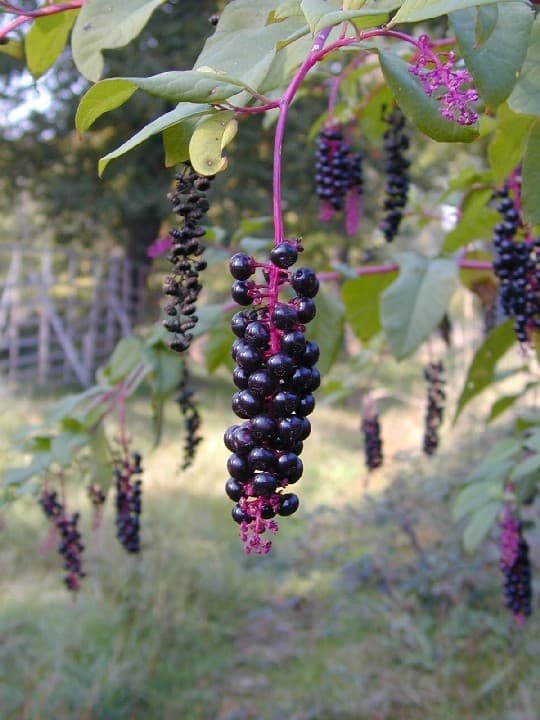
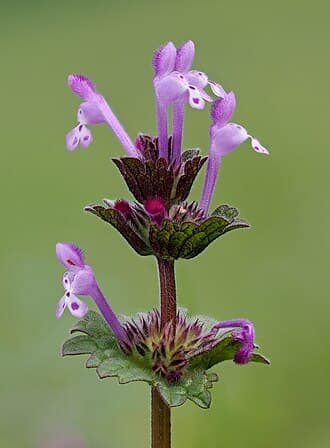
A dramatic native perennial that erupts each year from a massive taproot into a shrub-sized plant 4–10 feet tall and 3–5 feet wide: smooth magenta-to-purple stems, big bright-green leaves up to 12 inches long, drooping white-pink flower stalks, and late-summer clusters of glossy purple-black berries on hot-pink stems. It shows up where birds perch — fence lines, under trees, bed edges — not in the middle of a mowed lawn. The tell versus elderberry: elderberry carries its berries in flat, umbrella-shaped clusters on a woody shrub, while pokeweed's hang in grape-like racemes from smooth, fleshy pink stems.
Photo: Wikimedia Commons
Not sure if it's Pokeweed?
Snap a photo — our free AI compares it to pokeweed and tells you in seconds. No app needed.
Best approach: Spray or dig
Wear gloves and long sleeves — non-negotiable: pokeweed's toxins can be absorbed through cuts and abraded skin and cause contact dermatitis, so wash up thoroughly after handling. First-year plants pull easily while the taproot is pencil-thin. Established plants need a real dig: get the crown and as much of the carrot-like taproot as you can — it runs up to a foot deep and 4 inches thick, and any substantial crown piece left behind resprouts, so expect a hole. Don't compost the roots or berries anywhere kids or pets dig. For established taproots you'd rather not excavate, glyphosate spot-treatment on a fully leafed-out plant is the fallback.
Best products for Pokeweed
Formulated to kill pokeweed without wiping out your grass — see the timing and chemistry below.

Hi-Yield Triclopyr Ester (8 oz)
✓ Kills pokeweedTriclopyr is the strongest broadleaf-specific herbicide available to homeowners. When 2,4-D products fail on creeping charlie or wild violet, triclopyr gets the job done.

BioAdvanced All-In-One Weed & Feed (22-0-4)
✓ Kills pokeweedBeginner friendly
Scotts Turf Builder Triple Action1
✓ Kills pokeweedBeginner friendlyPrevents crabgrass for up to 4 months, kills dandelion, clover and other listed broadleaf weeds, and feeds. Apply to wet grass, no more than twice a year. Not for St. Augustine. Its label allows centipede, but centipede does better with a stand-alone weed killer and a lighter feeding.
How much do you need?
Herbicide is dosed by lawn size. Pick your yard size for a quick estimate:
Stop guessing
Get the exact amount for your lawn
Measure your lawn on a satellite map in about 30 seconds, then use its exact square footage to choose the right number of packs.
Measure my lawn free →Prefer to read how satellite measurement works first? See the lawn measuring tool.
As an Amazon Associate, Measure Lawn earns from qualifying purchases.
When to treat Pokeweed
Spray in spring or fall when temperatures are 60–80°F and the weed is actively growing. Avoid summer heat — stressed grass takes collateral damage.
Chemical treatment
Glyphosate is the best consumer-available option: spot-treat with 2.5–4 oz per gallon of a 41% concentrate, spraying to wet, and expect around 80% end-of-season control from a single application — good, but not a guaranteed kill of that huge taproot. It is non-selective, so accept the dead spot in surrounding grass and reseed; and since pokeweed lives along fences and bed edges, drift onto ornamentals is the bigger practical risk — spray on calm mornings and shield anything you want to keep. Time it for a fully leafed-out, actively growing plant: the window runs April through August, control is best at flowering, and a late-summer to early-fall application before hard frost drives the most herbicide into the root. Triclopyr is the listed selective alternative at 1–1.25 oz per gallon of a 61% product, useful in beds and on cool-season lawns only — never on any warm-season grass (bermudagrass, zoysiagrass, centipedegrass, St. Augustinegrass, bahiagrass). In a lawn, a broadleaf mix built on 2,4-D or dicamba will top-kill the shoots, but the taproot usually resprouts — treat it as a knockdown that needs repeat applications, not a one-shot kill; researchers watched established plants recover within a year even after a glyphosate-plus-dicamba treatment. On St. Augustine and centipede lawns, use 2,4-D only at reduced rates. Whatever you spray, plan on a follow-up next season for anything that regrows.
Non-chemical management
Pokeweed essentially cannot establish in regularly mowed turf — weekly mowing cuts every shoot and eventually exhausts the taproot, so the lawn itself is mostly self-defending; it is a fence-line and bed weed. Patrol the places the mower doesn't reach: fence lines, tree lines, bed edges. Hand-pull first-year plants early in the growing season while the taproot is still pencil-thin, and hoe or till seedlings before the root forms — tillage stops working once the plant is established. In unmowed spots where you can't dig, repeated cutting every time a shoot appears will drain the root over time.
How to stop Pokeweed coming back
Birds are the vector — new pokeweed populations are spread primarily by birds, and one plant makes 1,500–7,000 seeds a year that stay viable in soil for up to 50 years, so expect fresh seedlings under fences and tree lines every year regardless of what you kill this season. Kill seedlings the year they appear, before the taproot forms. Mulch beds to smother germination. If you deliberately keep a plant for wildlife, cut the berry clusters off before they ripen in late summer; otherwise remove plants before they fruit.
Stop fighting weeds one by one →
Get your free 12-month AI lawn care plan
A thick, healthy lawn is the best weed killer there is. Measure your yard on a satellite map in 30 seconds — we'll build a personalized schedule (fertilizer, seed, mowing, weed control) so pokeweed doesn't come back.
Measure my lawn — it's free →FAQ
What does Pokeweed look like?
A dramatic native perennial that erupts each year from a massive taproot into a shrub-sized plant 4–10 feet tall and 3–5 feet wide: smooth magenta-to-purple stems, big bright-green leaves up to 12 inches long, drooping white-pink flower stalks, and late-summer clusters of glossy purple-black berries on hot-pink stems. It shows up where birds perch — fence lines, under trees, bed edges — not in the middle of a mowed lawn. The tell versus elderberry: elderberry carries its berries in flat, umbrella-shaped clusters on a woody shrub, while pokeweed's hang in grape-like racemes from smooth, fleshy pink stems.
What's the best way to kill Pokeweed?
Spray or dig. Wear gloves and long sleeves — non-negotiable: pokeweed's toxins can be absorbed through cuts and abraded skin and cause contact dermatitis, so wash up thoroughly after handling. First-year plants pull easily while the taproot is pencil-thin. Established plants need a real dig: get the crown and as much of the carrot-like taproot as you can — it runs up to a foot deep and 4 inches thick, and any substantial crown piece left behind resprouts, so expect a hole. Don't compost the roots or berries anywhere kids or pets dig. For established taproots you'd rather not excavate, glyphosate spot-treatment on a fully leafed-out plant is the fallback.
Is Pokeweed hard to get rid of?
Pokeweed is rated moderate to control. Consistent treatment over a season usually does the job.
How do I stop Pokeweed coming back?
Birds are the vector — new pokeweed populations are spread primarily by birds, and one plant makes 1,500–7,000 seeds a year that stay viable in soil for up to 50 years, so expect fresh seedlings under fences and tree lines every year regardless of what you kill this season. Kill seedlings the year they appear, before the taproot forms. Mulch beds to smother germination. If you deliberately keep a plant for wildlife, cut the berry clusters off before they ripen in late summer; otherwise remove plants before they fruit.
Other broadleaf weeds
See every weed we cover:
Full weed guide•Photo identifier•Lawn care calendar•Free lawn care plan•Best mowers by size