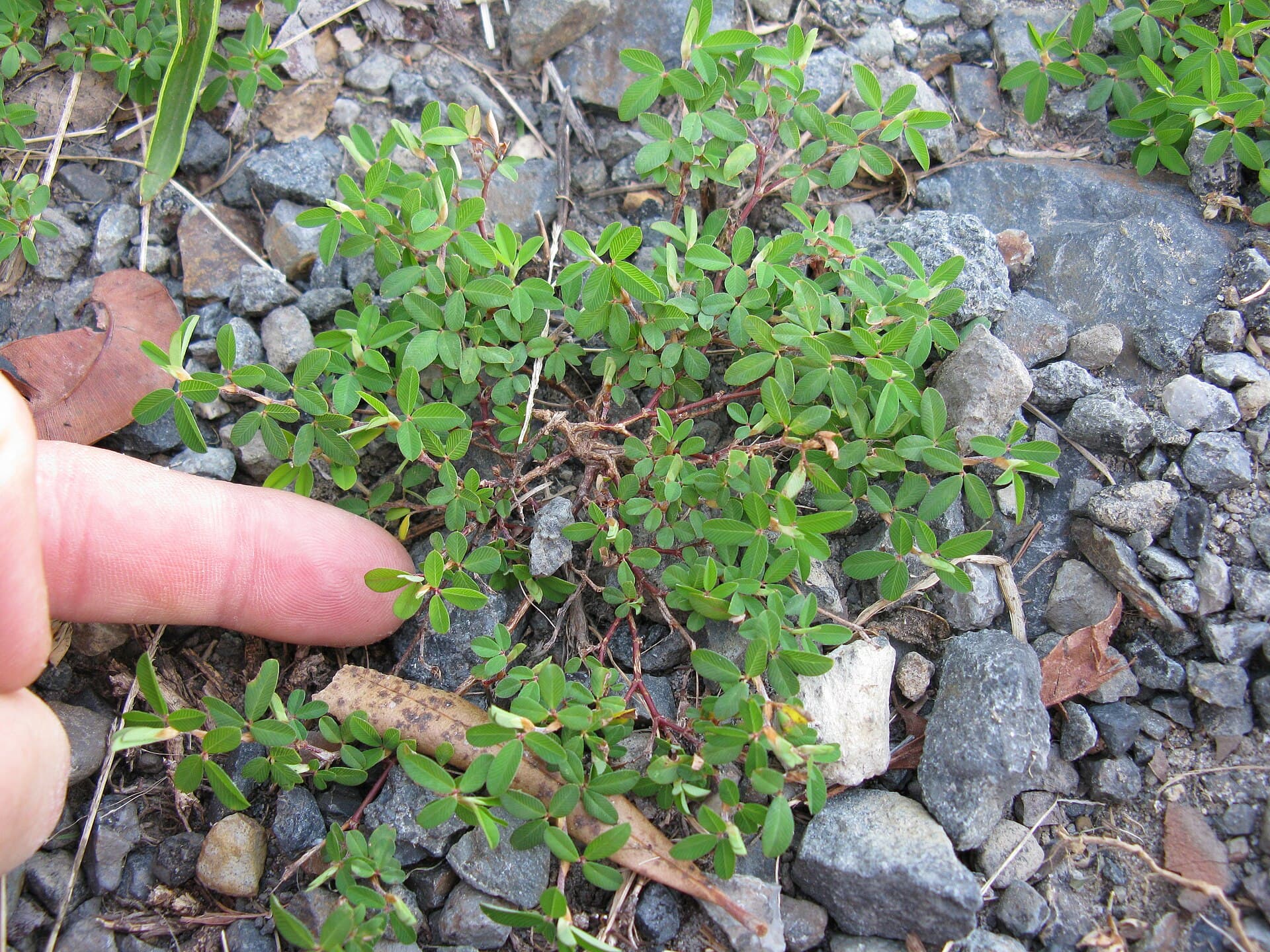
What Common Lespedeza (Japanese Clover) looks like
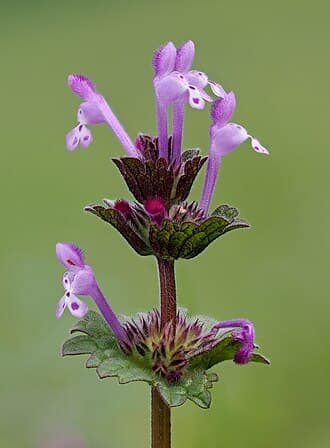
A wiry, ground-hugging summer annual legume that forms flat, dense mats in the driest, thinnest, low-fertility parts of the lawn — it grows below mower height, so it seldom gets cut. Each dark-green leaf has three small oblong leaflets with parallel veins running nearly at right angles off a prominent midvein; the tough, semi-woody stems carry tiny downward-pointing hairs and rise from a single taproot. Small pink-to-purple pea-like flowers appear singly in the leaf axils in late summer, exactly when it visibly takes over. The tell versus real clover: a wiry, non-succulent "clover" mat that shows up mid-to-late summer and won't pull like clover.
Photo: Wikimedia Commons
Not sure if it's Common Lespedeza (Japanese Clover)?
Snap a photo — our free AI compares it to common lespedeza (japanese clover) and tells you in seconds. No app needed.
Best approach: Herbicide spray
It grows from a single semi-woody taproot, and mature mats pull poorly — stems snap off and the crown regrows — so spot-spraying is the practical route; hand-pulling is realistic only for young plants in moist soil or in landscape beds. Mowing never touches it, because the mats hug the ground below blade height. Hit it in late spring or early summer while stems are still soft and succulent — it's easier to control then and the turf has a greater chance of recovering — and remember it's an annual: stopping this year's seed set plus a pre-emergent next spring beats heroic pulling.
Best products for Common Lespedeza (Japanese Clover)
Formulated to kill common lespedeza (japanese clover) without wiping out your grass — see the timing and chemistry below.

Hi-Yield Triclopyr Ester (8 oz)
✓ Kills common lespedeza (japanese clover)Triclopyr is the strongest broadleaf-specific herbicide available to homeowners. When 2,4-D products fail on creeping charlie or wild violet, triclopyr gets the job done.

Spectracide Weed Stop + Crabgrass Killer Concentrate (40 oz)
✓ Kills common lespedeza (japanese clover)Beginner friendlyFour active ingredients in one bottle - knocks out broadleaf weeds, crabgrass and nutsedge in a single pass, so you treat a mixed-weed lawn without buying three products.

BioAdvanced All-In-One Weed & Feed (22-0-4)
✓ Kills common lespedeza (japanese clover)Beginner friendlyHow much do you need?
Herbicide is dosed by lawn size. Pick your yard size for a quick estimate:
Stop guessing
Get the exact amount for your lawn
Measure your lawn on a satellite map in about 30 seconds, then use its exact square footage to choose the right number of packs.
Measure my lawn free →Prefer to read how satellite measurement works first? See the lawn measuring tool.
As an Amazon Associate, Measure Lawn earns from qualifying purchases.
When to treat Common Lespedeza (Japanese Clover)
Spray in spring or fall when temperatures are 60–80°F and the weed is actively growing. Avoid summer heat — stressed grass takes collateral damage.
Chemical treatment
Triclopyr is the lead active: in University of Arkansas zoysia trials, the herbicides that contained it were the most effective on lespedeza, and it is the one that still works late in the season once stems harden and mats turn woody — use it on cool-season lawns (tall fescue, Kentucky bluegrass, perennial ryegrass) and generally on zoysia, but never on bermuda, St. Augustine, or centipede. A three-way mix built on dicamba and mecoprop (MCPP) with 2,4-D rates good-not-great — 80–89% control in Georgia trials — and it is the dicamba and mecoprop that do the real work, so a plain single-ingredient broadleaf spray is a waste of time here; catch plants young, repeat 10–14 days apart on mature mats, use a reduced rate on St. Augustine and centipede, and never spray during spring green-up, under drought stress, or above 90°F. For warm-season southern lawns the excellent option (90–100% control) is metsulfuron — safe on bermuda, centipede, St. Augustine, and zoysia — a pro-market product you order online rather than pull off a shelf; add a non-ionic surfactant, keep it off tall fescue lawns entirely, don't overseed ryegrass within 8 weeks, and skip it under drought stress or above 85°F. Four-way combos that add sulfentrazone and quinclorac to the broadleaf actives also rated excellent in Georgia trials and are fine on tall fescue, bermuda, and zoysia — but not safe on centipede or St. Augustine. On St. Augustine and centipede specifically, atrazine is the answer — those two grasses only — with both post- and pre-emergence activity on lespedeza. On the pre-emergent side, dithiopyr controls common lespedeza at better than 90%, with pendimethalin and prodiamine also effective: this weed germinates early, once soil in the top 4 inches reaches the low-to-mid 50s°F, so apply at crabgrass-preventer timing or slightly earlier, and a mid-to-late-spring application (or a split application) covers the long March-through-June emergence window better than a late-winter one. In beds and along edges, spot-spray with glyphosate at about a 5% solution, knowing it kills everything it touches.
Non-chemical management
Common lespedeza is a billboard for starving turf — it wins where nitrogen is low, soil is compacted, and drought has thinned the stand. Supplemental nitrogen helps the grass compete against this nitrogen-fixing legume, with one exception: centipede lawns are deliberately kept low-N, so some lespedeza in centipede is normal and over-fertilizing to fight it hurts the grass. Raise your mowing height, core-aerate compacted areas and reroute the traffic that packed them, water deeply and infrequently through drought, correct pH per a soil test, and overseed thin spots. Wash the mower deck after cutting infested areas so you don't ferry seed across the lawn. It fixes nitrogen like clover, was once planted as forage — hence "Japanese clover" — and stays green on droughty soil where turf browns, but unlike white clover nobody recommends keeping it: the mat is an annual that dies to brown wire at frost and leaves bare soil behind.
How to stop Common Lespedeza (Japanese Clover) coming back
A dense, well-fed lawn is the real barrier. In lawns that had lespedeza this year, put down a spring pre-emergent — dithiopyr controls it at better than 90% — timed at crabgrass-preventer stage or slightly earlier, since it germinates once topsoil hits the low-to-mid 50s°F, and don't let surviving plants reach their late-summer seed set.
Stop fighting weeds one by one →
Get your free 12-month AI lawn care plan
A thick, healthy lawn is the best weed killer there is. Measure your yard on a satellite map in 30 seconds — we'll build a personalized schedule (fertilizer, seed, mowing, weed control) so common lespedeza (japanese clover) doesn't come back.
Measure my lawn — it's free →FAQ
What does Common Lespedeza (Japanese Clover) look like?
A wiry, ground-hugging summer annual legume that forms flat, dense mats in the driest, thinnest, low-fertility parts of the lawn — it grows below mower height, so it seldom gets cut. Each dark-green leaf has three small oblong leaflets with parallel veins running nearly at right angles off a prominent midvein; the tough, semi-woody stems carry tiny downward-pointing hairs and rise from a single taproot. Small pink-to-purple pea-like flowers appear singly in the leaf axils in late summer, exactly when it visibly takes over. The tell versus real clover: a wiry, non-succulent "clover" mat that shows up mid-to-late summer and won't pull like clover.
What's the best way to kill Common Lespedeza (Japanese Clover)?
Herbicide spray. It grows from a single semi-woody taproot, and mature mats pull poorly — stems snap off and the crown regrows — so spot-spraying is the practical route; hand-pulling is realistic only for young plants in moist soil or in landscape beds. Mowing never touches it, because the mats hug the ground below blade height. Hit it in late spring or early summer while stems are still soft and succulent — it's easier to control then and the turf has a greater chance of recovering — and remember it's an annual: stopping this year's seed set plus a pre-emergent next spring beats heroic pulling.
Is Common Lespedeza (Japanese Clover) hard to get rid of?
Common Lespedeza (Japanese Clover) is rated moderate to control. Consistent treatment over a season usually does the job.
How do I stop Common Lespedeza (Japanese Clover) coming back?
A dense, well-fed lawn is the real barrier. In lawns that had lespedeza this year, put down a spring pre-emergent — dithiopyr controls it at better than 90% — timed at crabgrass-preventer stage or slightly earlier, since it germinates once topsoil hits the low-to-mid 50s°F, and don't let surviving plants reach their late-summer seed set.
Other broadleaf weeds
See every weed we cover:
Full weed guide•Photo identifier•Lawn care calendar•Free lawn care plan•Best mowers by size