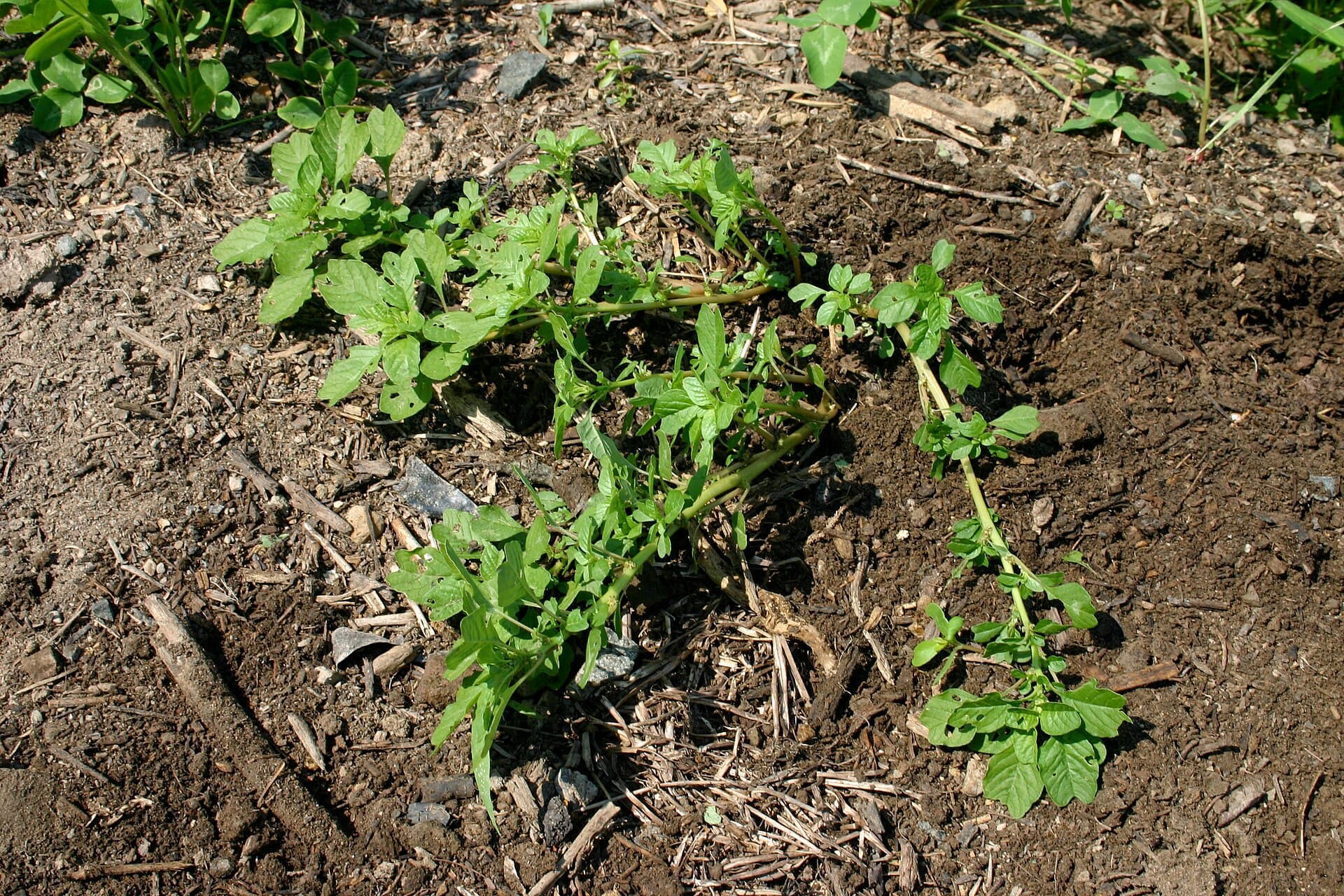
What Pigweed (Prostrate and Redroot) looks like
Pigweed shows up in yards wearing two faces. Redroot pigweed is the upright one — a rough-hairy summer annual reaching 2 to 3 feet (up to 6 unmowed) with dull-green oval leaves on long stalks, a red-striped lower stem, bristly green bottlebrush seedheads at the stem tips, and the giveaway pink-to-red taproot when you dig one up. Prostrate pigweed is the lawn version: a smooth, hairless mat of reddish stems 1 to 3 feet long radiating in a circle, with small shiny spoon-shaped leaves clustered at the stem tips and tiny green flowers hidden in the leaf axils, appearing mid-summer in thin, new, or disturbed turf and along bed and driveway edges. The tell against its mat-forming look-alikes: snap a stem — pigweed has no milky sap (spotted spurge does), no papery sheath at each joint (prostrate knotweed does), and no fat succulent leaves (purslane does).
Photo: Wikimedia Commons
Not sure if it's Pigweed (Prostrate and Redroot)?
Snap a photo — our free AI compares it to pigweed (prostrate and redroot) and tells you in seconds. No app needed.
Best approach: Spray or dig
Hand-pulling is genuinely sufficient for scattered plants — both forms are shallow-rooted annuals that pull cleanly from moist soil, redroot by its short pink-to-red taproot and prostrate by its small central root. Do it before seed set in mid-to-late summer: a single redroot plant can shed up to 250,000 seeds, so pull before the seedhead browns and bag any plant that has already flowered rather than composting it. No gloves needed.
Best products for Pigweed (Prostrate and Redroot)
Formulated to kill pigweed (prostrate and redroot) without wiping out your grass — see the timing and chemistry below.

Scotts Turf Builder Triple Action1
✓ Kills pigweed (prostrate and redroot)Beginner friendlyPrevents crabgrass for up to 4 months, kills dandelion, clover and other listed broadleaf weeds, and feeds. Apply to wet grass, no more than twice a year. Not for St. Augustine. Its label allows centipede, but centipede does better with a stand-alone weed killer and a lighter feeding.

BioAdvanced All-In-One Weed & Feed (22-0-4)
✓ Kills pigweed (prostrate and redroot)Beginner friendly
Scotts Turf Builder Weed & Feed3
✓ Kills pigweed (prostrate and redroot)Beginner friendlyHow much do you need?
Herbicide is dosed by lawn size. Pick your yard size for a quick estimate:
Stop guessing
Get the exact amount for your lawn
Measure your lawn on a satellite map in about 30 seconds, then use its exact square footage to choose the right number of packs.
Measure my lawn free →Prefer to read how satellite measurement works first? See the lawn measuring tool.
As an Amazon Associate, Measure Lawn earns from qualifying purchases.
When to treat Pigweed (Prostrate and Redroot)
Spray in spring or fall when temperatures are 60–80°F and the weed is actively growing. Avoid summer heat — stressed grass takes collateral damage.
Chemical treatment
The standard three-way of 2,4-D, mecoprop (MCPP) and dicamba is the reliable consumer answer, and it is most effective on young, actively growing plants — hit the summer flush early rather than spraying a woody August mat. Triclopyr also controls pigweed but is strictly a cool-season-turf herbicide (labels prohibit it on bermudagrass, centipede, St. Augustine, bahia and bentgrass), and MCPA is a listed turf option as well. On St. Augustine and centipede, both sensitive to 2,4-D, use a reduced-rate southern-lawn three-way formulation or an atrazine-based broadleaf product instead; bermuda tolerates standard three-way rates. Whatever you spray, avoid treating any warm-season lawn during spring green-up or above 85–90°F, and keep dicamba away from the root zones of trees and ornamentals. For the seed bank, pendimethalin and prodiamine are the documented pre-emergents for pigweeds in turf, applied 2–3 weeks before germination — and because pigweed germinates in genuinely hot soil (86–104°F is optimal), well after many spring weed-and-feed passes are exhausted, a split or late-spring second application is what actually covers its long warm-season window. In beds and along driveway edges, glyphosate works as a non-selective spot treatment, though it is rarely needed in the lawn itself since the selective options work. One caveat borrowed from agriculture: Palmer amaranth and waterhemp have evolved resistance to several top herbicides including glyphosate — none of that involves the phenoxy three-ways sold for lawns, which remain reliable on lawn pigweeds — but if a glyphosate spot-spray inexplicably fails on a big pigweed near a farm field or new-construction fill, resistant seed is a real possibility; pull that plant instead of respraying.
Non-chemical management
Density is the whole game. Pigweed invades thin, damaged or under-fertilized lawns and new establishments where the turf is not yet dense and competitive, and because it must re-establish from seed every single year, extension guidance is blunt: it will not persist more than one season if the turf is encouraged to fill in during the fall. So overseed and fertilize bare and thin patches in fall and let the canopy close. Regular mowing keeps upright redroot pigweed from ever establishing in a lawn — but do not count on the mower for prostrate pigweed, which grows entirely below blade height. Avoid unnecessary tilling or soil disruption: buried seed stays viable from a couple of years up to decades depending on depth, and disturbance is exactly what exposes it to germinate.
How to stop Pigweed (Prostrate and Redroot) coming back
Apply pendimethalin or prodiamine at your normal spring crabgrass timing, then add a split or late-spring second application — pigweed germinates when soil reaches 86–104°F, later and longer than the weeds most spring programs are aimed at, so a single early pass runs out before pigweed's window even opens (the rule is 2–3 weeks ahead of germination). Keep the lawn thick with fall overseeding and fertilization of thin spots, hold a 2–3 inch mulch layer in beds, and hand-pull escapes before they set seed.
Stop fighting weeds one by one →
Get your free 12-month AI lawn care plan
A thick, healthy lawn is the best weed killer there is. Measure your yard on a satellite map in 30 seconds — we'll build a personalized schedule (fertilizer, seed, mowing, weed control) so pigweed (prostrate and redroot) doesn't come back.
Measure my lawn — it's free →FAQ
What does Pigweed (Prostrate and Redroot) look like?
Pigweed shows up in yards wearing two faces. Redroot pigweed is the upright one — a rough-hairy summer annual reaching 2 to 3 feet (up to 6 unmowed) with dull-green oval leaves on long stalks, a red-striped lower stem, bristly green bottlebrush seedheads at the stem tips, and the giveaway pink-to-red taproot when you dig one up. Prostrate pigweed is the lawn version: a smooth, hairless mat of reddish stems 1 to 3 feet long radiating in a circle, with small shiny spoon-shaped leaves clustered at the stem tips and tiny green flowers hidden in the leaf axils, appearing mid-summer in thin, new, or disturbed turf and along bed and driveway edges. The tell against its mat-forming look-alikes: snap a stem — pigweed has no milky sap (spotted spurge does), no papery sheath at each joint (prostrate knotweed does), and no fat succulent leaves (purslane does).
What's the best way to kill Pigweed (Prostrate and Redroot)?
Spray or dig. Hand-pulling is genuinely sufficient for scattered plants — both forms are shallow-rooted annuals that pull cleanly from moist soil, redroot by its short pink-to-red taproot and prostrate by its small central root. Do it before seed set in mid-to-late summer: a single redroot plant can shed up to 250,000 seeds, so pull before the seedhead browns and bag any plant that has already flowered rather than composting it. No gloves needed.
Is Pigweed (Prostrate and Redroot) hard to get rid of?
Pigweed (Prostrate and Redroot) is rated easy to control. Most homeowners can handle it in one or two treatments.
How do I stop Pigweed (Prostrate and Redroot) coming back?
Apply pendimethalin or prodiamine at your normal spring crabgrass timing, then add a split or late-spring second application — pigweed germinates when soil reaches 86–104°F, later and longer than the weeds most spring programs are aimed at, so a single early pass runs out before pigweed's window even opens (the rule is 2–3 weeks ahead of germination). Keep the lawn thick with fall overseeding and fertilization of thin spots, hold a 2–3 inch mulch layer in beds, and hand-pull escapes before they set seed.
Other broadleaf weeds
See every weed we cover:
Full weed guide•Photo identifier•Lawn care calendar•Free lawn care plan•Best mowers by size