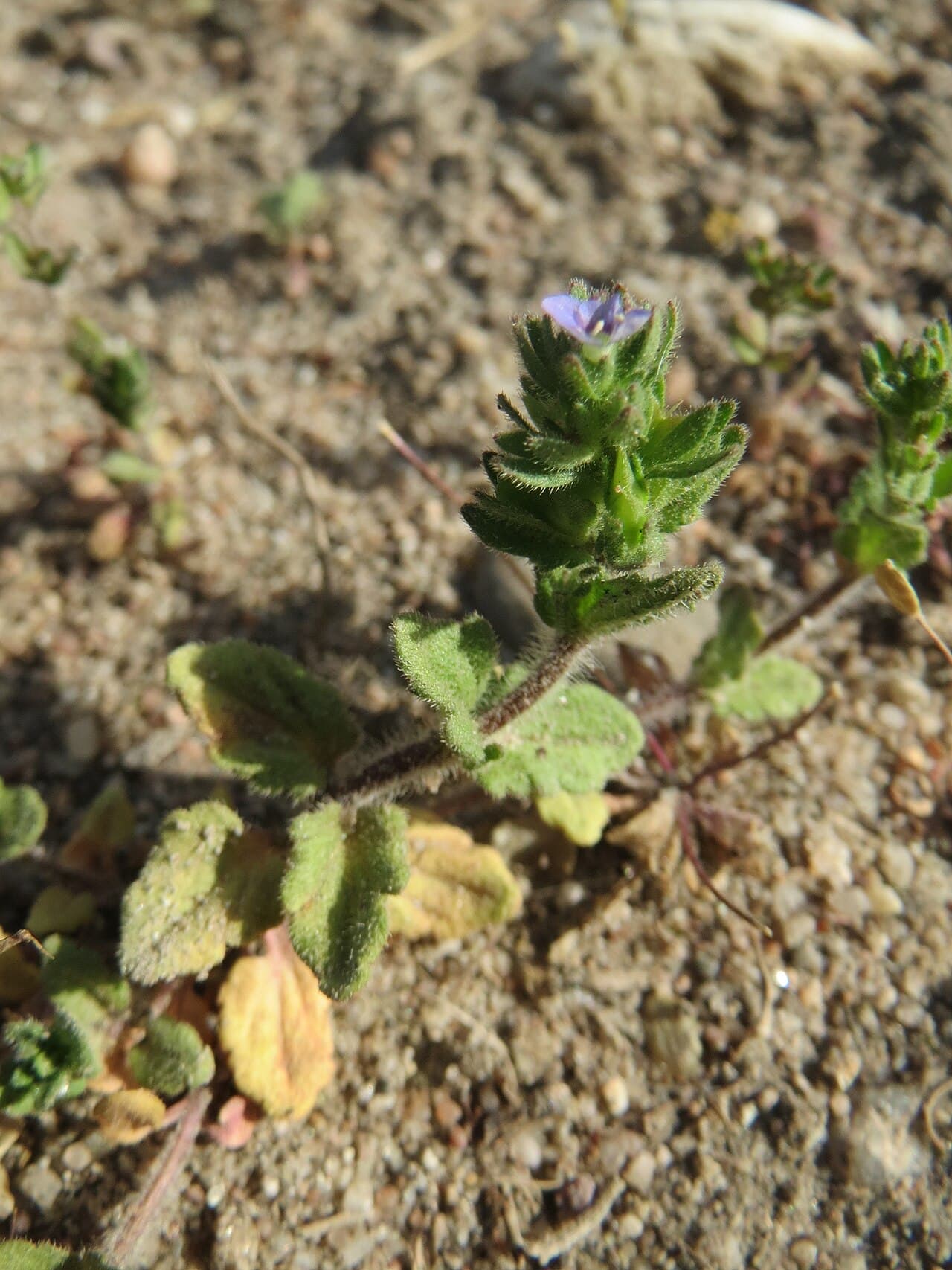
What Speedwell (Corn and Persian) looks like
A low spreading carpet of small scalloped leaves growing in opposite pairs, dotted in early spring with tiny four-petal sky-blue flowers barely wider than a match head, followed by distinctive flat heart-shaped seed pods.
Photo: Wikimedia Commons
Not sure if it's Speedwell (Corn and Persian)?
Snap a photo — our free AI compares it to speedwell (corn and persian) and tells you in seconds. No app needed.
Best approach: Spray or dig
The annual speedwells pull easily by hand in spring when soil is moist, and small patches are worth pulling before they seed. Important lookalike: if your plant creeps and roots along the stems as it goes, it is creeping speedwell (Veronica filiformis), a perennial that resists 2,4-D, MCPA, mecoprop, dicamba and triclopyr — for that one, hand removal plus thickening the turf is the only honest answer.
Best products for Speedwell (Corn and Persian)
Formulated to kill speedwell (corn and persian) without wiping out your grass — see the timing and chemistry below.
Paid links. As an Amazon Associate, MeasureLawn earns from qualifying purchases.

Scotts Turf Builder Triple Action1
✓ Kills speedwell (corn and persian)Beginner friendlyPrevents crabgrass for up to 4 months, kills dandelion, clover and other listed broadleaf weeds, and feeds. Apply to wet grass, no more than twice a year. Not for St. Augustine. Its label allows centipede, but centipede does better with a stand-alone weed killer and a lighter feeding.

Spectracide Weed Stop + Crabgrass Killer Concentrate (40 oz)
✓ Kills speedwell (corn and persian)Beginner friendlyFour active ingredients in one bottle - knocks out broadleaf weeds, crabgrass and nutsedge in a single pass, so you treat a mixed-weed lawn without buying three products.

BioAdvanced All-In-One Weed & Feed (22-0-4)
✓ Kills speedwell (corn and persian)Beginner friendlyHow much do you need?
Herbicide is dosed by lawn size. Pick your yard size for a quick estimate:
Stop guessing
Get the exact amount for your lawn
Measure your lawn on a satellite map in about 30 seconds, then use its exact square footage to choose the right number of packs.
Measure my lawn free →Prefer to read how satellite measurement works first? See the lawn measuring tool.
When to treat Speedwell (Corn and Persian)
Spray in spring or fall when temperatures are 60–80°F and the weed is actively growing. Avoid summer heat — stressed grass takes collateral damage.
Chemical treatment
Speedwell shrugs off plain 2,4-D, so you need a combination product — but the choice depends on your grass. On cool-season lawns only (tall fescue, Kentucky bluegrass, perennial ryegrass, fine fescue), use a combination containing triclopyr and dicamba, or one with carfentrazone or sulfentrazone; do not use triclopyr- or dicamba-heavy products on warm-season lawns (bermuda, zoysia, St. Augustine, centipede, bahia), where they cause real turf injury, with St. Augustine and centipede damaged most easily. On warm-season lawns, pick a product that names your grass on the label — sulfentrazone or carfentrazone are the safest bets, and in southern states an atrazine product sold for St. Augustine and centipede works well (check it's sold in your state, and never spray during spring green-up). Spray in fall or early spring while plants are small and actively growing, with no rain forecast for 24 hours, and expect to repeat. A late-summer or early-fall pre-emergent (prodiamine, dithiopyr or pendimethalin) is the more reliable control for these winter annuals — but skip it any year you're seeding or overseeding in fall, because it stops grass seed from germinating too.
Non-chemical management
Raise mowing height and correct low fertility — speedwell exploits closely mown, underfed, damp and shaded turf. Hand-pull the annual types in spring before seed pods form.
How to stop Speedwell (Corn and Persian) coming back
Apply a fall pre-emergent and overseed thin shady areas — corn and Persian speedwell germinate in cool, moist fall conditions.
Stop fighting weeds one by one →
Get your free 12-month AI lawn care plan
A thick, healthy lawn is the best weed killer there is. Measure your yard on a satellite map in 30 seconds — we'll build a personalized schedule (fertilizer, seed, mowing, weed control) so speedwell (corn and persian) doesn't come back.
Measure my lawn — it's free →FAQ
What does Speedwell (Corn and Persian) look like?
A low spreading carpet of small scalloped leaves growing in opposite pairs, dotted in early spring with tiny four-petal sky-blue flowers barely wider than a match head, followed by distinctive flat heart-shaped seed pods.
What's the best way to kill Speedwell (Corn and Persian)?
Spray or dig. The annual speedwells pull easily by hand in spring when soil is moist, and small patches are worth pulling before they seed. Important lookalike: if your plant creeps and roots along the stems as it goes, it is creeping speedwell (Veronica filiformis), a perennial that resists 2,4-D, MCPA, mecoprop, dicamba and triclopyr — for that one, hand removal plus thickening the turf is the only honest answer.
Is Speedwell (Corn and Persian) hard to get rid of?
Speedwell (Corn and Persian) is rated hard to control. It usually requires multiple applications and a consistent plan.
How do I stop Speedwell (Corn and Persian) coming back?
Apply a fall pre-emergent and overseed thin shady areas — corn and Persian speedwell germinate in cool, moist fall conditions.
Other broadleaf weeds
See every weed we cover:
Full weed guide•Photo identifier•Lawn care calendar•Free lawn care plan•Best mowers by size