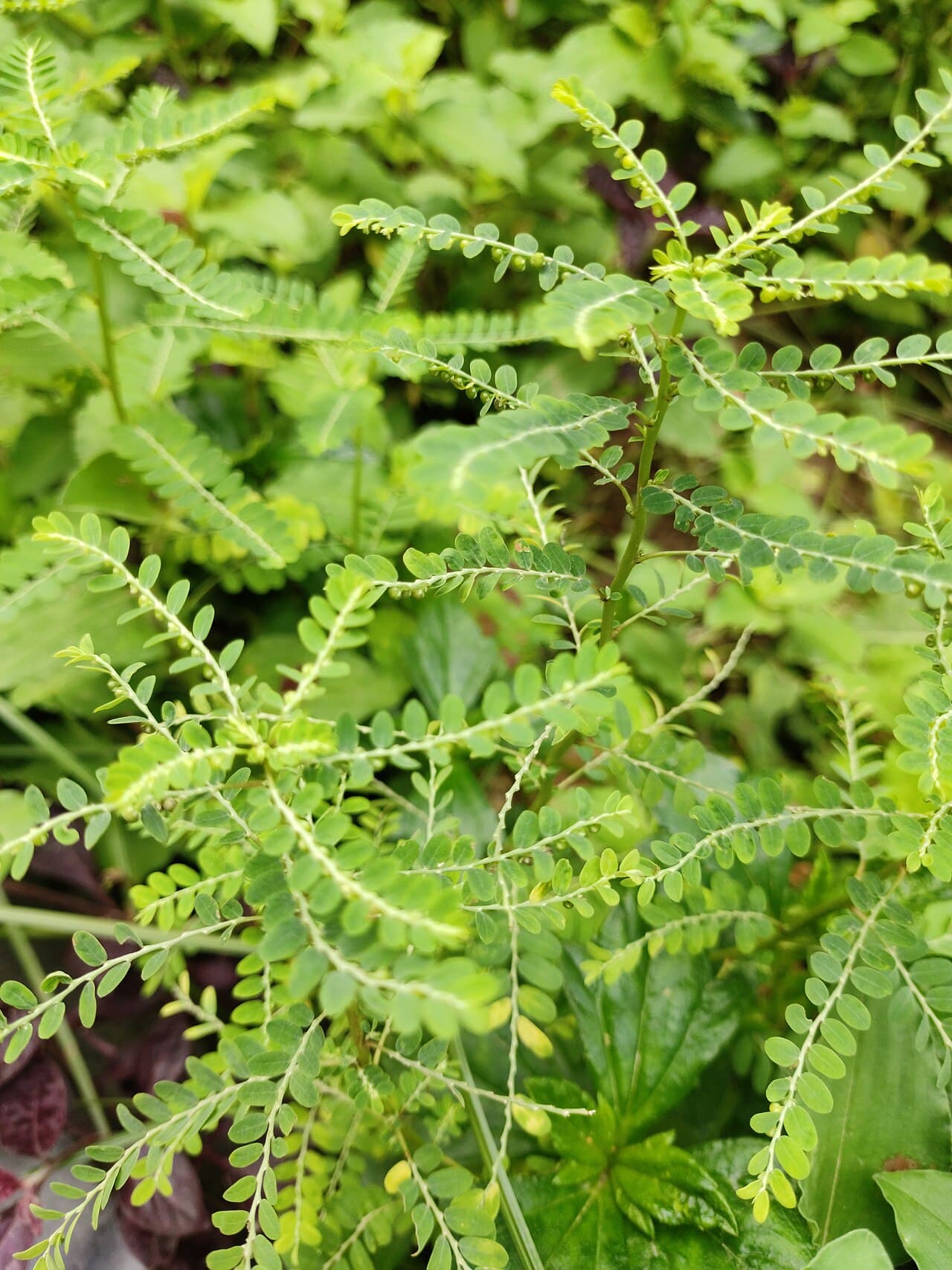
What Chamberbitter looks like
A summer annual that looks uncannily like a tiny mimosa tree seedling — two neat rows of small oblong leaflets along each branchlet, folding shut at night, on reddish branching stems. Flip a branchlet over for the definitive check: rows of small warty green seed capsules sit tight against the underside, and nothing else in a lawn does that.
Photo: Wikimedia Commons
Not sure if it's Chamberbitter?
Snap a photo — our free AI compares it to chamberbitter and tells you in seconds. No app needed.
Best approach: Spray or dig
It germinates after the standard pre-emergent window has closed, builds a taproot within weeks and then forcibly ejects its own seed across the surrounding turf, so scout weekly from June rather than monthly. Landscape beds are the seed reservoir — never let a plant there go to seed beside your lawn.
Best products for Chamberbitter
Formulated to kill chamberbitter without wiping out your grass — see the timing and chemistry below.

BioAdvanced All-In-One Weed & Feed (22-0-4)
✓ Kills chamberbitterBeginner friendly
Scotts Turf Builder Triple Action1
✓ Kills chamberbitterBeginner friendlyPrevents crabgrass for up to 4 months, kills dandelion, clover and other listed broadleaf weeds, and feeds. Apply to wet grass, no more than twice a year. Not for St. Augustine. Its label allows centipede, but centipede does better with a stand-alone weed killer and a lighter feeding.

Scotts Turf Builder Weed & Feed3
✓ Kills chamberbitterBeginner friendlyHow much do you need?
Herbicide is dosed by lawn size. Pick your yard size for a quick estimate:
Stop guessing
Get the exact amount for your lawn
Measure your lawn on a satellite map in about 30 seconds, then use its exact square footage to choose the right number of packs.
Measure my lawn free →Prefer to read how satellite measurement works first? See the lawn measuring tool.
As an Amazon Associate, Measure Lawn earns from qualifying purchases.
When to treat Chamberbitter
Spray in spring or fall when temperatures are 60–80°F and the weed is actively growing. Avoid summer heat — stressed grass takes collateral damage.
Chemical treatment
Set expectations first: extension sources agree chamberbitter resists most common herbicides and takes repeat applications across two or three seasons, not one weekend. Your options split hard by grass type. On centipedegrass and St. Augustinegrass, atrazine is the most effective active — two applications 30 days apart, only after full spring green-up; it is not labelled for tall fescue, Kentucky bluegrass or perennial ryegrass and will injure them. For everyone else, a three-way broadleaf herbicide (2,4-D + mecoprop + dicamba) is the workhorse, at full rate on tall fescue, bermudagrass and zoysiagrass but reduced rate on centipede and St. Augustine, sprayed on young plants and repeated after 30 days. A thiencarbazone + iodosulfuron + dicamba product is the warm-season specialist (bermuda, zoysia, centipede, St. Augustine only — never cool-season lawns) and the one product you may apply during spring green-up. The pre-emergent most people get wrong: a February crabgrass barrier has expired by the time this germinates in June — use isoxaben in late spring instead, with a second pass eight weeks later.
Non-chemical management
Hand-pulling genuinely works if you are early and consistent — young plants lift easily, and mature ones release if you wet the soil first. Two rules make or break it: check the underside for seed capsules before you pull, and if they are there, cup the whole plant and bag it. Never shake soil off the roots, which is exactly how the seed spreads.
How to stop Chamberbitter coming back
Dense turf mowed at the top of its range is the real defence, and getting pre-emergent timing right matters more here than anywhere — late spring, not late winter. In beds, four inches of mulch buries the light-hungry seed for good.
Stop fighting weeds one by one →
Get your free 12-month AI lawn care plan
A thick, healthy lawn is the best weed killer there is. Measure your yard on a satellite map in 30 seconds — we'll build a personalized schedule (fertilizer, seed, mowing, weed control) so chamberbitter doesn't come back.
Measure my lawn — it's free →FAQ
What does Chamberbitter look like?
A summer annual that looks uncannily like a tiny mimosa tree seedling — two neat rows of small oblong leaflets along each branchlet, folding shut at night, on reddish branching stems. Flip a branchlet over for the definitive check: rows of small warty green seed capsules sit tight against the underside, and nothing else in a lawn does that.
What's the best way to kill Chamberbitter?
Spray or dig. It germinates after the standard pre-emergent window has closed, builds a taproot within weeks and then forcibly ejects its own seed across the surrounding turf, so scout weekly from June rather than monthly. Landscape beds are the seed reservoir — never let a plant there go to seed beside your lawn.
Is Chamberbitter hard to get rid of?
Chamberbitter is rated hard to control. It usually requires multiple applications and a consistent plan.
How do I stop Chamberbitter coming back?
Dense turf mowed at the top of its range is the real defence, and getting pre-emergent timing right matters more here than anywhere — late spring, not late winter. In beds, four inches of mulch buries the light-hungry seed for good.
Other broadleaf weeds
See every weed we cover:
Full weed guide•Photo identifier•Lawn care calendar•Free lawn care plan•Best mowers by size