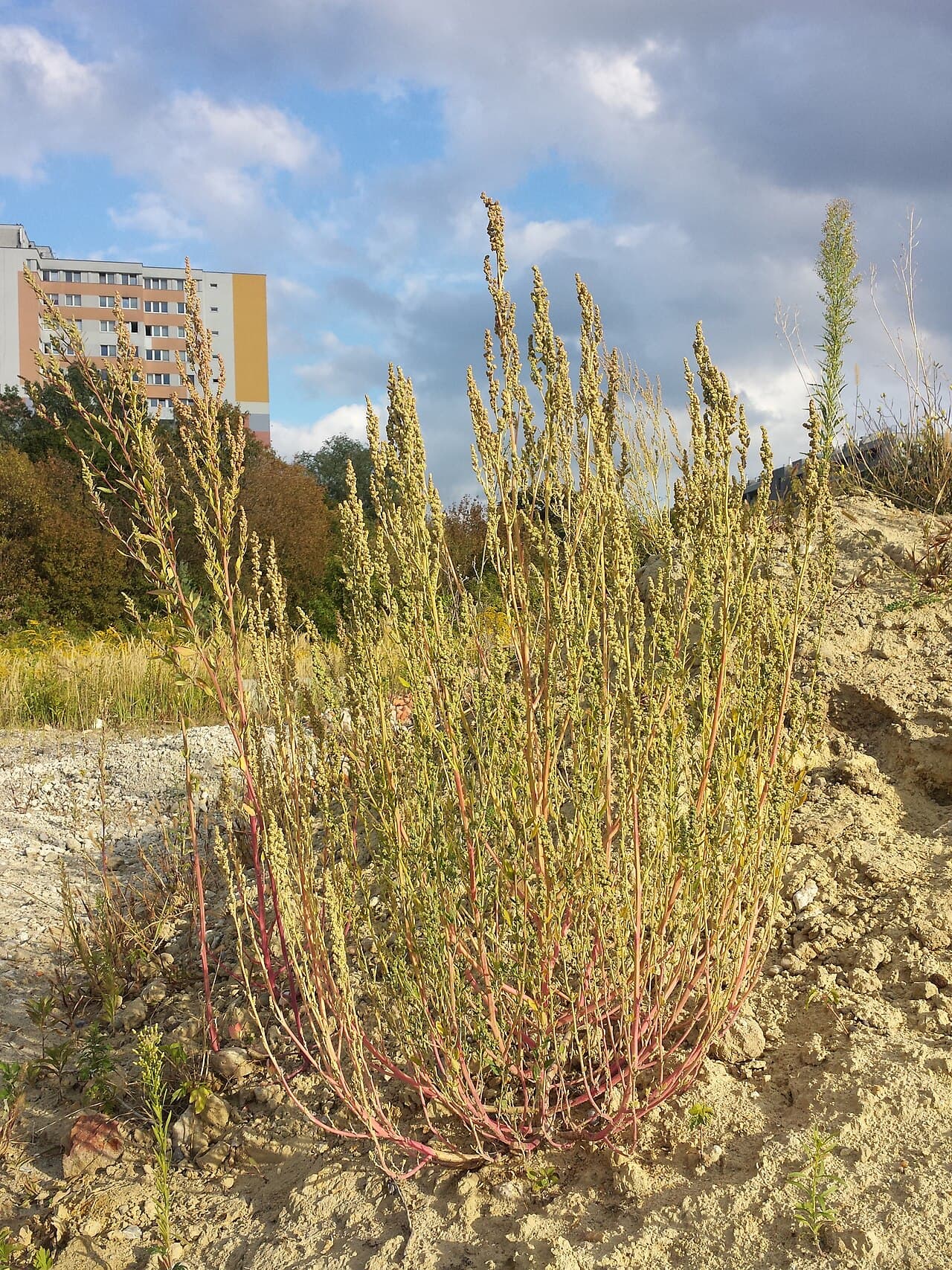
What Common Lambsquarters looks like
An upright, fast-growing summer annual with diamond-to-triangular leaves on ridged stems streaked maroon, shooting three to five feet tall if nothing stops it. The dead giveaway is the coating: young leaves and growing tips look dusted with fine grey-white flour that smears when you rub it — redroot pigweed, its usual lookalike, has no such bloom.
Photo: Wikimedia Commons
Not sure if it's Common Lambsquarters?
Snap a photo — our free AI compares it to common lambsquarters and tells you in seconds. No app needed.
Best approach: Spray or dig
One plant sets 70,000 or more seeds that stay viable in soil for decades, so bag any plant that has already flowered rather than composting it, and do not shake the soil off the roots. In a maintained lawn it rarely persists; the real battle is in beds and on freshly disturbed ground.
Best products for Common Lambsquarters
Formulated to kill common lambsquarters without wiping out your grass — see the timing and chemistry below.

BioAdvanced All-In-One Weed & Feed (22-0-4)
✓ Kills common lambsquartersBeginner friendly
Scotts Turf Builder Triple Action1
✓ Kills common lambsquartersBeginner friendlyPrevents crabgrass for up to 4 months, kills dandelion, clover and other listed broadleaf weeds, and feeds. Apply to wet grass, no more than twice a year. Not for St. Augustine. Its label allows centipede, but centipede does better with a stand-alone weed killer and a lighter feeding.

Scotts Turf Builder Weed & Feed3
✓ Kills common lambsquartersBeginner friendlyHow much do you need?
Herbicide is dosed by lawn size. Pick your yard size for a quick estimate:
Stop guessing
Get the exact amount for your lawn
Measure your lawn on a satellite map in about 30 seconds, then use its exact square footage to choose the right number of packs.
Measure my lawn free →Prefer to read how satellite measurement works first? See the lawn measuring tool.
As an Amazon Associate, Measure Lawn earns from qualifying purchases.
When to treat Common Lambsquarters
Spray in spring or fall when temperatures are 60–80°F and the weed is actively growing. Avoid summer heat — stressed grass takes collateral damage.
Chemical treatment
In a mowed lawn you usually need no herbicide at all, so read the cultural note first. Where it has taken over thin or newly seeded ground, a three-way broadleaf lawn herbicide (2,4-D + dicamba + mecoprop) sprayed while plants are young gives good control — dicamba does most of the work, and timing matters because the mealy wax on older leaves blocks absorption, so a six-inch plant treats far better than a three-foot one. That three-way is safe at label rates on Kentucky bluegrass, tall fescue, perennial ryegrass, fine fescue, bermudagrass, zoysiagrass and bahiagrass; centipedegrass and St. Augustinegrass are sensitive to 2,4-D, so use only a product naming them, at the reduced rate, after full spring green-up. Triclopyr also works and suits cool-season lawns, but it injures bermudagrass and must not go on St. Augustine or centipede. Never spray any of them above 85°F or during drought stress, and do not treat a newly seeded lawn until it has been mowed three times.
Non-chemical management
Mowing is the most effective control and it costs nothing — lambsquarters cannot survive repeated cutting, so a month or two of normal mowing usually makes it vanish from a lawn on its own. Where you cannot mow, hand-pull while plants are young; the taproot lifts cleanly from moist soil. The rule that matters: get it before it flowers.
How to stop Common Lambsquarters coming back
It needs bare soil and light, so close the canopy — reseed thin patches promptly, mow at the top of your grass’s range, and keep two to three inches of mulch on beds, which buries the seed below the light it needs.
Stop fighting weeds one by one →
Get your free 12-month AI lawn care plan
A thick, healthy lawn is the best weed killer there is. Measure your yard on a satellite map in 30 seconds — we'll build a personalized schedule (fertilizer, seed, mowing, weed control) so common lambsquarters doesn't come back.
Measure my lawn — it's free →FAQ
What does Common Lambsquarters look like?
An upright, fast-growing summer annual with diamond-to-triangular leaves on ridged stems streaked maroon, shooting three to five feet tall if nothing stops it. The dead giveaway is the coating: young leaves and growing tips look dusted with fine grey-white flour that smears when you rub it — redroot pigweed, its usual lookalike, has no such bloom.
What's the best way to kill Common Lambsquarters?
Spray or dig. One plant sets 70,000 or more seeds that stay viable in soil for decades, so bag any plant that has already flowered rather than composting it, and do not shake the soil off the roots. In a maintained lawn it rarely persists; the real battle is in beds and on freshly disturbed ground.
Is Common Lambsquarters hard to get rid of?
Common Lambsquarters is rated easy to control. Most homeowners can handle it in one or two treatments.
How do I stop Common Lambsquarters coming back?
It needs bare soil and light, so close the canopy — reseed thin patches promptly, mow at the top of your grass’s range, and keep two to three inches of mulch on beds, which buries the seed below the light it needs.
Other broadleaf weeds
See every weed we cover:
Full weed guide•Photo identifier•Lawn care calendar•Free lawn care plan•Best mowers by size