A federal noxious weed in the United States
Kikuyu grass is on the USDA Federal Noxious Weed List, so moving it into the US or across state lines requires a federal permit. California also lists it as a noxious weed. If you live in the US, check with your state department of agriculture before planting or moving any kikuyu seed, turf or runners.
How to identify Kikuyu Grass
Kikuyu makes a thick, light green lawn on a dense mat of creeping stems. It grows fast in warm weather, creeps over edges and recovers quickly from wear. On cool, humid mornings you may see fine white threads above the grass. These are the stamens of its flowers, which otherwise stay hidden inside the leaf sheaths.
- Hidden flowers
- The flower heads stay tucked inside the leaf sheaths. Only long, white, thread-like stamens poke out, and they are easiest to see on cool, humid mornings.
- Runners
- Thick, flattened above-ground runners with many swollen joints, plus thick white underground rhizomes. The runners root wherever a joint touches soil.
- Blade
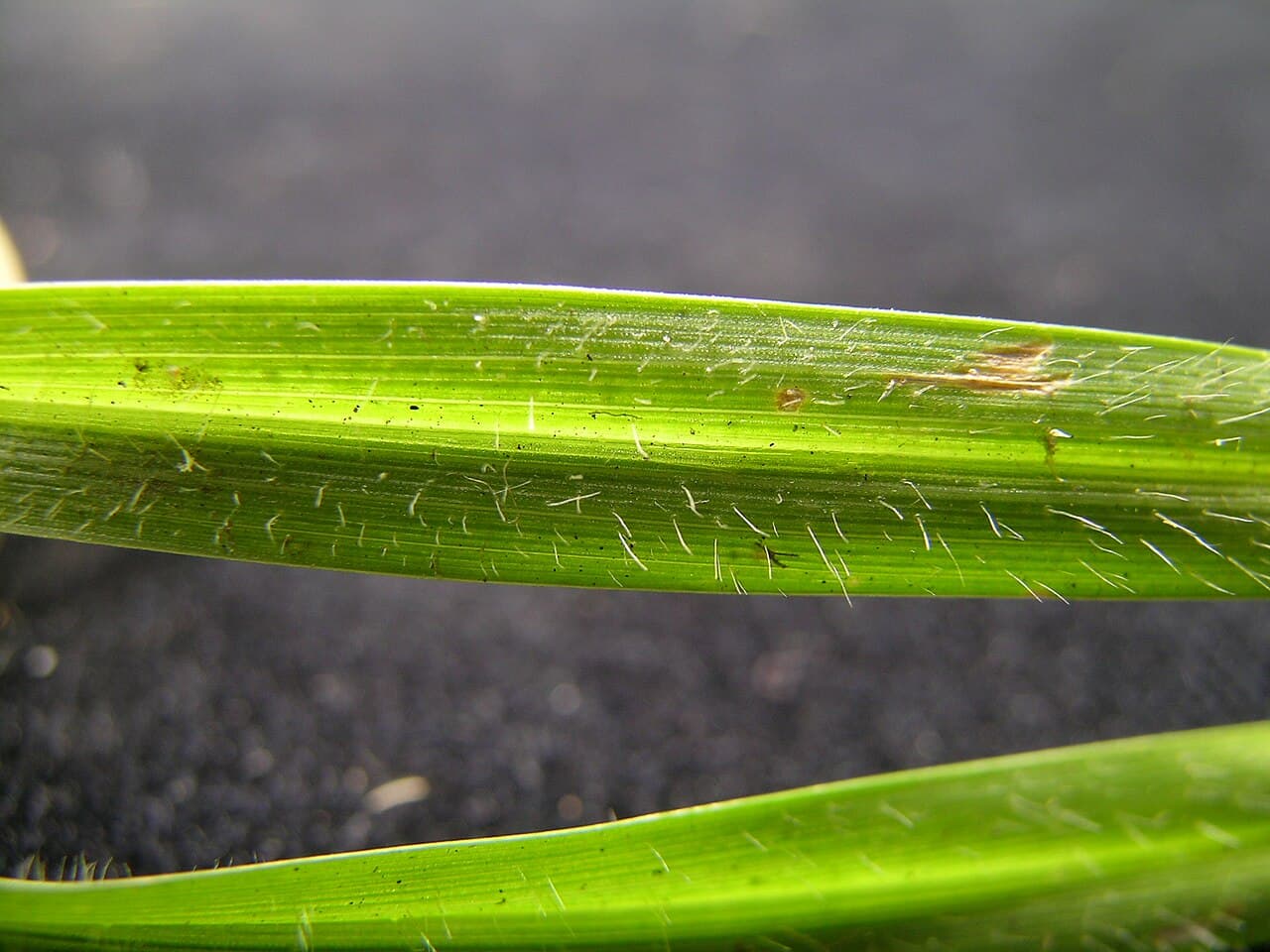
- Light green, flat blades about 1/8 to 1/4 inch wide. They can be smooth or hairy.
- Ligule
- A fringe of fine hairs of uneven length sits where the blade meets the stem.
- Growth habit
- A dense, tough mat of interwoven stems that spreads outward in every direction from where it starts.
- Frost response
- The leaves brown off after frost, but the runners survive and regrow when warm weather returns.
Photo: Harry Rose, Macleay Grass Man · CC BY-SA 2.0 · via Wikimedia Commons
Not sure it's Kikuyu Grass?
Snap a close-up of a few blades — our free AI identifies your grass in seconds. No app needed.
How to fix bare patches in Kikuyu Grass
- 1Work in warm weather, when kikuyu is growing fast. Small bare spots often fill in on their own from the runners around them.
- 2Loosen the bare soil and clear out dead grass so runners can root into it.
- 3Speed things up by planting cut runners. Use pieces with at least three joints, and bury two of the joints with one left above the soil.
- 4For large patches, lay turf that matches your lawn, or sow seed once the soil reaches about 68°F (20°C).
- 5Keep the patch moist until the new growth roots, then water deeply and less often.
- 6If the dead patch had yellow leaves and poor, dying roots, suspect kikuyu yellows, a root disease spread through wet soil by water-borne spores. No fungicide controls it well, so have it confirmed by a local turf adviser before you replant.
Working out how much seed to buy? The grass seed calculator does the math for your square footage.
When to plant or repair Kikuyu Grass
Best time: May–July. Also workable: April, August.
- Grows from
- Sod, sprigs or seed
- Soil temperature
- 68°F (20°C) and rising for seed
Kikuyu can be laid as turf, planted as runners or sown from seed. Whittet is the main seeded variety, while Village Green is supplied as turf.
In Australia or New Zealand? The seasons flip — shift these months by six, or see the Southern Hemisphere lawn calendar.
Kikuyu Grass care at a glance
- Mowing height
- 1–2 in
- Water
- 1 inch per week during growing season
- Sun
- Full sun to light shade (6+ hours ideal)
- Soil pH
- 5.5–7.0
- Fertilizer
- 3 lb nitrogen per 1,000 sq ft a year
- Growth habit
- Stolons and rhizomes
- Texture
- Coarse
- USDA zones
- 9-11
How it holds up
Mowing height by season
| Spring | Summer | Fall | Winter |
|---|---|---|---|
| 1"–1.5" | 1"–1.5" | 1.5"–2" | Dormant |
Varieties you'll see
Want these turned into a month-by-month schedule for your yard? Build a free lawn plan.
Kikuyu Grass pros and cons
Strengths
- Recovers quickly from wear and injury
- Spreads fast to fill bare patches
- Recovers from drought and tolerates acidic and slightly salty soil
- Survives frosts that kill its leaves
- Can be laid as turf, planted from runners or grown from seed
Weaknesses
- Invades garden beds, paths and neighboring lawns
- Does not grow well in heavy shade
- Browns off after frost
- Hard to get rid of, because runner pieces regrow and seed can stay alive in soil for years
- Needs regular mowing and edging in summer
- A federal noxious weed in the US
Problems to watch for
Where Kikuyu Grass grows best
Kikuyu comes from the highlands of East Africa and is widely grown as a lawn in Australia, and it is common in Northland and other warm coastal parts of New Zealand's upper North Island. In the US it has escaped into the wild along the California coast and in Hawaii, and it is a federal noxious weed. The planting months on this page follow the US calendar, so flip them if you live in the Southern Hemisphere, where spring is September to November. Local turf suppliers can tell you the best laying or sowing time for your area.
Commonly confused with
Couch has much finer blades, under 1/8 inch wide, and a seedhead of 3 to 5 thin spikes joined at the top of the stem. Kikuyu's flower heads stay hidden in the leaf sheaths, with only white threads showing.
Buffalo (St. Augustine grass) →
Buffalo has broad blades with blunt tips and spreads only by above-ground runners. Kikuyu blades are usually narrower, and it also spreads by underground rhizomes.
Know your grass? Put it to work →
Get a free 12-month plan built for Kikuyu Grass
Measure your yard on a satellite map in 30 seconds. We'll build a care schedule for kikuyu grass in your climate — mowing height, fertilizer, seed and weed control, with exact product amounts.
Measure my lawn — it's free →Kikuyu Grass FAQ
How do I stop kikuyu spreading into garden beds?
Keep a firm edge between lawn and bed, and trim along it often while the grass is growing. Kikuyu spreads by runners on top of the soil and rhizomes below it, and the runners root at every joint that touches soil. Pull out strays with every piece of stem, because pieces left behind can regrow. A deep, solid edging strip slows it down.
Is kikuyu grass illegal in the US?
At the federal level it is restricted rather than banned outright. Kikuyu is a federal noxious weed, so you need a federal permit to bring it into the US or move it between states. California also lists it as a noxious weed, and planting rules vary by state, so check with your state department of agriculture before you plant or share any kikuyu.
Does kikuyu grow in shade?
Only in light to moderate shade. Kikuyu handles some shade, but it does not grow well in heavy shade, so lawns under dense trees or beside tall fences and houses go thin and patchy. For those spots, a more shade-tolerant grass such as buffalo (St. Augustine) is usually a better fit.
Why is my kikuyu lawn turning yellow?
Frost, hunger or disease are the common causes. Frost browns the leaves in winter, and underfed kikuyu turns pale. Patches that yellow in the warm months and have poor, dying roots may be kikuyu yellows, a root disease caused by a soil-borne, fungus-like organism. Dig up a small piece and check the roots before you treat anything.
Will kikuyu grow back after frost?
Yes, usually. Frost kills the exposed leaves at around 28°F (-2°C), but established kikuyu survives colder snaps, down to about 16°F (-9°C), and regrows from its runners when warm weather returns. Expect a brown lawn after frosty nights until spring.
Other warm-season grasses

Sources
- USDA APHIS: Federal Noxious Weed List
- 7 CFR 360.300: Permit rule for moving federal noxious weeds
- California Department of Food and Agriculture: Kikuyugrass pest rating profile
- UC IPM Weed Gallery: Kikuyugrass
- UC IPM: Kikuyugrass in home landscapes
- UC Guide to Healthy Lawns: Kikuyugrass
- Tropical Forages: Cenchrus clandestinus (kikuyu)
- Tropical Grasslands-Forrajes Tropicales (2021): Disease resistance in kikuyu grass
- NSW Government: Establishing kikuyu pastures
- DairyNZ: Kikuyu
More free lawn tools:
Every lawn grass•Photo grass identifier•Grass seed calculator•Weed guide•Lawn care calendar