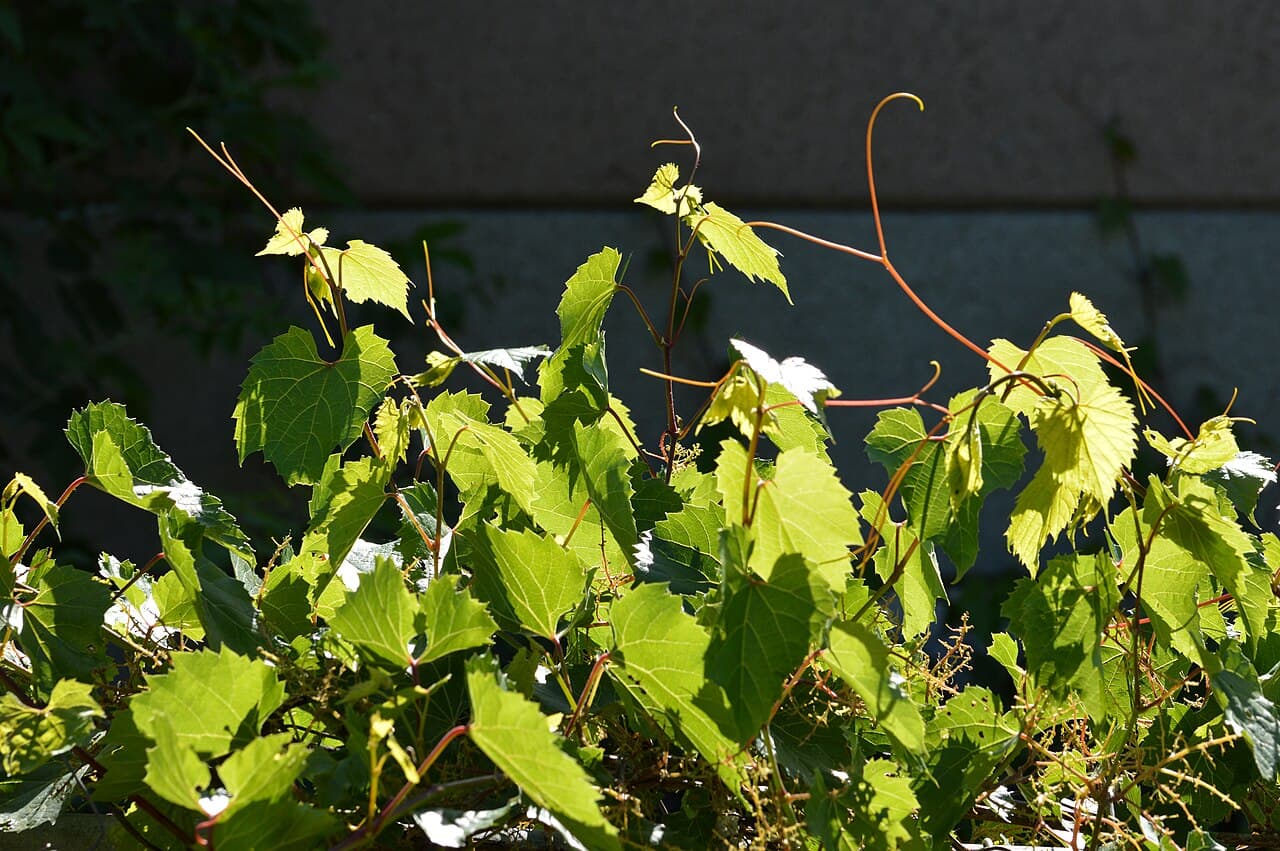
What Wild Grape looks like
A climbing woody vine with big heart-shaped, coarsely toothed leaves and shredding, stringy bark on older stems, hoisting itself up fences and shrubs on forked tendrils that grow opposite the leaves; the dead giveaway is those coiling tendrils with no thorns anywhere on the stem — greenbrier climbs the same way but is armed with stiff prickles.
Photo: Wikimedia Commons
Not sure if it's Wild Grape?
Snap a photo — our free AI compares it to wild grape and tells you in seconds. No app needed.
Best approach: Spray or dig
Seedlings pull cleanly with the root when the soil is damp. Mature vines resprout from roots and cut stumps, so plan on cut-stump treatment plus watching the spot for three to five years. A vine in full sun keeps sprouting indefinitely; one under heavy shade dies back in about three years even without herbicide.
Best products for Wild Grape
Formulated to kill wild grape without wiping out your grass — see the timing and chemistry below.

Hi-Yield Triclopyr Ester (8 oz)
✓ Kills wild grapeTriclopyr is the strongest broadleaf-specific herbicide available to homeowners. When 2,4-D products fail on creeping charlie or wild violet, triclopyr gets the job done.

BioAdvanced All-In-One Weed & Feed (22-0-4)
✓ Kills wild grapeBeginner friendly
Scotts Turf Builder Triple Action1
✓ Kills wild grapeBeginner friendlyPrevents crabgrass for up to 4 months, kills dandelion, clover and other listed broadleaf weeds, and feeds. Apply to wet grass, no more than twice a year. Not for St. Augustine. Its label allows centipede, but centipede does better with a stand-alone weed killer and a lighter feeding.
How much do you need?
Herbicide is dosed by lawn size. Pick your yard size for a quick estimate:
Stop guessing
Get the exact amount for your lawn
Measure your lawn on a satellite map in about 30 seconds, then use its exact square footage to choose the right number of packs.
Measure my lawn free →Prefer to read how satellite measurement works first? See the lawn measuring tool.
As an Amazon Associate, Measure Lawn earns from qualifying purchases.
When to treat Wild Grape
Cut and treat the stump from late summer through autumn, while the plant is moving reserves down to its roots — spring treatments fail because the sap is flowing the other way.
Chemical treatment
For an established vine the method is cut-stump, not spraying: cut the stem a few inches above the ground and paint the fresh cut within minutes with a concentrated triclopyr brush killer (above 8% active ingredient, used undiluted) or a concentrated glyphosate at 20% or more — brush it on with a foam dauber, never a sprayer, and do it late summer through fall when the vine is moving sugars down to its roots. Spring applications fail, because sap is flowing the wrong way. Because you are coating a cut stump rather than the turf, this is safe beside any lawn grass as long as nothing drips. Young grape shoots in an actual lawn are a different job: a three-way broadleaf lawn herbicide (2,4-D + dicamba + mecoprop) takes them out, and grapes are unusually sensitive to it. That three-way is safe at label rates on Kentucky bluegrass, perennial ryegrass, tall fescue, bermudagrass and zoysiagrass; use the low rate only on centipedegrass and St. Augustinegrass, and skip it entirely above 85°F. Never broadcast triclopyr over bermuda, St. Augustine or centipede — it injures all three.
Non-chemical management
Pull seedlings by hand after rain while they are still a single wiry stem — caught in year one that is the whole job. Anything thicker than a pencil: cut it at the base and again at chest height, then pull the severed top out of the shrub rather than leaving it to dry in place. In a regularly mowed lawn, grape never becomes a problem — the mower alone keeps it flat.
How to stop Wild Grape coming back
Birds plant it, so walk fence lines, deck posts and the base of shrubs twice a season and pull anything with a coiling tendril. Expect a flush of seedlings anywhere a tree came down and new light hit the soil.
Stop fighting weeds one by one →
Get your free 12-month AI lawn care plan
A thick, healthy lawn is the best weed killer there is. Measure your yard on a satellite map in 30 seconds — we'll build a personalized schedule (fertilizer, seed, mowing, weed control) so wild grape doesn't come back.
Measure my lawn — it's free →FAQ
What does Wild Grape look like?
A climbing woody vine with big heart-shaped, coarsely toothed leaves and shredding, stringy bark on older stems, hoisting itself up fences and shrubs on forked tendrils that grow opposite the leaves; the dead giveaway is those coiling tendrils with no thorns anywhere on the stem — greenbrier climbs the same way but is armed with stiff prickles.
What's the best way to kill Wild Grape?
Spray or dig. Seedlings pull cleanly with the root when the soil is damp. Mature vines resprout from roots and cut stumps, so plan on cut-stump treatment plus watching the spot for three to five years. A vine in full sun keeps sprouting indefinitely; one under heavy shade dies back in about three years even without herbicide.
Is Wild Grape hard to get rid of?
Wild Grape is rated moderate to control. Consistent treatment over a season usually does the job.
How do I stop Wild Grape coming back?
Birds plant it, so walk fence lines, deck posts and the base of shrubs twice a season and pull anything with a coiling tendril. Expect a flush of seedlings anywhere a tree came down and new light hit the soil.
Other woody weeds
See every weed we cover:
Full weed guide•Photo identifier•Lawn care calendar•Free lawn care plan•Best mowers by size