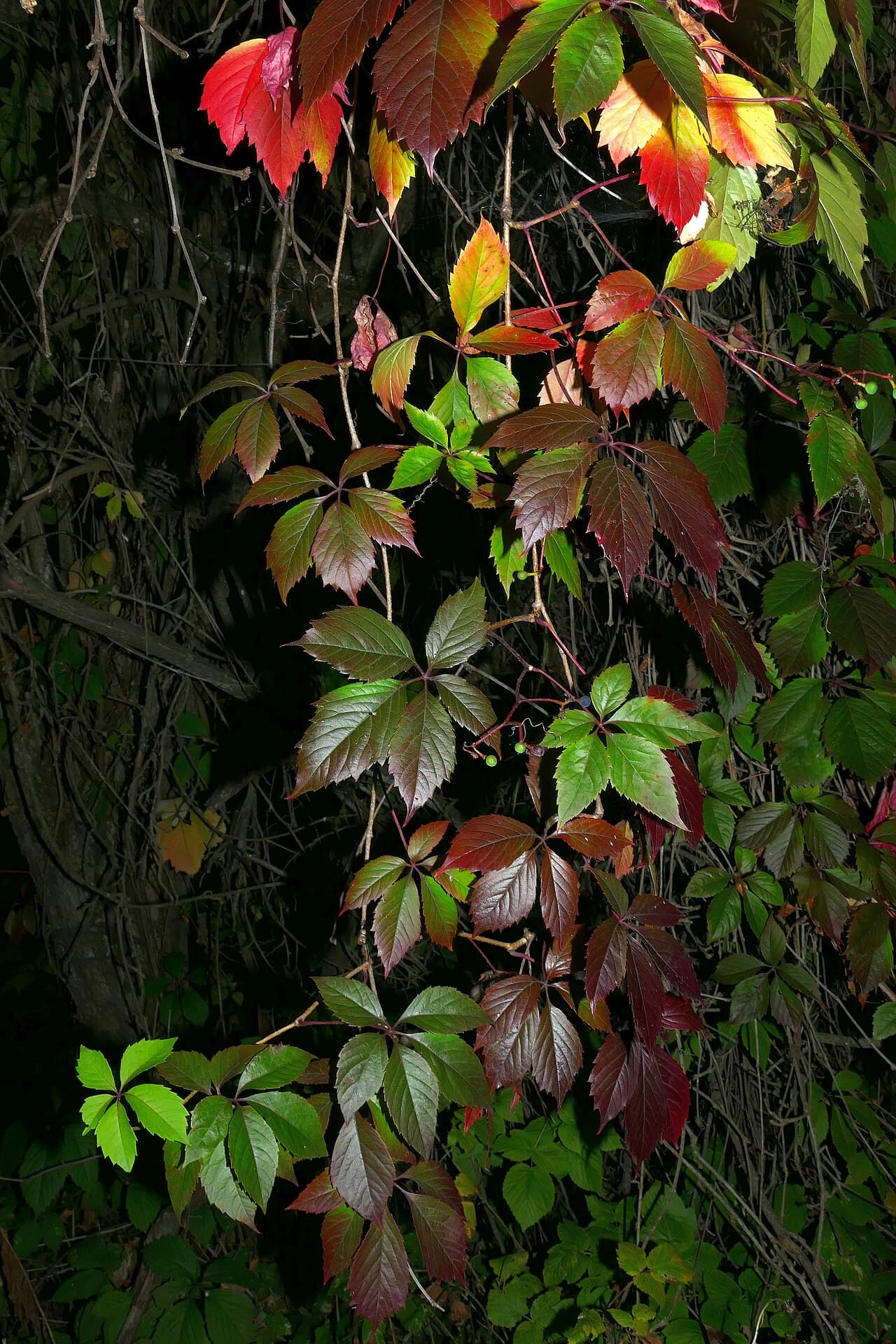
What Virginia Creeper looks like
A woody vine with five toothed leaflets spreading from a single point like fingers, turning fire-engine red in early autumn, that grips brick and bark with tendrils tipped in tiny adhesive suction pads. Before you touch it, count and look: five leaflets and sticky tendril discs mean creeper, three leaflets and a fuzzy hairy stem mean poison ivy.
Photo: Wikimedia Commons
Not sure if it's Virginia Creeper?
Snap a photo — our free AI compares it to virginia creeper and tells you in seconds. No app needed.
Best approach: Spray or dig
The berries are toxic if eaten, so keep children and pets away from a fruiting vine and bag the clippings. Loose stems root wherever they touch soil and birds keep reseeding it, so expect several rounds over more than one season rather than a single afternoon.
Best products for Virginia Creeper
Formulated to kill virginia creeper without wiping out your grass — see the timing and chemistry below.

Hi-Yield Triclopyr Ester (8 oz)
✓ Kills virginia creeperTriclopyr is the strongest broadleaf-specific herbicide available to homeowners. When 2,4-D products fail on creeping charlie or wild violet, triclopyr gets the job done.
How much do you need?
Herbicide is dosed by lawn size. Pick your yard size for a quick estimate:
Stop guessing
Get the exact amount for your lawn
Measure your lawn on a satellite map in about 30 seconds, then use its exact square footage to choose the right number of packs.
Measure my lawn free →Prefer to read how satellite measurement works first? See the lawn measuring tool.
As an Amazon Associate, Measure Lawn earns from qualifying purchases.
When to treat Virginia Creeper
Cut and treat the stump from late summer through autumn, while the plant is moving reserves down to its roots — spring treatments fail because the sap is flowing the other way.
Chemical treatment
This is a bed, fence and tree-trunk problem rather than a lawn weed — regular mowing keeps it out of turf entirely, so nothing here is a broadcast lawn spray. For an established vine, cut it at the base and immediately paint the fresh cut with a concentrated triclopyr brush killer (above 8% active ingredient, undiluted) or concentrated glyphosate at 20% or more, applied with a dauber to the inner bark ring in late summer or early autumn. For foliage in a bed, a 1% glyphosate solution wetting at least half the leaves, late summer through early autumn before the leaves colour up, will suppress it — expect to repeat, because it regrows from an extensive root system. Glyphosate is non-selective and kills every lawn grass it touches, so shield the turf or keep it on the stump. Triclopyr is tolerated by tall fescue, zoysia, Kentucky bluegrass, ryegrass and fine fescue (halve the rate on the last two) but must never be broadcast over bermuda, St. Augustine or centipede. Avoid treating creeper tangled in a tree you want to keep — herbicide can move between plants through grafted roots.
Non-chemical management
Digging is usually the fastest real progress: go after the crown and follow the runners out. Young plants pull up by hand. Peel stems off siding and bark rather than yanking, because the adhesive discs take paint with them. Wear gloves — the sap irritates some skin, and you are often working next to poison ivy.
How to stop Virginia Creeper coming back
Check where birds perch — fence lines, deck rails, shrub interiors — and pull anything with five toothed leaflets while it is still one soft stem. Lift any stem lying across bare soil before it roots at the nodes, which is how a small patch becomes a big one with no new seed at all.
Stop fighting weeds one by one →
Get your free 12-month AI lawn care plan
A thick, healthy lawn is the best weed killer there is. Measure your yard on a satellite map in 30 seconds — we'll build a personalized schedule (fertilizer, seed, mowing, weed control) so virginia creeper doesn't come back.
Measure my lawn — it's free →FAQ
What does Virginia Creeper look like?
A woody vine with five toothed leaflets spreading from a single point like fingers, turning fire-engine red in early autumn, that grips brick and bark with tendrils tipped in tiny adhesive suction pads. Before you touch it, count and look: five leaflets and sticky tendril discs mean creeper, three leaflets and a fuzzy hairy stem mean poison ivy.
What's the best way to kill Virginia Creeper?
Spray or dig. The berries are toxic if eaten, so keep children and pets away from a fruiting vine and bag the clippings. Loose stems root wherever they touch soil and birds keep reseeding it, so expect several rounds over more than one season rather than a single afternoon.
Is Virginia Creeper hard to get rid of?
Virginia Creeper is rated hard to control. It usually requires multiple applications and a consistent plan.
How do I stop Virginia Creeper coming back?
Check where birds perch — fence lines, deck rails, shrub interiors — and pull anything with five toothed leaflets while it is still one soft stem. Lift any stem lying across bare soil before it roots at the nodes, which is how a small patch becomes a big one with no new seed at all.
Other woody weeds
See every weed we cover:
Full weed guide•Photo identifier•Lawn care calendar•Free lawn care plan•Best mowers by size