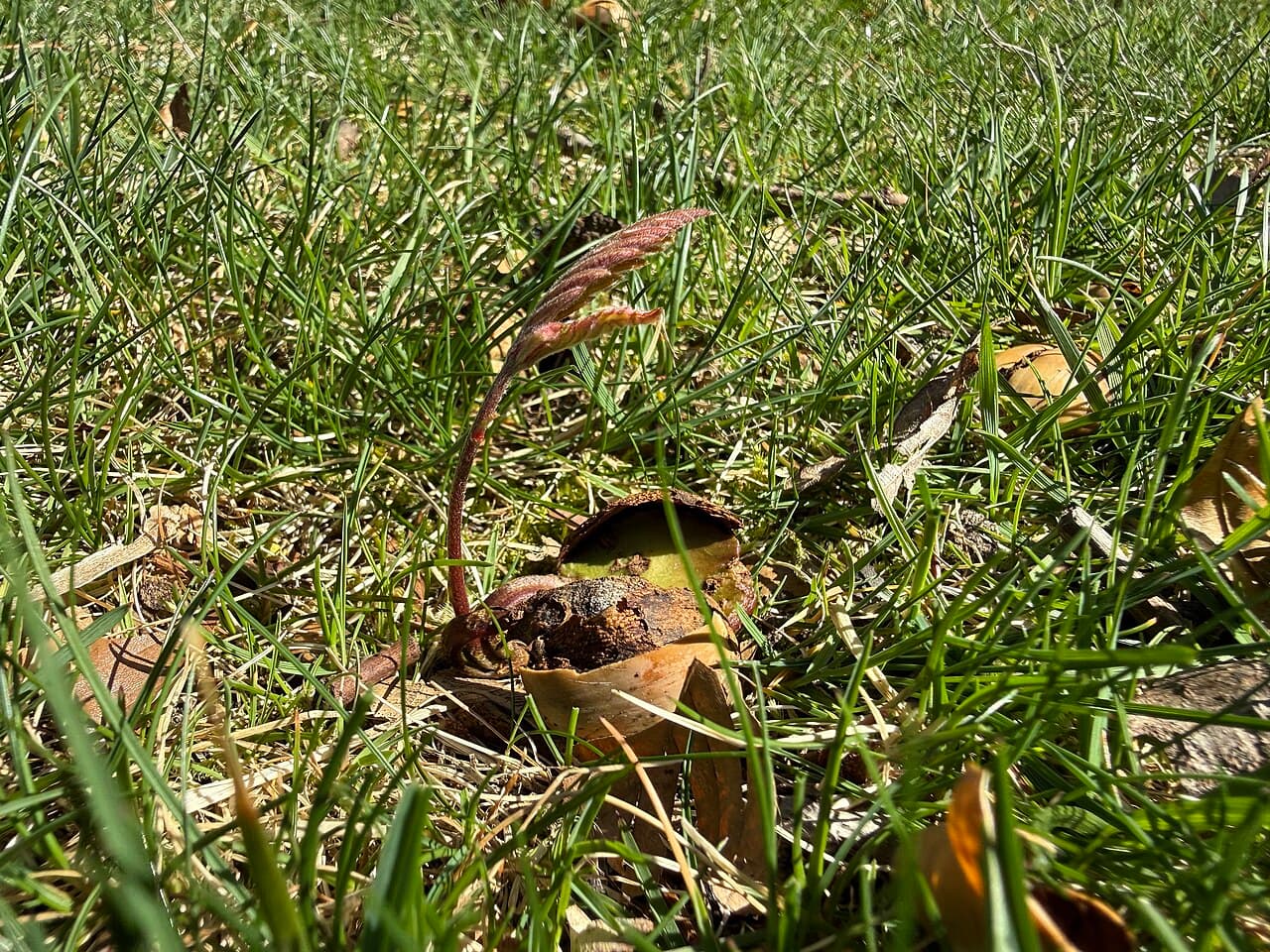
What Tree & Shrub Seedlings looks like
Baby trees and shrubs sprouting where nobody mows — boxelder and maple, wild cherry and chokecherry, Kentucky coffeetree, autumn olive, forsythia — usually in a telltale line along a fence, under a wire, or against the foundation where a bird sat. The giveaway is the stem: stiff, round and already turning woody at the base, with true leaves that look like a miniature tree leaf rather than a weed.
Photo: Wikimedia Commons
Not sure if it's Tree & Shrub Seedlings?
Snap a photo — our free AI compares it to tree & shrub seedlings and tells you in seconds. No app needed.
Best approach: Spray or dig
Big-seeded trees are the exception — acorns and similar carry enough stored energy to keep regrowing through repeated mowing, so dig those out. Autumn olive gets no grace period either: it is invasive, fruits within three years and resprouts hard when cut, so treat the stump or dig it rather than just lopping it.
Best products for Tree & Shrub Seedlings
Formulated to kill tree & shrub seedlings without wiping out your grass — see the timing and chemistry below.

Hi-Yield Triclopyr Ester (8 oz)
✓ Kills tree & shrub seedlingsTriclopyr is the strongest broadleaf-specific herbicide available to homeowners. When 2,4-D products fail on creeping charlie or wild violet, triclopyr gets the job done.
How much do you need?
Herbicide is dosed by lawn size. Pick your yard size for a quick estimate:
Stop guessing
Get the exact amount for your lawn
Measure your lawn on a satellite map in about 30 seconds, then use its exact square footage to choose the right number of packs.
Measure my lawn free →Prefer to read how satellite measurement works first? See the lawn measuring tool.
As an Amazon Associate, Measure Lawn earns from qualifying purchases.
When to treat Tree & Shrub Seedlings
Cut and treat the stump from late summer through autumn, while the plant is moving reserves down to its roots — spring treatments fail because the sap is flowing the other way.
Chemical treatment
Most seedlings in a lawn need no herbicide at all, because the mower already handles them — chemicals are for the one that got past you, went woody, and now resprouts every time you cut it. Use the cut-stump method: cut the stem close to the soil, brush off the sawdust, and within minutes paint the cut face with a concentrated triclopyr brush killer (above 8% active ingredient, undiluted) or concentrated glyphosate at about 20%, using a dauber rather than a sprayer. Late summer through autumn is the right window, when woody plants move reserves down to their roots; spring applications fail against the upward sap flow. A bottle labelled brush killer is not a lawn product: glyphosate is non-selective and kills any grass it lands on, and triclopyr, while tolerated by tall fescue, Kentucky bluegrass, ryegrass and fine fescue, must never be broadcast over bermuda, zoysia, St. Augustine or centipede. Keep both on the stump and off the turf and your grass type stops mattering.
Non-chemical management
Mowing wins, and for most lawns it is the entire treatment — keep mowing at your normal height and seedlings never make it out of the turf. Do not scalp the lawn to hurry it along. Elsewhere, hand-pull when the soil is soaked: grip low and pull straight up so the root comes too, because a sideways yank snaps the stem and it regrows from the crown.
How to stop Tree & Shrub Seedlings coming back
The pattern maps where seed lands and nothing mows: fence bottoms, behind the shed, the mulch line, under bird perches. Trim those strips on the same schedule as the lawn, keep beds mulched two to three inches deep, and the problem mostly disappears.
Stop fighting weeds one by one →
Get your free 12-month AI lawn care plan
A thick, healthy lawn is the best weed killer there is. Measure your yard on a satellite map in 30 seconds — we'll build a personalized schedule (fertilizer, seed, mowing, weed control) so tree & shrub seedlings doesn't come back.
Measure my lawn — it's free →FAQ
What does Tree & Shrub Seedlings look like?
Baby trees and shrubs sprouting where nobody mows — boxelder and maple, wild cherry and chokecherry, Kentucky coffeetree, autumn olive, forsythia — usually in a telltale line along a fence, under a wire, or against the foundation where a bird sat. The giveaway is the stem: stiff, round and already turning woody at the base, with true leaves that look like a miniature tree leaf rather than a weed.
What's the best way to kill Tree & Shrub Seedlings?
Spray or dig. Big-seeded trees are the exception — acorns and similar carry enough stored energy to keep regrowing through repeated mowing, so dig those out. Autumn olive gets no grace period either: it is invasive, fruits within three years and resprouts hard when cut, so treat the stump or dig it rather than just lopping it.
Is Tree & Shrub Seedlings hard to get rid of?
Tree & Shrub Seedlings is rated easy to control. Most homeowners can handle it in one or two treatments.
How do I stop Tree & Shrub Seedlings coming back?
The pattern maps where seed lands and nothing mows: fence bottoms, behind the shed, the mulch line, under bird perches. Trim those strips on the same schedule as the lawn, keep beds mulched two to three inches deep, and the problem mostly disappears.
Other woody weeds
See every weed we cover:
Full weed guide•Photo identifier•Lawn care calendar•Free lawn care plan•Best mowers by size