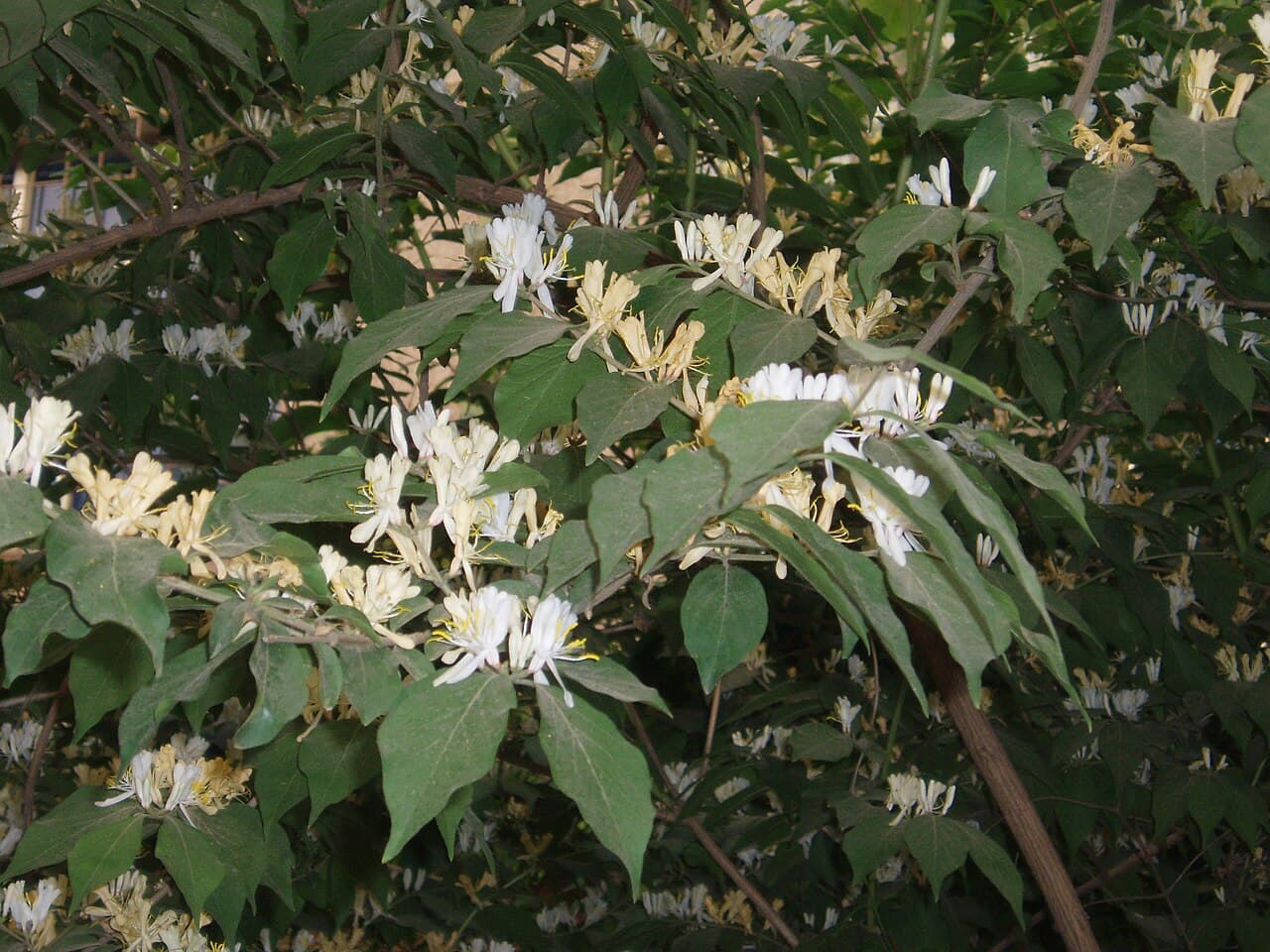
What Bush Honeysuckle looks like
An invasive multi-stemmed shrub with paired oval leaves, paired white-to-yellow (or pink) tubular flowers and paired shiny red berries, growing six to twenty feet in the back corner nobody weeds. Snap a pencil-thick twig for the definitive test: the invasive bush honeysuckles are hollow in the centre, while every native honeysuckle has solid white pith.
Photo: Wikimedia Commons
Not sure if it's Bush Honeysuckle?
Snap a photo — our free AI compares it to bush honeysuckle and tells you in seconds. No app needed.
Best approach: Spray or dig
Cutting alone makes it worse — a cut shrub sprouts back thicker, so either treat the stump or commit to repeated cutting starting in early summer when root reserves are lowest. Seed stays viable about two years and birds keep delivering more, so check the spot each spring for several years.
Best products for Bush Honeysuckle
Formulated to kill bush honeysuckle without wiping out your grass — see the timing and chemistry below.

Hi-Yield Triclopyr Ester (8 oz)
✓ Kills bush honeysuckleTriclopyr is the strongest broadleaf-specific herbicide available to homeowners. When 2,4-D products fail on creeping charlie or wild violet, triclopyr gets the job done.
How much do you need?
Herbicide is dosed by lawn size. Pick your yard size for a quick estimate:
Stop guessing
Get the exact amount for your lawn
Measure your lawn on a satellite map in about 30 seconds, then use its exact square footage to choose the right number of packs.
Measure my lawn free →Prefer to read how satellite measurement works first? See the lawn measuring tool.
As an Amazon Associate, Measure Lawn earns from qualifying purchases.
When to treat Bush Honeysuckle
Cut and treat the stump from late summer through autumn, while the plant is moving reserves down to its roots — spring treatments fail because the sap is flowing the other way.
Chemical treatment
No lawn herbicide touches this — it is a shrub, and a weed-and-feed does nothing at all. Cut every stem low with loppers or a pruning saw and treat the stumps within ten minutes, before the cut seals: concentrated glyphosate at 20–50%, or a concentrated triclopyr brush killer used undiluted, painted on with a dauber. Late summer, autumn and the dormant season all work; avoid spring sap flow, when stump treatments simply fail. Foliar spraying often works even better and is easiest in late autumn, because honeysuckle holds its leaves for weeks after native shrubs go bare — a 2–4% glyphosate or 3–5% triclopyr solution then hits almost nothing else. Both actives demand care around turf: glyphosate is non-selective and kills Kentucky bluegrass, ryegrass, tall fescue, bermuda, zoysia, St. Augustine and centipede alike, and triclopyr must never be broadcast over bermuda, St. Augustine or centipede. Since every method here is a painted stump or a shielded spot spray, you can work beside any lawn grass — the risk is drips and drift, not the technique.
Non-chemical management
Pull it young: honeysuckle is shallow-rooted, and seedlings and small plants come out by hand after a soaking rain, easiest in early spring or late autumn. Hang the pulled roots off the ground so they cannot re-root. Medium plants lever out with a weed wrench. Never simply cut a mature shrub and walk away — it comes back with more stems than it had.
How to stop Bush Honeysuckle coming back
Do one walk in late October, when it is the only green shrub left standing, and pull every seedling you find. Remove any mature honeysuckle you own before it fruits, because one established shrub reseeds the whole neighbourhood via birds.
Stop fighting weeds one by one →
Get your free 12-month AI lawn care plan
A thick, healthy lawn is the best weed killer there is. Measure your yard on a satellite map in 30 seconds — we'll build a personalized schedule (fertilizer, seed, mowing, weed control) so bush honeysuckle doesn't come back.
Measure my lawn — it's free →FAQ
What does Bush Honeysuckle look like?
An invasive multi-stemmed shrub with paired oval leaves, paired white-to-yellow (or pink) tubular flowers and paired shiny red berries, growing six to twenty feet in the back corner nobody weeds. Snap a pencil-thick twig for the definitive test: the invasive bush honeysuckles are hollow in the centre, while every native honeysuckle has solid white pith.
What's the best way to kill Bush Honeysuckle?
Spray or dig. Cutting alone makes it worse — a cut shrub sprouts back thicker, so either treat the stump or commit to repeated cutting starting in early summer when root reserves are lowest. Seed stays viable about two years and birds keep delivering more, so check the spot each spring for several years.
Is Bush Honeysuckle hard to get rid of?
Bush Honeysuckle is rated hard to control. It usually requires multiple applications and a consistent plan.
How do I stop Bush Honeysuckle coming back?
Do one walk in late October, when it is the only green shrub left standing, and pull every seedling you find. Remove any mature honeysuckle you own before it fruits, because one established shrub reseeds the whole neighbourhood via birds.
Other woody weeds
See every weed we cover:
Full weed guide•Photo identifier•Lawn care calendar•Free lawn care plan•Best mowers by size