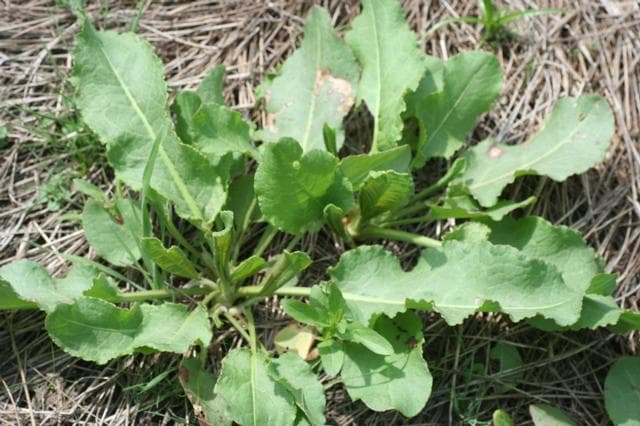
What Curly Dock looks like
A flat rosette of long narrow leaves, 6 to 12 inches each, with distinctly wavy crinkled edges like a ruffled ribbon and often a reddish-purple tinge, sending up a stiff stalk that turns rusty brown and carries dense clusters of papery three-sided seeds.
Photo: Wikimedia Commons
Not sure if it's Curly Dock?
Snap a photo — our free AI compares it to curly dock and tells you in seconds. No app needed.
Best approach: Spray or dig
Either works: dig young plants and take the top 4-6 inches of taproot or it regrows, or spray rosettes in fall. On St. Augustine, centipede and bahia lawns, digging is the ONLY safe option. Once it has bolted, cut the stalk and treat the fresh regrowth instead.
Best products for Curly Dock
Formulated to kill curly dock without wiping out your grass — see the timing and chemistry below.
Paid links. As an Amazon Associate, MeasureLawn earns from qualifying purchases.

BioAdvanced All-In-One Weed & Feed (22-0-4)
✓ Kills curly dockBeginner friendly
Scotts Turf Builder Triple Action1
✓ Kills curly dockBeginner friendlyPrevents crabgrass for up to 4 months, kills dandelion, clover and other listed broadleaf weeds, and feeds. Apply to wet grass, no more than twice a year. Not for St. Augustine. Its label allows centipede, but centipede does better with a stand-alone weed killer and a lighter feeding.

Scotts Turf Builder Weed & Feed5
✓ Kills curly dockBeginner friendlyWeed killer plus 26-0-2 lawn food for dandelion, clover and other listed broadleaf weeds. Apply to wet grass. On bahia, wait until mid-April and the third mowing, and make fall applications before Nov 1. Not for St. Augustine. Its label allows centipede, but centipede does better with a stand-alone weed killer and a lighter feeding.
How much do you need?
Herbicide is dosed by lawn size. Pick your yard size for a quick estimate:
Stop guessing
Get the exact amount for your lawn
Measure your lawn on a satellite map in about 30 seconds, then use its exact square footage to choose the right number of packs.
Measure my lawn free →Prefer to read how satellite measurement works first? See the lawn measuring tool.
When to treat Curly Dock
Spray in spring or fall when temperatures are 60–80°F and the weed is actively growing. Avoid summer heat — stressed grass takes collateral damage.
Chemical treatment
Treat while it is still a flat rosette — fall is the best window for established plants because the taproot is pulling everything downward, and control drops sharply once the flower stalk is up. On cool-season lawns (tall fescue, Kentucky bluegrass, ryegrass, fine fescue) and on bermuda or zoysia, a three-way 2,4-D + dicamba + MCPP works, and products with fluroxypyr or triclopyr are noticeably stronger on dock — but treat bermuda only when fully green, never during green-up, use the lower rate on fine fescue, and keep all of these off bentgrass. On St. Augustine, centipede or bahia, do not use any of these — all of them injure those grasses and most labels prohibit them outright — dig dock out of those lawns instead. Expect a second application 3-4 weeks later; a taprooted dock rarely dies from one spray.
Non-chemical management
Dig young plants out with a spade and take at least the top 4 to 6 inches of the taproot, or it will regrow from what you leave behind. Keep the lawn thick and mowed high, since dock mainly moves into thin, compacted or poorly drained ground.
How to stop Curly Dock coming back
Relieve compaction, fix wet low spots and overseed thin areas so dock seedlings never get a foothold.
Stop fighting weeds one by one →
Get your free 12-month AI lawn care plan
A thick, healthy lawn is the best weed killer there is. Measure your yard on a satellite map in 30 seconds — we'll build a personalized schedule (fertilizer, seed, mowing, weed control) so curly dock doesn't come back.
Measure my lawn — it's free →FAQ
What does Curly Dock look like?
A flat rosette of long narrow leaves, 6 to 12 inches each, with distinctly wavy crinkled edges like a ruffled ribbon and often a reddish-purple tinge, sending up a stiff stalk that turns rusty brown and carries dense clusters of papery three-sided seeds.
What's the best way to kill Curly Dock?
Spray or dig. Either works: dig young plants and take the top 4-6 inches of taproot or it regrows, or spray rosettes in fall. On St. Augustine, centipede and bahia lawns, digging is the ONLY safe option. Once it has bolted, cut the stalk and treat the fresh regrowth instead.
Is Curly Dock hard to get rid of?
Curly Dock is rated moderate to control. Consistent treatment over a season usually does the job.
How do I stop Curly Dock coming back?
Relieve compaction, fix wet low spots and overseed thin areas so dock seedlings never get a foothold.
Other broadleaf weeds
See every weed we cover:
Full weed guide•Photo identifier•Lawn care calendar•Free lawn care plan•Best mowers by size