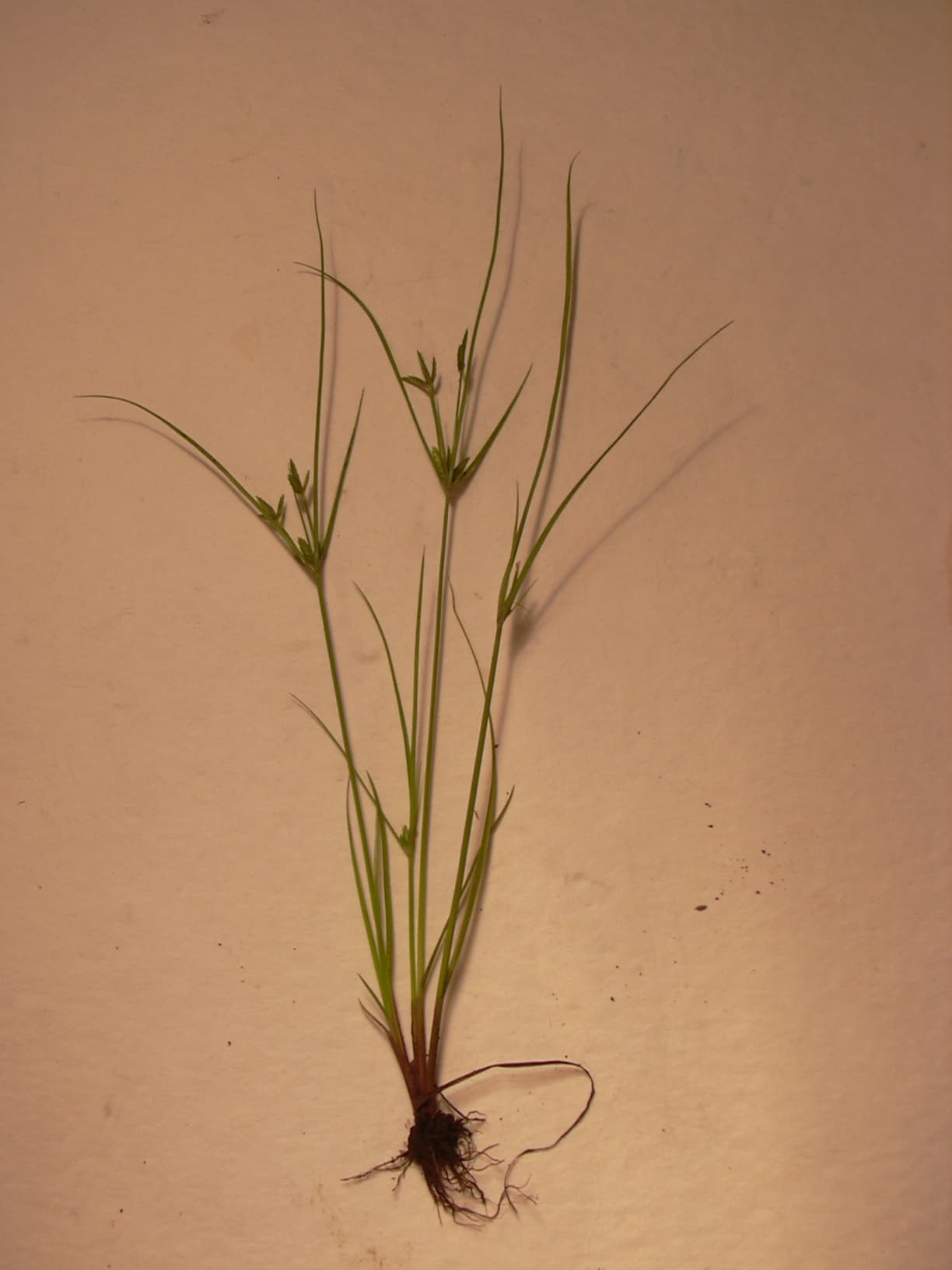
What Annual Sedge looks like
An upright clumpy tuft of glossy grass-like blades on a triangular stem, topped by an unusually large star-shaped head of flat, greenish spikelets with a toothed, comb-like outline — pull one up and you get plain fibrous roots with no nutlets, which is what separates it from nutsedge.
Photo: Wikimedia Commons
Not sure if it's Annual Sedge?
Snap a photo — our free AI compares it to annual sedge and tells you in seconds. No app needed.
Best approach: Spray or dig
It is an annual with no nutlets, so hand-pulling before it seeds actually ends it; a sedge herbicide is only worth buying when there are more clumps than you want to pull.
Best products for Annual Sedge
Formulated to kill annual sedge without wiping out your grass — see the timing and chemistry below.
Paid links. As an Amazon Associate, MeasureLawn earns from qualifying purchases.

SedgeHammer Plus Turf Herbicide (13.5g)
✓ Kills annual sedgeBeginner friendlyThe go-to nutsedge herbicide - targets sedges specifically without harming your lawn grass, and the pre-mixed surfactant means nothing extra to buy.

Blindside Herbicide WDG (8 oz)
✓ Kills annual sedgeProfessional-grade dual-action herbicide. Kills both broadleaf weeds AND sedges in a single application. Extremely concentrated — lasts years for residential use.

Image Kills Nutsedge Concentrate (24 oz)
Beginner friendlyNutsedge and dollarweed on warm-season lawns — attacks tubers underground for lasting control
How much do you need?
Herbicide is dosed by lawn size. Pick your yard size for a quick estimate:
Stop guessing
Get the exact amount for your lawn
Measure your lawn on a satellite map in about 30 seconds, then use its exact square footage to choose the right number of packs.
Measure my lawn free →Prefer to read how satellite measurement works first? See the lawn measuring tool.
When to treat Annual Sedge
Treat in late spring through summer while the sedge is actively growing — dormant plants shrug off herbicide.
Chemical treatment
Halosulfuron (SedgeHammer+, Hi-Yield Nutsedge Control) is the safest homeowner pick, and it is the rare herbicide with no grass restrictions to worry about — the label covers every common lawn grass, cool-season (tall fescue, fine fescue, Kentucky bluegrass, perennial ryegrass, bentgrass) and warm-season (bermuda, zoysia, St. Augustine, centipede, bahia) alike. Spray young, actively growing plants in early to mid summer; it works slowly, so expect about a week before symptoms show and roughly three weeks to full kill, with a repeat spray often needed 6 to 10 weeks later. Sulfentrazone (Ortho Nutsedge Killer for Lawns) burns it down faster and is labeled for that same full range of grasses, but sulfentrazone premixes and combination weed-and-sedge products carry narrower grass lists, so check that your grass is actually named on the bottle you buy. With either product, only treat established turf that is not heat- or drought-stressed and hold off above about 85F — stressed lawns are where temporary yellowing shows up, most visibly on St. Augustine and centipede — and if halosulfuron produces no response after three to four weeks, switch to sulfentrazone rather than respraying, because halosulfuron-resistant annual sedge has been confirmed in the Southeast.
Non-chemical management
Because it is a true summer annual with fibrous roots and no tubers, digging or pulling clumps before the seedheads mature genuinely finishes them — nothing regrows from underground. Thickening the lawn and easing off frequent watering closes the wet, thin patches it germinates into.
How to stop Annual Sedge coming back
Keep the lawn dense and stop over-watering, since annual sedge can only return from seed dropped the previous summer.
Stop fighting weeds one by one →
Get your free 12-month AI lawn care plan
A thick, healthy lawn is the best weed killer there is. Measure your yard on a satellite map in 30 seconds — we'll build a personalized schedule (fertilizer, seed, mowing, weed control) so annual sedge doesn't come back.
Measure my lawn — it's free →FAQ
What does Annual Sedge look like?
An upright clumpy tuft of glossy grass-like blades on a triangular stem, topped by an unusually large star-shaped head of flat, greenish spikelets with a toothed, comb-like outline — pull one up and you get plain fibrous roots with no nutlets, which is what separates it from nutsedge.
What's the best way to kill Annual Sedge?
Spray or dig. It is an annual with no nutlets, so hand-pulling before it seeds actually ends it; a sedge herbicide is only worth buying when there are more clumps than you want to pull.
Is Annual Sedge hard to get rid of?
Annual Sedge is rated easy to control. Most homeowners can handle it in one or two treatments.
How do I stop Annual Sedge coming back?
Keep the lawn dense and stop over-watering, since annual sedge can only return from seed dropped the previous summer.
Other sedge weeds
See every weed we cover:
Full weed guide•Photo identifier•Lawn care calendar•Free lawn care plan•Best mowers by size