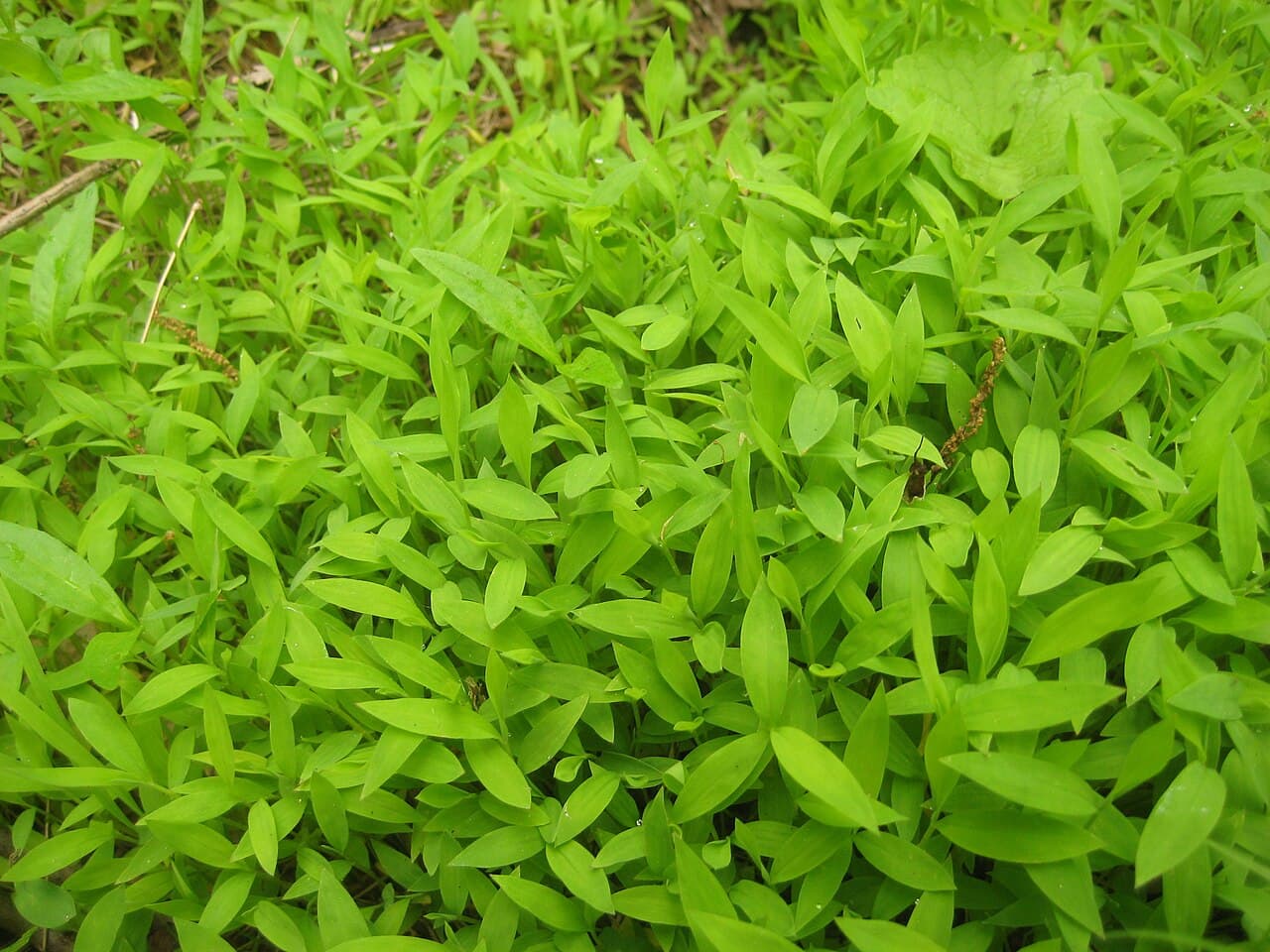
What Japanese Stiltgrass looks like
A sprawling annual grass that looks like miniature bamboo — short, broad, pale-green lance-shaped leaves on thin wiry stems that root wherever a node touches soil, thriving in the shady damp edges where turf gives up. Tilt a leaf to the light for the giveaway: a silvery stripe of reflective hairs runs down the midrib, slightly off-centre. Crabgrass has nothing like it.
Photo: Wikimedia Commons
Not sure if it's Japanese Stiltgrass?
Snap a photo — our free AI compares it to japanese stiltgrass and tells you in seconds. No app needed.
Best approach: Spray or dig
Seed stays viable about five years, so expect to repeat for three to five — though populations crash fast once seed production stops. It also self-pollinates in hidden florets inside the leaf sheaths, so no visible seedhead does not mean no seed. Most consumer crabgrass killers underperform badly on it; the pre-emergent barrier, timed early, is what actually works.
Best products for Japanese Stiltgrass
Formulated to kill japanese stiltgrass without wiping out your grass — see the timing and chemistry below.

The Andersons Barricade Professional-Grade Granular
✓ Kills japanese stiltgrassBeginner friendly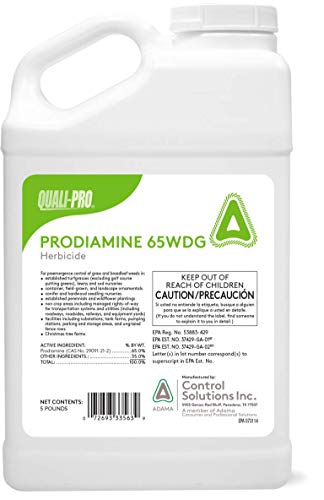
Quali-Pro Prodiamine 65 WDG Pre-Emergent Herbicide
✓ Kills japanese stiltgrassWater-dispersible granules: mix with water and spray. The label caps a year at 0.55 oz per 1,000 sq ft on Kentucky bluegrass and ryegrass and 0.83 oz on warm-season grass and tall fescue; 0.37 oz is 1 lb per acre. Weigh it rather than scooping, water it in with 0.5 inch of rain or irrigation within 14 days, and wait at least 4 months before overseeding.

Scotts Turf Builder Triple Action1
✓ Kills japanese stiltgrassBeginner friendlyPrevents crabgrass for up to 4 months, kills dandelion, clover and other listed broadleaf weeds, and feeds. Apply to wet grass, no more than twice a year. Not for St. Augustine. Its label allows centipede, but centipede does better with a stand-alone weed killer and a lighter feeding.
How much do you need?
Herbicide is dosed by lawn size. Pick your yard size for a quick estimate:
Stop guessing
Get the exact amount for your lawn
Measure your lawn on a satellite map in about 30 seconds, then use its exact square footage to choose the right number of packs.
Measure my lawn free →Prefer to read how satellite measurement works first? See the lawn measuring tool.
As an Amazon Associate, Measure Lawn earns from qualifying purchases.
When to treat Japanese Stiltgrass
Stiltgrass germinates about a month before crabgrass, at 50°F soil temperature — put the pre-emergent down two to four weeks earlier than your usual crabgrass date or it does nothing.
Chemical treatment
The main lever is a pre-emergent barrier, and the timing is the entire story: stiltgrass germinates about a month before crabgrass, once soil hits 50°F, so a normal crabgrass-timed application arrives too late to do anything. Apply prodiamine, pendimethalin or dithiopyr two to four weeks earlier than your usual crabgrass date — late February in the South, mid-March in the mid-Atlantic, late March into early April further north — with a second pass eight to ten weeks later. All three are safe on established Kentucky bluegrass, perennial ryegrass, tall fescue, fine fescue, bermudagrass, zoysiagrass, St. Augustinegrass, centipedegrass and bahiagrass, but never on newly seeded or sodded turf, and they block grass seed as well as weed seed — so seed in autumn, then pre-empt the following late winter. For plants already up, fenoxaprop is the one widely sold selective option and it works on cool-season lawns only: safe on tall fescue, ryegrass and fine fescue, cautiously on Kentucky bluegrass and zoysia, and never on bermudagrass, which it is normally used to kill. On warm-season lawns the honest answer is that no homeowner post-emergent is labelled for it — hand-weed, cut before seed set, and put everything into next spring’s early barrier.
Non-chemical management
One well-timed cut in late July or August — after the flower stalks rise but before seed matures — cuts seed production about as effectively as mowing all season, and it is the highest-value free move you have. Scalp patches with a string trimmer in that same window, bag the clippings, and never compost seed-bearing plants. Hand-pulling is easy: the roots are shallow and fibrous and a whole handful lifts after rain.
How to stop Japanese Stiltgrass coming back
Run the early barrier every year in any lawn that has had it, and set the date by soil temperature rather than the crabgrass adverts. Patrol the first twenty feet where lawn meets woods, ditch or path — that band is where every infestation starts — and clean the mower deck after cutting near a woodland edge.
Stop fighting weeds one by one →
Get your free 12-month AI lawn care plan
A thick, healthy lawn is the best weed killer there is. Measure your yard on a satellite map in 30 seconds — we'll build a personalized schedule (fertilizer, seed, mowing, weed control) so japanese stiltgrass doesn't come back.
Measure my lawn — it's free →FAQ
What does Japanese Stiltgrass look like?
A sprawling annual grass that looks like miniature bamboo — short, broad, pale-green lance-shaped leaves on thin wiry stems that root wherever a node touches soil, thriving in the shady damp edges where turf gives up. Tilt a leaf to the light for the giveaway: a silvery stripe of reflective hairs runs down the midrib, slightly off-centre. Crabgrass has nothing like it.
What's the best way to kill Japanese Stiltgrass?
Spray or dig. Seed stays viable about five years, so expect to repeat for three to five — though populations crash fast once seed production stops. It also self-pollinates in hidden florets inside the leaf sheaths, so no visible seedhead does not mean no seed. Most consumer crabgrass killers underperform badly on it; the pre-emergent barrier, timed early, is what actually works.
Is Japanese Stiltgrass hard to get rid of?
Japanese Stiltgrass is rated hard to control. It usually requires multiple applications and a consistent plan.
How do I stop Japanese Stiltgrass coming back?
Run the early barrier every year in any lawn that has had it, and set the date by soil temperature rather than the crabgrass adverts. Patrol the first twenty feet where lawn meets woods, ditch or path — that band is where every infestation starts — and clean the mower deck after cutting near a woodland edge.
Other grassy weeds
See every weed we cover:
Full weed guide•Photo identifier•Lawn care calendar•Free lawn care plan•Best mowers by size