Warning: serious property risk
Japanese knotweed is one of the most destructive plants that can show up on a property. Its rhizomes exploit and widen existing cracks in foundations, drains, driveways, patios, and retaining walls, and it regrows from a fragment the size of a fingernail. Left unchecked it can lower property value, is expensive to eradicate, and readily spreads onto neighboring land — which in many areas makes containing it your responsibility. Do not dig or string-trim a mature stand; cutting and disturbance only spread it. Treat early shoots promptly, and get a professional assessment for anything established.
What Knotweed (Japanese and Giant) looks like
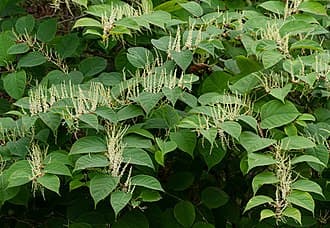
Fast-growing, bamboo-like canes 3–10 feet tall with hollow, reddish-speckled stems, broad shovel- or heart-shaped leaves arranged in a zig-zag up the stem, and sprays of small creamy-white flowers in late summer.
Photo: Wikimedia Commons
Not sure if it's Knotweed (Japanese and Giant)?
Snap a photo — our free AI compares it to knotweed (japanese and giant) and tells you in seconds. No app needed.
Best approach: Herbicide spray
This is the hardest weed on this list to remove, and it is worth taking seriously. The rhizomes run up to about 7 feet deep and many feet sideways, so digging almost never gets it all — and any fragment left behind regrows. There is no quick fix: stem-inject or spray glyphosate in late summer into fall and repeat for several years. For anything more than a single fresh shoot — especially near your home, drains, or a property boundary — get a professional knotweed assessment rather than taking on a mature stand yourself.
When to treat Knotweed (Japanese and Giant)
Spray in spring or fall when temperatures are 60–80°F and the weed is actively growing. Avoid summer heat — stressed grass takes collateral damage.
Chemical treatment
Glyphosate is the only thing that reliably works, and it has to reach the rhizomes. The most effective DIY method is stem injection — injecting concentrated glyphosate directly into each hollow cane in late summer into fall, when the plant is moving energy down to its roots. Foliar spraying works too but needs more repeat applications. Plan on treating for 3–5 years before the rhizomes are truly dead; for an established stand, a licensed knotweed specialist gets faster, more reliable results.
No catalog product confirmed yet
We do not currently have a product in our catalog confirmed for knotweed (japanese and giant). Follow the treatment guidance below and check any product label for your turf before applying.
Glyphosate is the only thing that reliably works, and it has to reach the rhizomes. The most effective DIY method is stem injection — injecting concentrated glyphosate directly into each hollow cane in late summer into fall, when the plant is moving energy down to its roots. Foliar spraying works too but needs more repeat applications. Plan on treating for 3–5 years before the rhizomes are truly dead; for an established stand, a licensed knotweed specialist gets faster, more reliable results.
Use the removal and non-chemical management steps below for this species. A thick, healthy lawn helps resist new invasions; measure your lawn to build a plan that keeps it dense.
Non-chemical management
Never cut, mow, string-trim, dig, or rototill knotweed — every fragment of cane or rhizome can root and start a new plant, and disturbance only helps it spread. Do not compost it or bag it with normal yard waste; many areas regulate how invasive-plant material is disposed of, so check your local rules. Patient, repeated herbicide — not mechanical removal — is what actually clears it.
How to stop Knotweed (Japanese and Giant) coming back
Treat new shoots the moment you spot them, before a clump establishes. Never move soil that may contain rhizome fragments, and clean tools and boots after working near it so you do not carry it elsewhere.
Stop fighting weeds one by one →
Get your free 12-month AI lawn care plan
A thick, healthy lawn is the best weed killer there is. Measure your yard on a satellite map in 30 seconds — we'll build a personalized schedule (fertilizer, seed, mowing, weed control) so knotweed (japanese and giant) doesn't come back.
Measure my lawn — it's free →FAQ
What does Knotweed (Japanese and Giant) look like?
Fast-growing, bamboo-like canes 3–10 feet tall with hollow, reddish-speckled stems, broad shovel- or heart-shaped leaves arranged in a zig-zag up the stem, and sprays of small creamy-white flowers in late summer.
What's the best way to kill Knotweed (Japanese and Giant)?
Herbicide spray. This is the hardest weed on this list to remove, and it is worth taking seriously. The rhizomes run up to about 7 feet deep and many feet sideways, so digging almost never gets it all — and any fragment left behind regrows. There is no quick fix: stem-inject or spray glyphosate in late summer into fall and repeat for several years. For anything more than a single fresh shoot — especially near your home, drains, or a property boundary — get a professional knotweed assessment rather than taking on a mature stand yourself.
Is Knotweed (Japanese and Giant) hard to get rid of?
Knotweed (Japanese and Giant) is rated hard to control. It usually requires multiple applications and a consistent plan.
How do I stop Knotweed (Japanese and Giant) coming back?
Treat new shoots the moment you spot them, before a clump establishes. Never move soil that may contain rhizome fragments, and clean tools and boots after working near it so you do not carry it elsewhere.
Other broadleaf weeds
See every weed we cover:
Full weed guide•Photo identifier•Lawn care calendar•Free lawn care plan•Best mowers by size