How to Measure Your Lawn (And Why Getting It Wrong Costs You Hundreds)
Most homeowners guess their lawn size. That guess costs them $50–$200 every single year in wasted fertilizer, herbicide, and seed. Here's how to get your number right — and why it changes everything.
You just bought a bag of Scotts Turf Builder. The label says it covers 5,000 square feet. You look at your yard, shrug, and figure that sounds about right.
Except your lawn is actually 7,800 square feet. You under-applied by 36%. The fertilizer barely does anything, weeds fill the gaps, and three weeks later you're back at the hardware store buying another bag — spending double what you needed.
This happens to millions of homeowners every year, and it's completely avoidable.
Why Does Your Lawn Size Matter So Much?
Every lawn care product on the shelf is dosed by square footage. Fertilizer, pre-emergent herbicide, grass seed, grub control — all of it. The math is simple: wrong square footage equals wrong amount of product.
Under-apply pre-emergent and crabgrass punches through the gaps. Over-apply fertilizer and you burn your grass into brown streaks that take weeks to recover. Spread too little seed and your overseeding project looks like a patchy afterthought.
The margin for error is smaller than most people think. With pre-emergent herbicide, leaving even 15% of your lawn untreated creates an open door for weeds. With fertilizer, applying 50% more than needed doesn't make your grass 50% greener — it makes it 100% dead in the spots where granules piled up.
Consider a real example: a homeowner with a 6,000 square foot lawn applies fertilizer as if their lawn were 4,500 square feet. They're under-applying by 25%, which means weaker nutrient availability during peak growth seasons. In late spring and early fall, when your lawn needs nitrogen most for density and color, that deficit becomes visible — the grass appears slightly pale or thin compared to a properly fertilized neighbor's yard. By the time you notice, recovery takes an extra month or more.
Can You Accurately Estimate Your Lawn Size by Eye?
Humans are terrible at estimating area. Studies show most people overestimate small spaces and underestimate large ones. A lawn that "looks like" 4,000 square feet might be 6,500. A yard that "seems huge" might only be 3,200 once you subtract the driveway, house footprint, garden beds, and patio.
And that subtraction matters. Your property might be 10,000 square feet total, but your actual turf area — the grass you're treating — could be half that after you remove hardscapes and landscaping. Buying product for 10,000 square feet when you only have 5,000 square feet of grass is burning money.
Here's why the eyeball method fails so consistently: when you stand in your yard looking at your grass, you're at ground level with a limited perspective. You can't easily visualize how the irregular edges of your lawn fit together, and you forget to mentally "subtract" areas that look negligible at eye level. That back corner that's only 6 feet wide? Seems small when you're standing there, but if it runs 40 feet deep, that's 240 square feet you might forget to count. Multiply that by several "small" areas (the planting bed, the patio border, the driveway edge), and your estimate can easily be off by 20–40%.
What Are the Best Ways to Measure Your Lawn?
Method 1: Walk It Off (Least Accurate)
One average adult stride is roughly 2.5 feet. Walk the length and width of your yard, multiply, and you have a rough rectangle. For irregular shapes, break the yard into smaller rectangles and add them up.
This method gets you within about 25% of your actual size — better than guessing but still imprecise enough to cause over- or under-application problems. The error compounds when your lawn has curves or angled edges. A corner lot or a lot with a curved driveway can introduce 15–20% error just from that single feature. Plus, pacing depends on your stride length, which varies by height, age, and how carefully you're counting. One person's 100 paces might equal another person's 95 paces, and that difference amplifies across a large property.
Method 2: Use a Measuring Wheel ($20–$40)
A measuring wheel rolls along the ground and counts distance mechanically. Walk the perimeter, note the measurements, and calculate area. More accurate than pacing, but still tedious for irregular yards, and you still need to subtract non-grass areas manually. Popular options like the Keson measuring wheel or Stanley telescoping wheel are durable and reliable, but they take 30–45 minutes for most residential lawns because you have to measure every edge and manually calculate the resulting area. You also need to account for elevation changes — if your yard is sloped, the wheel measures the ground distance, not the true horizontal distance, which can introduce 5–10% error on hilly properties.
Method 3: Satellite Measurement (Most Accurate)
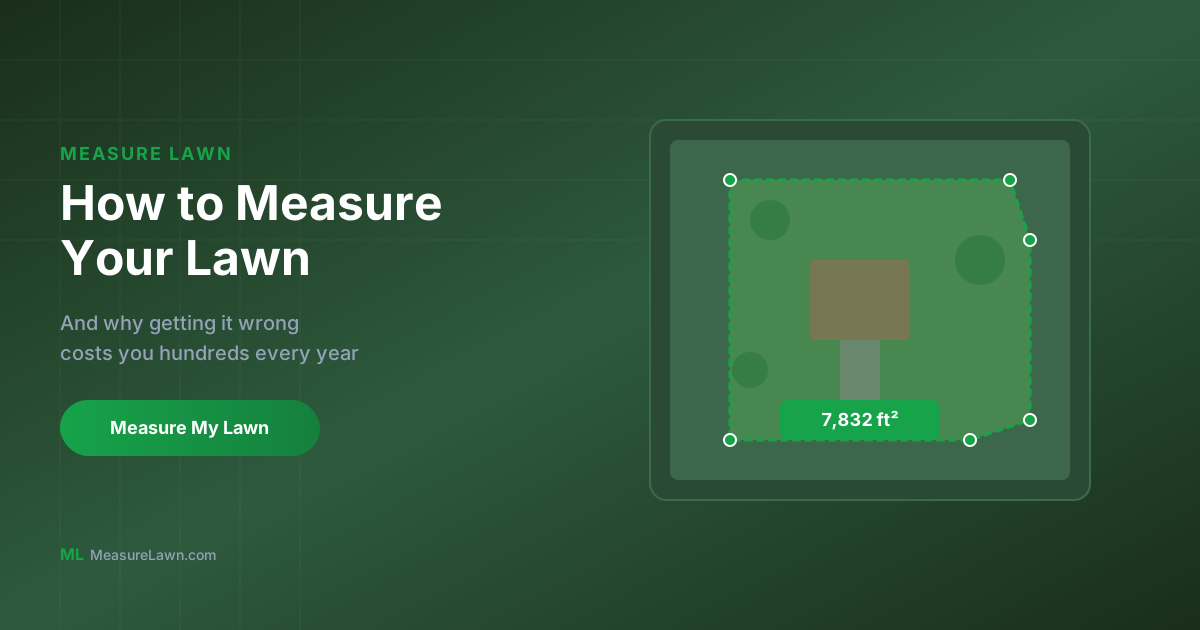
Modern satellite imagery lets you trace the exact outline of your lawn from overhead, automatically calculating the area to within a few percent. You can see your driveway, garden beds, and patio from above, so you trace around only the grass.
This is what we built MeasureLawn to do. You type in your address, we pull up a satellite view of your property, and you trace the areas that are actually grass. The tool calculates your precise square footage in seconds, and that number feeds directly into your personalized lawn care plan — every product recommendation, every quantity calculation, every bag count is based on your real lawn size. The satellite imagery we use is accurate to within a few feet, and the tracing tool snaps to property lines and edges, reducing human error to nearly zero. For a complex lot with multiple grass areas, beds, or hardscapes, this method saves you both time and frustration compared to field measurements.
How Does Knowing Your Exact Lawn Size Save You Money?
Once you know your actual lawn size, everything clicks into place.
Product quantities become exact. Instead of guessing how many bags of fertilizer you need, you know. For a 7,800 square foot lawn, you need two bags of a product that covers 5,000 square feet — not one, not three. You buy right the first time and stop wasting trips to the store. This is especially important with premium products like Scotts Turf Builder Advanced, which costs $25–$35 per bag. Buying the right quantity saves $25–$70 per application, and most homeowners make four to six applications per year.
Your annual budget becomes predictable. Lawn care for a 5,000 square foot lawn costs roughly $200–$500 per year in products. For a 10,000 square foot lawn, that doubles. Knowing your size means you can budget accurately instead of getting surprised at checkout. You can also compare the true cost per square foot between products — some premium fertilizers cost slightly more per bag but cover more area, changing the real price calculus.
Seasonal plans become actionable. A lawn care calendar that says "apply pre-emergent in March" is vague. A plan that says "spread 2 bags of Scotts Halts across your 8,200 square feet when soil hits 55°F" is something you can actually execute. You know exactly what to buy before you go to the store, you know when to apply it (Scotts Halts covers 8,000 square feet per bag), and you can set phone reminders based on your actual location's soil temperature.
Overseeding and renovation projects stop failing. Seed rates are typically 5–10 pounds per 1,000 square feet depending on grass type. On a 6,000 square foot lawn, that's 30–60 pounds of seed. Get that number wrong and you either waste seed or leave bare patches that weeds colonize immediately. With your exact square footage, you order the precise amount for your grass type — whether that's fine fescue (which needs less seed due to fine blade size) or tall fescue (which germinates spottily and needs denser seeding). This prevents both waste and failure.
How Much Does Guessing Your Lawn Size Actually Cost?
Let's do the math on a hypothetical 7,500 square foot lawn where the homeowner thinks they have 5,000 square feet.
Over a typical year, they'd apply spring fertilizer, pre-emergent, summer fertilizer, fall fertilizer, and grub control — five applications. Under-applying each one by 33% means weaker results across the board: thinner grass, more weed breakthrough, less root development heading into winter. That's not just cosmetic — thin grass in fall means shallow roots going into dormancy, which makes the lawn more vulnerable to winter kill and spring thin-out.
To compensate, they end up making extra trips for additional product, spot-treating weeds that shouldn't have appeared, and reseeding patches that failed because the initial seeding rate was too low. Conservative estimate: $100–$200 in wasted product and time per year. But that's just the direct cost. The indirect costs include: a less attractive lawn (affecting curb appeal and property value perception), more hand-pulling or herbicide applications to combat weed breakthrough, and potential lawn damage from over-application when the homeowner finally realizes their calculation was wrong and tries to "catch up."
Over five years, that's $500–$1,000 — all because of a number they could have gotten right in 60 seconds. And if the lawn's condition degrades enough to require renovation (aeration, overseeding, or topdressing), you could be looking at $500–$2,000 in professional services that wouldn't have been necessary with proper initial dosing.
What's the Easiest Way to Get Your Lawn Measured?
Your lawn size is the foundation of every decision you'll make about lawn care. Get it right and everything downstream — product selection, quantities, timing, budget — falls into place. Whether you choose the walk-it-off method (fast but rough), a measuring wheel (accurate but time-consuming), or satellite measurement (accurate and instant), the key is doing it once and using that number consistently.
For most homeowners, satellite measurement is the best balance of accuracy and effort. You get a number that's accurate to within 1–3%, you don't have to spend an afternoon measuring, and you can see your property from above to verify the boundary yourself. If you've got a simple rectangular lot with clear grass boundaries, the walk-it-off method takes 10 minutes and gets you within 15% accuracy, which is good enough for most casual applications. If you're doing a major renovation, overseeding project, or applying expensive specialty products, satellite measurement is worth the extra few minutes.
MeasureLawn gives you that number for free — no account needed, takes 2 minutes. Type in your address, draw your lawn boundary on real satellite imagery, and get your exact square footage instantly. From there, we build you an AI-customized month-by-month plan with the specific products and quantities your lawn needs — down to the bag. You'll also get soil temperature alerts so you know when pre-emergent and grub control applications will be most effective in your region — another layer of precision that ensures you're not just applying the right amount, but at the right time.
Ready to measure your lawn?
Get a free, AI-customized lawn care plan with exact product quantities for your property.
Measure My Lawn — It's Free →