Best Lawn Mower 2026: Free AI Tool That Matches a Mower to Your Yard
See how many passes each mower takes on YOUR lawn. Our free AI tool analyzes your yard size, slopes, and gate widths to recommend the most efficient mower for your property.
Why Every "Best Mower" List Gets It Wrong
Google "best lawn mower 2026" and you'll find dozens of lists ranking mowers by brand, price, or star ratings. The problem? A mower that's perfect for a flat 5,000 square foot lot in Ohio is completely wrong for a sloped half-acre in Tennessee with a 30-inch side gate.
The best lawn mower isn't a universal answer. It depends on three things most reviews ignore: how big your lawn actually is, what your terrain looks like, and whether the mower physically fits through your access points. That's exactly what our free comparison tool figures out.
Mowers worth considering
From budget push mowers to robotic — compare before you buy.
As an Amazon Associate, Measure Lawn earns from qualifying purchases.
Watch It in Action
What Makes This Different From a Spec Sheet
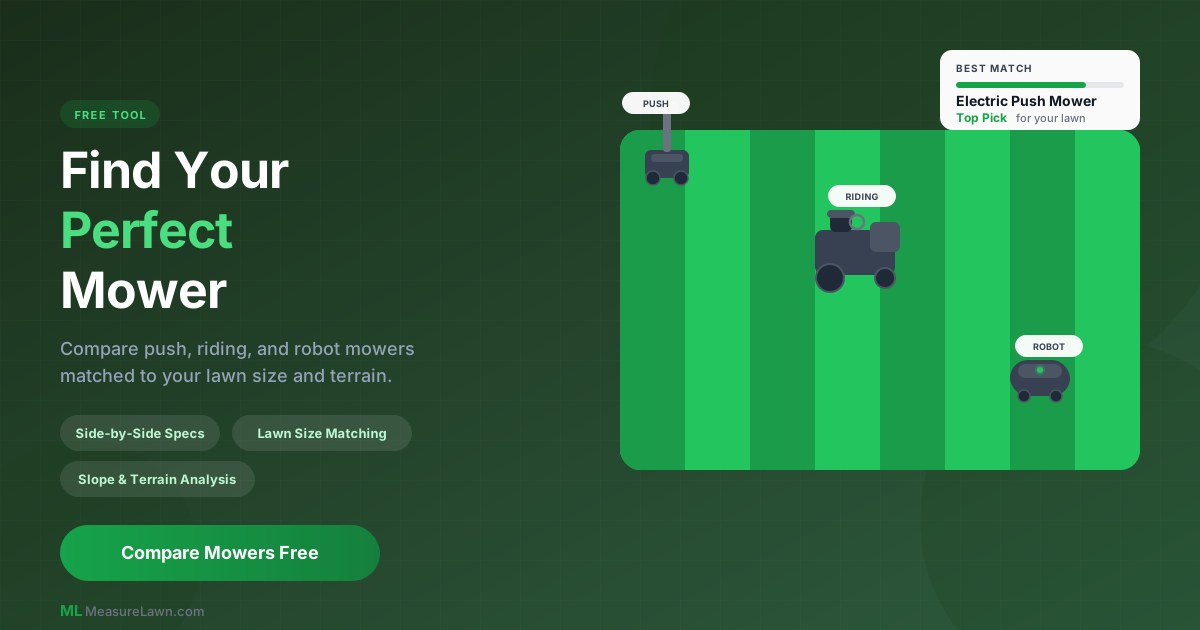
Most mower comparisons show you a table of numbers. Ours shows you what each mower actually looks like mowing YOUR lawn. You map your lawn on satellite imagery (takes about 2 minutes), and the tool instantly analyzes your property. Then it does something no review article can -- it simulates every mower on your actual lawn and ranks them by efficiency.
It Visualizes Mowing Passes on Your Lawn
This is the feature that changes everything. Click any mower and watch an animated mowing path overlay on your actual property map. A 21-inch push mower might need 64 passes across your lawn. A 42-inch zero-turn does it in 32. You can literally see the difference -- the stripe pattern, the turn-arounds, the total coverage. It makes spec sheets feel pointless.
AI Analyzes Your Yard Specifics
The tool doesn't just measure square footage. It uses AI to analyze the specific challenges of your property:
Slope detection. Using elevation data, it measures the actual grades across your yard. That gentle hill in your backyard might be 15 degrees -- steep enough to make a standard push mower a real workout and a reel mower dangerous. The tool flags which mowers can handle your terrain and which ones can't.
Maximum width passing points. Got a 36-inch gate between your house and fence? The tool knows which mowers physically fit through and which don't. It checks body width (not just cutting width) against your narrowest access point. No more buying a mower you can't get to your back lawn.
Yard size efficiency. A compact 20-inch push mower on a 15,000 square foot lawn means two hours of walking in the sun. The tool calculates actual mowing time for each mower on your specific lawn and recommends the most efficient option -- whether that's stepping up to self-propelled, a wider deck, or even a riding mower.
It Tells You the Best Mower Before You See a Single Product
Before you browse any mower cards, you get a plain-English AI briefing: "Your lawn is 9,700 square feet with gentle slopes and a 36-inch side gate. A self-propelled mower with a 21-inch deck is ideal. Your terrain is also suitable for a robotic mower." No jargon. Just what your lawn needs.
The 2026 Mower Categories, Ranked for Your Lawn
The tool compares 26 real mowers you can buy today across six categories. Here's what each is best for:
Push Mowers
Best for flat lawns under 5,000 sq ft. Cheapest option, minimal maintenance. The tool shows you exactly how many passes you'll make -- if it's over 60, you probably want to step up.
Self-Propelled Mowers
The sweet spot for most homeowners. The drive system handles slopes and larger lawns (5,000-12,000 sq ft) without exhausting you. The tool checks whether your slopes actually justify the upgrade -- if your yard is flat, you might not need it.
Reel Mowers
The cleanest cut available -- scissors vs. tearing. Great for small, flat lawns under 3,000 sq ft. But the tool will warn you if your yard has any slopes above 10 degrees, where reel mowers become impractical.
Robotic Mowers
Set it and forget it. The tool checks if your lawn size and slopes fall within robotic mower capabilities. For lawns under 10,000 sq ft with moderate terrain, these are increasingly the smartest choice in 2026.
Riding Mowers
When your lawn crosses 12,000+ sq ft, walking stops making sense. The tool shows the dramatic difference in pass count -- a riding mower might cut your mowing time from 90 minutes to 25.
Zero-Turn Mowers
Maximum efficiency for large, open lawns. The pass visualization really shines here -- you can see how the zero-turn radius eliminates wasted motion compared to a standard riding mower.
Electric vs. Gas in 2026
Battery technology has caught up. For lawns under 10,000 sq ft, electric mowers match gas in every category that matters: power, cut quality, and reliability. No oil changes, no spark plugs, no gas station trips, and significantly quieter operation.
The tool lets you toggle between Electric and Gas to compare the best of each on your specific lawn. For many homeowners in 2026, the answer is electric -- but the tool shows you if your lawn size pushes you into gas territory where runtime matters.
How to Find Your Best Mower (Takes 3 Minutes)
Go to measurelawn.com/lawn-calculator and enter your address.
Draw your lawn boundary on the satellite image. Mark your house, driveway, and any flower beds. The tool calculates your exact lawn area.
Open the Mowers tab in your lawn plan. Your top 3 AI-recommended mowers appear immediately, scored against your lawn.
Filter by type -- toggle between All, Electric, Gas, and Robot to compare the best in each category for your yard.
Set your gate width if you have a narrow access point. Recommendations update instantly, filtering out anything that won't fit.
Click any mower to watch the mowing path animation on your lawn map. Compare a 21-inch push mower against a 42-inch riding mower on your actual property.
Stop Reading Reviews, Start Seeing the Difference
The best lawn mower for 2026 isn't the one with the most Amazon stars. It's the one that fits your lawn, your terrain, and your gate. Map your lawn once and let the data decide.
Map your lawn and find your perfect mower -- it's free, takes 3 minutes, and you'll know exactly which mower to buy before you set foot in a store.
Ready to measure your lawn?
Get a free, AI-customized lawn care plan with exact product quantities for your property.
Measure My Lawn — It's Free →