Push Mowing Your Lawn: The Backyard Workout That Burns More Calories Than You Think
Who knew that your Saturday morning lawn care routine could rival a trip to the gym? Push mowing—the kind where you do the work and the mower doesn't—is one of the most underrated forms of exercise hiding in plain sight. If you've ever finished mowing your lawn and felt genuinely tired, there's a reason: you just completed a legitimate cardio and strength-training session. Let's explore why putting in the elbow grease with a non-self-propelled mower is one of the best workouts you can get right in your own backyard.
How many calories does push mowing actually burn?
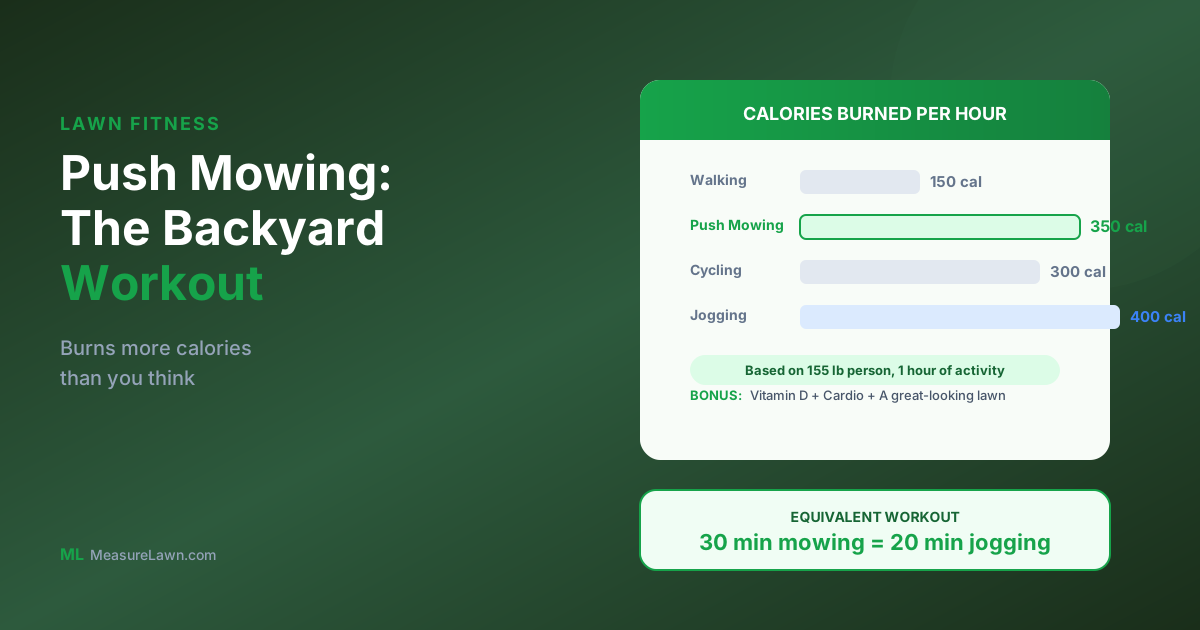
The numbers might surprise you. Push mowing a non-self-propelled mower burns between 350 to 450 calories per hour for the average adult. To put that in perspective, that's serious calorie expenditure—more than a casual walk and competitive with many gym sessions.
But here's what makes this even more relevant to your actual lawn: a typical 5,000 square foot lawn takes about 30 to 40 minutes to push mow. That translates to roughly 200 to 250 calories burned in a single session. If you've got a larger property—say 10,000 square feet—you're looking at 45 minutes to an hour of mowing, which means 400 to 500 calories gone in one Saturday morning.
These numbers aren't just estimates either. They're based on metabolic research that accounts for the combination of cardio exertion and the muscle engagement required to propel a mower forward. The faster you mow, the higher your heart rate climbs, and the more calories you burn. Knowing your exact lawn size matters here—Measure My Lawn — It's Free →—because it helps you understand exactly how much of a workout you're actually getting.
For context, this calorie burn is consistent regardless of whether you're pushing a manual reel mower or a motorless rotary push mower. The defining factor is that the mower relies entirely on your effort to move forward, not an engine doing the work for you.
Mowers worth considering
From budget push mowers to robotic — compare before you buy.
As an Amazon Associate, Measure Lawn earns from qualifying purchases.
Why is a non-self-propelled mower a surprisingly good workout?
The secret lies in the dual-action challenge of push mowing. Unlike walking on a treadmill or cycling on flat terrain, pushing a mower requires you to overcome constant resistance. You're not just moving your body forward—you're propelling a 50 to 100-pound machine against the friction of the ground and the cutting resistance from the grass.
This resistance training element is what elevates push mowing from "light activity" to genuine exercise. Your muscles have to work harder to move the mower forward than they would to move your body alone. That's why your legs feel tired afterward, and why many people underestimate just how much effort they've put in.
Additionally, push mowing demands consistency. You can't just coast downhill or take an easier path like you might on a walk. From your first pass to your final swipe, the resistance stays constant. This creates a steady, sustained effort that keeps your heart rate elevated throughout the entire session.
The mental component matters too. Push mowing requires focus and coordination—you're steering, maintaining straight lines, overlapping passes, and navigating around obstacles. Your brain is actively engaged, not just along for the ride. That engagement, combined with the physical effort, creates a more comprehensive workout experience than many people realize.
How does push mowing compare to other common exercises?
Let's put push mowing head-to-head with activities most people think of as "exercise":
Walking (casual pace): Burns approximately 280 calories per hour. Push mowing beats this by 70 to 170 calories per hour—that's 25 to 60% more calorie burn for roughly the same time investment.
Cycling (moderate effort): Burns around 400 calories per hour. Push mowing lands squarely in this range at 350 to 450 calories per hour, making it essentially equivalent to a solid cycling session.
Hiking: Burns approximately 430 calories per hour. Push mowing comes remarkably close, especially if your lawn has any slope or if you're moving faster.
Running (moderate pace): Burns 500 to 600 calories per hour. Push mowing doesn't quite match running's intensity, but it's in the same ballpark without the joint stress.
Gym elliptical (moderate resistance): Burns 300 to 400 calories per hour. Again, push mowing is competitive.
Here's the remarkable part: push mowing is often more accessible than these other activities. You don't need special equipment (beyond the mower you likely already have), a gym membership, or ideal weather conditions. It's built right into your regular lawn care routine. When you combine the calorie burn with the fact that you're also getting your lawn mowed, push mowing becomes arguably one of the most efficient workouts available.
What muscles does push mowing work?
Push mowing isn't just a leg workout—it's a comprehensive full-body engagement. Here's which muscle groups are actively working:
Legs and Glutes: These are doing the primary work. Your quadriceps are constantly pushing against resistance, your hamstrings are engaged for stability, and your glutes fire with each forward motion. If your lawn has any slope, this intensity skyrockets.
Core Muscles: Your abs and lower back are working hard to maintain posture and stability while pushing. Poor form leads to back fatigue, which is why maintaining good posture throughout the mow makes a big difference.
Arms and Shoulders: You're gripping the handle and steering throughout the entire session. Your forearms, shoulders, and upper back all play a supporting role, especially when you need to push harder through thicker grass or while making tight turns.
Cardiovascular System: Your heart and lungs are working to deliver oxygen to all those muscles. This is where the cardio benefit comes in—you're elevating your heart rate to a moderate workout zone and maintaining it for 30 minutes or longer.
The distribution of work is actually ideal for functional fitness because it mimics real-world movement patterns—pushing, walking, and maintaining posture—rather than isolating individual muscle groups like weight machines do.
Can you turn mowing into a real fitness routine?
Absolutely. If you're looking to incorporate push mowing into an actual fitness regimen, the numbers work in your favor. During the mowing season—roughly April through October in most of the country—you're looking at 25 or more mowing sessions. That's consistent, built-in cardio happening on a regular schedule.
Here's how to optimize your mowing workout:
Increase Speed: Don't just plod along. Maintain a brisk pace. Your heart rate will climb, and you'll burn noticeably more calories in the same time window.
Leverage Slopes: If your lawn has any elevation change, mow uphill when possible. This dramatically increases the difficulty and calorie burn.
Use Proper Form: Stand upright, avoid slouching, and engage your core. Poor form leads to fatigue and potential injury.
Skip the Self-Propelled Mower: If you're looking for the fitness benefit, deliberately choose a non-self-propelled model. You're paying for the workout, not the convenience.
Track Your Sessions: Keep a simple log of mowing dates and lawn size. You'll be surprised by the consistency when you actually see it documented. You can pair this with knowing your exact lawn measurements—Measure My Lawn — It's Free →—to estimate your calorie burn more accurately.
Many fitness enthusiasts actually prefer push mowing to traditional cardio equipment because it provides variety, purpose, and visible results (a mowed lawn). You're not staring at a wall in a gym; you're outside, getting fresh air, and accomplishing something productive simultaneously.
How does lawn size affect your mowing workout?
This is where the math gets practical. Lawn size directly correlates to workout duration and intensity:
Small lawn (under 3,000 sq ft): Typically takes 15 to 20 minutes to push mow. This is a light workout session—roughly 100 to 150 calories burned. Good for a quick, maintenance-level cardio session.
Medium lawn (3,000 to 7,000 sq ft): Takes 25 to 40 minutes. This is your sweet spot for a solid workout—200 to 300 calories burned. This is the range where most homeowners fall, and it's enough to feel like genuine exercise.
Large lawn (7,000 to 12,000 sq ft): Takes 45 to 60+ minutes. You're now burning 400 to 500+ calories—equivalent to an intensive gym session or an hour-long cycling ride.
Very large lawn (over 12,000 sq ft): Pushes the boundaries of what most people can sustain with a manual mower. You're looking at 90+ minutes and 600+ calories burned, though most people find this difficult without breaks.
The practical takeaway: if you're choosing between a self-propelled and a push mower, and fitness is part of your decision, understanding your lawn size helps you make the right call. A small lawn might not provide enough consistent workout stimulus to justify the added effort of push mowing. A medium to large lawn, though? You're getting a legitimate, regular exercise session built into your routine.
What are the mental health benefits of mowing your own lawn?
Beyond the physical calorie burn, there's a significant mental health component to push mowing that often gets overlooked.
Outdoor Activity: You're outside, getting sunlight and fresh air. This alone is associated with improved mood, better stress reduction, and increased vitamin D production. Gym treadmills can't replicate this environmental benefit.
Meditative Repetition: The rhythmic, repetitive nature of mowing—back and forth, line by line—can be surprisingly meditative. Many people find it clears their head and reduces anxiety in a way that other exercise doesn't. You're focused enough to stay engaged, but not so focused that you can't think or zone out.
Sense of Accomplishment: You can literally see the results of your work. This visible progress triggers a dopamine response in the brain—that "job well done" feeling. Contrast this with running on a treadmill where you end up exactly where you started.
Control and Autonomy: You're choosing when to mow, how fast to go, and what pattern to use. This element of control is psychologically beneficial and often missing from gym-based workouts.
Reduction of Screen Time: Mowing is one of the few exercise activities that naturally keeps you away from phones and screens. The mental health benefits of this digital detox are increasingly well-documented.
Social Connection: If you're mowing your front lawn, you're visible to neighbors. Many people find this creates natural social interaction—waving, chatting briefly—which contributes to community connection and mental wellbeing.
The combination of physical exertion, outdoor exposure, visible accomplishment, and mental engagement makes push mowing one of the more holistic forms of exercise available.
Ready to Turn Your Lawn Into Your Gym?
Push mowing might not look as impressive as a fitness class or a gym session, but the science is clear: it's a legitimate, calorie-burning workout that rivals many traditional forms of exercise. And here's the best part—you're getting your lawn mowed in the process.
If you're thinking about upgrading your mower setup or trying to decide between push and self-propelled options, think about your lawn size and your fitness goals. A medium to large lawn with a non-self-propelled mower might be the most underrated piece of exercise equipment in your yard.
Start by understanding your actual lawn dimensions. Measure My Lawn — It's Free → will give you the exact square footage and help you estimate how much of a workout each mowing session represents. Then grab your mower, embrace the effort, and enjoy knowing that you're burning serious calories while getting the job done.
Ready to measure your lawn?
Get a free, AI-customized lawn care plan with exact product quantities for your property.
Measure My Lawn — It's Free →