Lawn Disease Identification: How to Spot Brown Patch, Dollar Spot, and Common Fungus
Your lawn looked fine last week. Now there's a circular brown patch spreading across it, or tiny tan circles appearing in the shaded areas, and you don't know if it's disease, drought, or just a dead spot. Lawn fungal diseases are tricky because they mimic multiple problems, and by the time you realize what's happening, the disease has already spread. Learning to identify fungal diseases early—and knowing the difference between disease and normal stress—is the fastest way to stop the damage.
How do you tell the difference between lawn disease and other problems?
This is the hardest part. Lawn disease looks similar to drought stress, nutrient deficiency, compaction, pest damage, and even mowing scalp. You need to understand what makes disease different.
Fungal disease appears as discolored patches that expand in a pattern—rings, circles, or streaks that grow outward from a center point. The affected grass usually has a distinct color change—brown, tan, gray, or black—and the problem gets worse over days or weeks, not after a single mowing.
Drought stress, by contrast, shows up uniformly across the lawn in the driest areas. A hill top will stress before a valley bottom. There's no clear circular or ring pattern. Mowing too short creates scalp damage that looks burned but appears immediately after mowing, not developing days later.
Nutrient deficiency shows up as uniform yellowing across the entire lawn or following traffic patterns (nitrogen moves in footsteps first). Pest damage—like grubs or chinch bugs—creates irregular dead zones where you'll find visible insects if you dig.
Disease has another signature: it's usually localized at first, then spreads. You'll see one patch, then another appears nearby a few days later. The affected grass may have a slimy feel, unusual smell, or visible fungal growth when you inspect closely. Morning dew often makes fungal issues more visible—you might see white or gray mycelium (fungal threads) on the blades.
Temperature and humidity history help too. Most fungal diseases thrive in specific conditions—warm + humid for some, cool + moist for others. If you've had high humidity and 65-80°F temperatures, fungal disease is likely. If you've had 100°F heat with no rain, drought stress is more probable.
Lawn fungicides for this problem
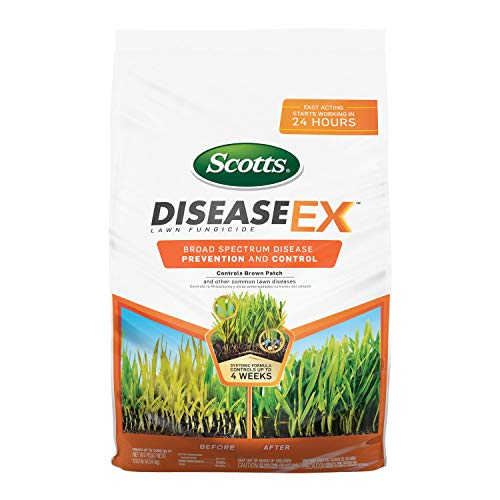
Scotts DiseaseEx
Beginner friendly
Spectracide Immunox Fungus Plus Insect Control for Lawns
Beginner friendlyReady-to-spray hose-end; also controls listed insects

BioAdvanced Fungus Control for Lawns (Primary Liquid Fungicide)
Beginner friendlyAs an Amazon Associate, Measure Lawn earns from qualifying purchases.
What does brown patch look like and what causes it?
Brown patch is the most common lawn fungal disease, especially on cool-season grasses during spring and fall when temperatures and moisture align perfectly.
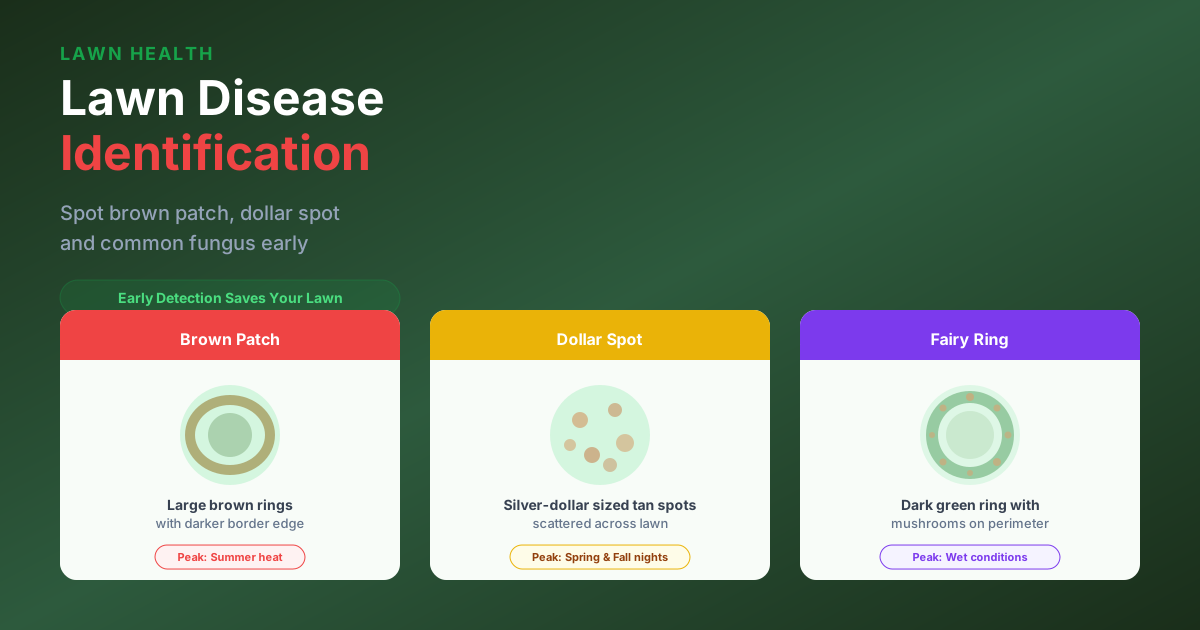
Appearance: Brown patch starts as circular brown rings, typically 1-3 feet in diameter, though they can grow much larger. The edges of the ring are darker than the center—sometimes you see a complete ring with tan or even living grass in the middle, which makes it look like a doughnut. Individual leaf blades show a brown lesion that starts at the tip and works down toward the base. The affected grass looks like it's dying from the top down.
Causes: Brown patch is caused by the fungus Rhizoctonia solani. It thrives when nighttime temperatures are 60-75°F with high humidity. This makes spring (April-May in northern regions) and fall (September-October) the peak disease windows. The disease is worse on poorly maintained lawns with excessive nitrogen, because lush soft growth is vulnerable. It's also worse with evening watering, because wet blades overnight provide perfect fungal conditions.
Cool-season grasses like perennial ryegrass, tall fescue, and Kentucky bluegrass get brown patch in spring and fall when conditions are cool and wet. Warm-season grasses (Bermuda, zoysia) get brown patch in spring and early summer as temperatures climb but humidity remains high.
Why it spreads: The fungus spreads through water splash—from rain, irrigation, or wet grass hitting the mower deck. It also spreads through foot traffic. The fungus produces spores that travel through the air and land on new grass.
The disease cycle is fast. Once brown patch starts spreading, without intervention it can take over half your lawn in 2-3 weeks during ideal conditions.
How do you identify dollar spot in your lawn?
Dollar spot is the second most common lawn fungal disease, and it's particularly destructive on low-nitrogen lawns and in drought conditions.
Appearance: Dollar spot creates small circular patches, 2-6 inches in diameter—hence the name. They look like small tan circles scattered across the lawn. Individual leaf blades have distinctive hourglass-shaped lesions (wider on both ends, pinched in the middle) with tan or straw-colored centers. The lesions work their way up from the blade tip. In wet conditions, you might see white mycelium (fungal growth) crossing the leaf surface, looking like a cobweb.
Causes: Dollar spot is caused by Sclerotinia homoeocarpa and thrives in warm (70-85°F), humid conditions, particularly when nights are cool (below 60°F). It's worse on slow-growing, nitrogen-starved lawns because weak grass can't defend itself. Poor drainage and heavy thatch also promote dollar spot. It appears most often in late spring and early fall when daytime warmth is combined with cool nights and morning dew.
Dollar spot is a classic disease of under-fertilized, under-maintained lawns. It's almost a symptom of benign neglect—the grass isn't getting enough food to grow thick and strong, so fungal disease moves in.
Why it spreads: Dollar spot spreads through infected clippings, foot traffic, and contaminated equipment. It also spreads through splashing water. Unlike brown patch which has clear environmental triggers, dollar spot can be stubborn and reappear on the same lawn year after year if the underlying conditions (low nitrogen, poor drainage, heavy thatch) aren't addressed.
What is gray leaf spot and which grasses does it affect?
Gray leaf spot is another fungal disease that affects specific grass types, making it easier to identify if you know your grass species.
Appearance: Gray leaf spot creates small, oval lesions on grass blades with olive-gray centers and sometimes a dark border. The lesions start small but can merge together, making entire leaf sections look bleached or whitish-gray. The disease often starts on lower leaves first, so you might not notice it until it's progressed upward. In humid conditions, you'll see gray fungal growth on the affected blades.
Affected Grasses: Gray leaf spot is particularly destructive on St. Augustine grass and perennial ryegrass, though it can affect other species. If you have one of these grass types and see these symptoms, gray leaf spot is likely the culprit.
Causes: Gray leaf spot is caused by Pyricularia grisea and thrives in warm (75-90°F), humid conditions, especially when there's frequent rainfall or overhead watering. It's most common in summer and early fall. St. Augustine grass is vulnerable because many varieties have genetic susceptibility to the disease. Perennial ryegrass gets gray leaf spot when grown in warm climates or during warm, humid summers.
The disease is aggressive on stressed grass—lawns that are over-nitrogen fertilized (creating soft growth), scalped too short, or poorly drained are more vulnerable.
When are lawns most vulnerable to fungal disease?
Fungal diseases aren't random. They follow predictable environmental patterns. Understanding when your lawn is most vulnerable lets you take preventive action before disease starts.
Temperature + Humidity Combination: This is the critical factor. Cool-season grasses get brown patch when nighttime temps are 60-75°F—which happens in spring (April-May) and fall (September-October) in most northern regions. Dollar spot thrives at 70-85°F with cool nights. Gray leaf spot takes off at 75-90°F. Summer heat (over 90°F) and winter cold (below 40°F) slow most fungal diseases.
Moisture: All fungal diseases need moisture. Wet leaves at night are the fungus's perfect environment. Morning dew left on grass for hours, overhead irrigation that keeps blades wet, or frequent rainfall all promote fungal disease. Diseases are worse after rainy periods and in shaded areas where grass dries slowly.
Mowing Height: Grass cut too short (scalped) is more vulnerable because weak, stressed plants can't resist fungal infection. Mowing at the high end of recommended height for your grass type—3-4 inches for most cool-season grasses—creates stronger plants that resist disease.
Nitrogen Feeding: Excessive nitrogen creates soft, succulent growth that fungi love. Undersupply of nitrogen creates weak grass that can't fight disease. The sweet spot is adequate but not excessive nitrogen. A soil test reveals your actual nitrogen level.
Thatch: Thick thatch (dead grass buildup between soil and living grass) traps moisture and reduces airflow. This creates a fungal incubator. Lawns with heavy thatch get disease more often and more severely.
Poor Drainage: Areas where water pools after rain or where soil stays saturated are disease hotspots. These microclimates stay wet longer and provide perfect fungal conditions.
What's the best fungicide for home lawns?
Once you've identified the fungal disease, treatment options depend on the disease and severity. Chemical fungicides work, but they need to be applied correctly to be effective.
Scotts DiseaseEx is a popular homeowner option containing azoxystrobin, a broad-spectrum fungicide that treats brown patch, dollar spot, and gray leaf spot. It's available in granular form for spreader application and costs $15-20 for coverage of 5,000 square feet. Granular products are convenient because you apply them with a regular fertilizer spreader. A single application protects for 2-4 weeks depending on conditions.
BioAdvanced Fungus Control contains propiconazole and is available as a concentrate or ready-to-spray form. It's effective against brown patch and other fungal diseases and costs around $12-18. You apply it as a spray, which means more targeted coverage but requires a sprayer.
Copper Fungicides and Sulfur Fungicides are older, less expensive options ($8-15) that work on some diseases and are less likely to create resistant fungal strains. They're good for prevention but less effective once disease is established.
Application timing matters. Fungicides work best as a preventive—applied before disease appears—or in the very early stages before the disease spreads widely. Once fungal disease covers 25-50% of your lawn, fungicide helps slow spread but won't eliminate existing disease. The best window is applying at first sign of trouble, before you can clearly see rings or patches.
Reapplication is often necessary. Most fungicides protect for 2-4 weeks, so if conditions stay favorable for fungus (continued cool nights and moisture), you may need a second application 3-4 weeks after the first.
Can you prevent lawn disease without fungicide?
Yes—prevention without fungicide is possible and often more cost-effective. Most fungal diseases are symptoms of underlying maintenance issues. Fix the conditions that favor fungus, and disease stops appearing.
Mow High: Cut at the recommended height for your grass type—3-4 inches for cool-season grasses, 2-3 inches for warm-season. Higher cutting means deeper roots, thicker grass, and stronger resistance to fungal infection. Disease-susceptible areas should be mowed last so you don't spread spores from diseased grass to healthy grass.
Water Right: Water deeply and infrequently in the early morning (5-9 AM), not in the evening. Morning watering lets grass dry quickly in the sun, which creates unfavorable fungal conditions. Evening watering leaves blades wet all night—fungus's ideal environment. Avoid overhead sprinklers if you can use drip irrigation or soaker hoses instead. If you must use a sprinkler, ensure adequate airflow and drainage so grass dries quickly.
Fertilize Appropriately: Don't over-nitrogen. Follow soil test recommendations or use balanced formulations. Under-feeding starves your lawn into weakness; over-feeding creates soft growth that attracts fungus. Spring and fall feeding (not summer) promotes healthy growth during the plant's natural growth cycles.
Improve Drainage: If disease keeps returning to the same spots, the problem is likely saturated soil. Installing a French drain, raising the grade, or aerating to break compaction can improve drainage enough to prevent disease recurrence.
Dethatch: If your lawn has heavy thatch (you can see a brown, spongy layer between the grass and soil), dethatch in spring or fall. Thatch removal improves airflow and moisture drainage, which directly reduces fungal disease incidence.
Aerate: Soil compaction reduces drainage and root development. Aerating in spring or fall (depending on grass type) improves both, creating conditions where grass resists disease better.
Remove Clippings if Disease Present: While mulching clippings usually benefits the lawn, if fungal disease is active, removing clippings for the first few mowings after you notice disease helps prevent spread through infected plant material.
Ready to measure your lawn?
Get a free, AI-customized lawn care plan with exact product quantities for your property.
Measure My Lawn — It's Free →