Kill Weeds Without Killing Your Grass (Selective Herbicides)
Selective herbicides kill broadleaf weeds and leave grass unharmed - but only on the right grass type. Which products are safe for yours, and how to apply them.
What's the Difference Between Selective and Non-Selective Herbicide?
This distinction is fundamental to understanding weed control in lawns.
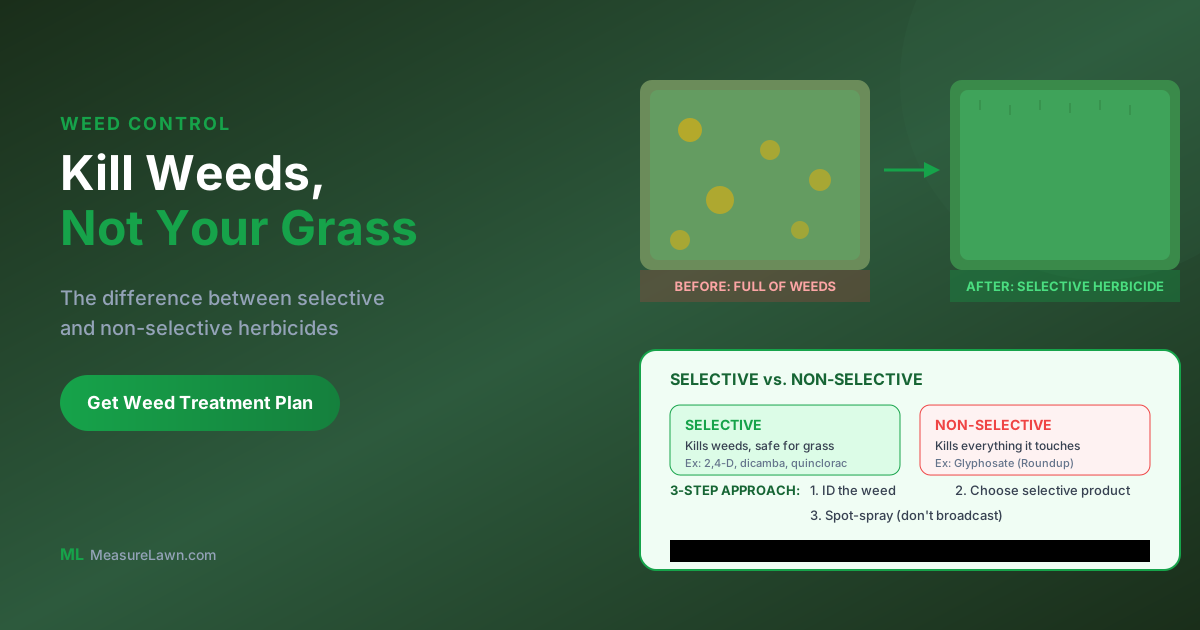
Non-selective herbicides like glyphosate (Roundup) and glufosinate are broad-spectrum plant killers. They interfere with a metabolic pathway that exists in virtually all plants — they don't care whether they're targeting a weed or a grass blade. Non-selective herbicides will kill any plant they contact, which is exactly why homeowners use them to clear garden beds, kill invasive groundcovers, or remove all vegetation from a pathway.
Non-selective herbicides are invaluable for renovation projects — clearing an overgrown lawn to start fresh — but they're completely wrong for spot-treating weeds in an established lawn. If you spray Roundup on a dandelion in your grass, the grass dies along with the weed.
Selective herbicides are engineered to exploit botanical differences between broadleaf weeds and grasses. Grasses and broadleaf plants have fundamentally different leaf structures, vascular systems, and physiology. Selective herbicides are designed to affect one or more of these differences in a way that kills the broadleaf weeds while leaving grass unharmed.
There are several major classes of selective herbicides, each working through different mechanisms:
- Auxin herbicides (like 2,4-D, MCPA, MCPP) disrupt plant growth hormones in broadleaf weeds, causing abnormal growth and death. Grasses are less sensitive to these growth regulators at application rates.
- Acetolactate synthase (ALS) inhibitors (like sulfosulfuron) block an enzyme essential for amino acid synthesis in certain plants, affecting some weeds more than grass.
- Photosystem II inhibitors (like atrazine) interfere with photosynthesis in susceptible plants.
The critical point: "selective" means selective to certain plant species, not selective to all grasses. Some selective herbicides are selective for cool-season grasses, while others are selective for warm-season grasses. Use the wrong one, and you'll get poor results or grass damage.
Weed killers for this job
Match the product to your weed — see the treatment notes above.

BioAdvanced All-In-One Weed & Feed (22-0-4)
Beginner friendly
Ortho WeedClear Lawn Weed Killer Concentrate (Northern)
Beginner friendlyAll-around broadleaf + crabgrass killer for northern lawns — dandelion, clover, chickweed, crabgrass

Ortho WeedClear Ready-to-Spray Hose-End (Northern)
Beginner friendlyEasiest broadleaf + crabgrass treatment — just attach to your garden hose and spray
As an Amazon Associate, Measure Lawn earns from qualifying purchases.
Why Does Roundup Kill Everything But Lawn Herbicides Don't?
The mechanism that makes Roundup so effective on all plants — its non-selectivity — is exactly why you can't use it safely in an established lawn.
Glyphosate (Roundup's active ingredient) disrupts a metabolic pathway called the shikimate pathway. This pathway is essential for amino acid synthesis in plants, and it exists across virtually all plant species. There's no botanical difference between grass and a dandelion in terms of this pathway — both are equally vulnerable.
This broad-spectrum effectiveness makes glyphosate incredibly useful for:
- Clearing areas before new construction
- Killing perennial weeds that are difficult to control with selective herbicides
- Renovating a lawn that's severely infested with weeds and grass
- Killing vegetation along fence lines or hardscape edges
But for ongoing weed management in a healthy lawn, you need selectivity. You need a product that recognizes grass as a friend and broadleaf weeds as enemies.
Selective herbicides achieve this by targeting characteristics that differ between grass and broadleaf plants:
Leaf structure: Grass leaves are narrow and parallel-veined; broadleaf weeds have broad leaves with net-like vein patterns. Some selective herbicides are absorbed more readily through the broader leaf surface of broadleaf weeds.
Physiology: Grasses and broadleaf plants have different growth patterns, hormone sensitivities, and enzyme systems. Selective herbicides exploit these differences.
Cuticle composition: The waxy outer layer of leaves varies between grasses and broadleaf plants. Some selective herbicides penetrate more readily through the broadleaf cuticle.
This selectivity at the plant biology level is why you can safely spray 2,4-D across your entire lawn, killing broadleaf weeds, and the grass is unharmed. The herbicide recognizes and exploits botanical differences that humans can see visually but are expressed at the cellular and molecular level.
The practical result: Roundup is the right tool for renovation or renovation-adjacent projects. Selective herbicides are the right tool for ongoing weed management in established lawns.
Which Selective Herbicides Are Safe for Cool-Season Grass?
Cool-season grasses — Kentucky bluegrass, perennial ryegrass, tall fescue, fine fescue — respond positively to most common selective herbicides, though some are more sensitive than others.
Auxin herbicides are the first-line choice for cool-season lawns:
2,4-D (2,4-dichlorophenoxyacetic acid) is the most widely used and safest option for cool-season grasses. It's been used for over 70 years with an excellent safety record in cool-season lawns. Effective at low rates, it's the gold standard for controlling broadleaf weeds like dandelions, clover, plantain, and chickweed.
MCPA (2-methyl-4-chlorophenoxyacetic acid) is similar to 2,4-D with slightly different selectivity. Some broadleaf weeds are more susceptible to MCPA; others respond better to 2,4-D.
MCPP (mecoprop) is often combined with 2,4-D or MCPA for broadened weed spectrum. It provides good control of difficult weeds like clover and oxalis.
Dicamba is another auxin herbicide, highly effective but somewhat more aggressive than 2,4-D. It's particularly effective on difficult weeds like wild carrot and Canada thistle.
For tough, resistant weeds or areas where auxin herbicides haven't provided adequate control:
Sulfosulfuron is an ALS inhibitor that provides selective control in cool-season grasses. It's particularly effective on sedges and some tougher broadleaf weeds that resist auxin herbicides.
Carfentrazone provides contact herbicide action against broadleaf weeds while being safe for established cool-season grass.
Important safety notes for cool-season grass:
- Don't apply auxin herbicides when temperatures exceed 85°F, as volatilization increases and grass tolerance decreases
- Don't apply during active growth or stress periods
- Wait 24-48 hours after mowing before application (herbicides work better on emerged foliage)
- Don't apply to newly seeded or recently installed sod — wait until grass is well-established
- Never use warm-season selective herbicides on cool-season grass
Most herbicide damage in cool-season lawns comes from applying warm-season-selective products or applying too much of the right product.
Measure My Lawn — It's Free → identifies your grass type and climate, then recommends only selective herbicides safe for your specific cool-season grass variety, with application timing that minimizes any risk of damage.
Which Selective Herbicides Are Safe for Warm-Season Grass?
Warm-season grasses — Bermuda, Zoysia, St. Augustine, Bahia, Buffalo — are significantly more sensitive to most selective herbicides than cool-season grasses. This creates a real challenge: the herbicides that work great on cool-season grass can damage warm-season grass.
The safe options are limited:
Atrazine has been the traditional choice for selective weed control in Bermuda and Zoysia grass. It provides pre-emergent and early post-emergent control of broadleaf weeds and some grassy weeds. However, atrazine availability is declining in many states due to environmental restrictions.
2,4-D can be used on some warm-season grasses in careful applications, but tolerance varies by grass species and variety. It's less safe than in cool-season grass.
MSMA (monosodium methanearsonate) has been used for warm-season grass, particularly Bermuda. However, arsenical herbicides are increasingly restricted.
Sulfosulfuron and some ALS inhibitors are being used more frequently in warm-season grass as traditional options become restricted.
The real challenge: many auxin herbicides that are perfectly safe for cool-season grass simply cannot be used on warm-season grass without risk of serious damage. This is a biological reality, not a misapplication problem.
For warm-season grass owners, the practical approach often includes:
- Use the limited selective herbicides available (your lawn care provider should know which ones are approved for your specific grass type)
- Accept that weed control is trickier in warm-season grass
- Employ non-chemical methods like hand-pulling, spot-treating with non-selective herbicide only where needed, or accepting some weed presence
- Focus on dense grass cultivation — a thick, healthy warm-season lawn naturally crowds out many weeds
Never apply cool-season selective herbicides to warm-season grass. This is a common mistake that damages warm-season turf.
How Do You Spot-Treat Weeds vs. Broadcast Treat?
Understanding when to spot-treat and when to broadcast treat changes the effectiveness of your weed control and your total chemical use.
Broadcast treatment means applying herbicide across the entire lawn, typically using a sprayer that covers the whole area. This is the right approach when:
- Weed pressure is heavy (more than 10-15% of lawn coverage)
- Weeds are scattered throughout rather than concentrated in specific areas
- You have multiple weed species affecting large areas
- You're trying to prevent dormant weed seeds from germinating
Broadcast treatments are efficient for large-scale problems and cost-effective when weed pressure justifies the treatment. You're treating the entire lawn with enough herbicide to control all weeds present or prevent emergence.
Spot-treating means identifying individual weeds or small patches and treating only those areas with herbicide. This is better when:
- Weed pressure is light (fewer than 10% of lawn coverage)
- Weeds are scattered in specific problem areas
- You want to minimize total herbicide use
- You have only one or two weed species to target
Spot-treating is more labor-intensive but uses less total herbicide and is appropriate for maintenance after a broadcast treatment has addressed major weed pressure.
The practical sequence: Many lawn care professionals recommend a spring broadcast treatment to address overwintered weeds and establish pre-emergent control, then spot-treat throughout the season as new weeds appear. This balances effectiveness with efficiency.
For spot-treating, use a hand sprayer or backpack sprayer and carefully apply herbicide only to the target weed. Read the label to understand mixing rates for spot-treating (they're often different from broadcast rates). Avoid drift onto nearby desirable plants.
What's the Safest Way to Apply Herbicide?
Application technique significantly impacts both effectiveness and safety. Poor application can reduce effectiveness, damage nearby plants, or pose unnecessary exposure risks.
Timing and conditions matter:
- Temperature: Don't apply when temperatures exceed the label recommendation (usually 85-90°F). Higher temperatures reduce grass tolerance to herbicides and increase volatilization of the product.
- Humidity: Apply when humidity is moderate to high. Dry conditions reduce herbicide uptake and effectiveness.
- Wind: Avoid windy conditions. Wind causes drift, moving herbicide to plants you don't want treated, including trees and shrubs. Most herbicide labels recommend wind speeds below 3-5 mph.
- Rain: Don't apply before rain is expected within 24 hours of treatment. Recent rainfall or wet foliage can reduce herbicide effectiveness.
- Mowing timing: Mow 2-3 days before applying post-emergent herbicides. Fresh mowing wounds can reduce grass tolerance, but waiting gives time for healing.
Application equipment:
- Use properly calibrated equipment. Underapplication wastes herbicide and provides incomplete control. Overapplication damages grass and increases chemical use.
- Use the appropriate spray tip size. Too fine a mist creates drift; too coarse a spray misses weed foliage.
- Keep nozzles clean and replace them regularly.
- For broadcast applications, use a spreader-type sprayer or drop spreader, ensuring even coverage.
- For spot-treating, use a hand sprayer with appropriate nozzle size.
Mixing and handling:
- Follow label mixing rates precisely. More concentrated = higher risk of damage, not better effectiveness.
- Mix in the order specified on the label (usually water first, then herbicide, then surfactant).
- Don't store mixed herbicide for extended periods — apply the same day.
- Wear appropriate protective equipment as specified on the label.
Application technique:
- Spray until foliage is thoroughly wet but not dripping.
- Avoid overlap, which results in excessive concentration in that area.
- Don't apply to newly seeded grass or stressed grass.
- For broadleaf weeds, apply to actively growing weeds — dormant plants respond poorly.
Safety protocols:
- Keep people and pets away during application and for the recommended wait time (usually 24-48 hours).
- Don't apply to grass if rain is expected within 24 hours.
- Never apply more than the label rate "to be safe." The label rate is based on safety and efficacy testing.
Documentation:
- Record what you applied, when, at what rate, and weather conditions. This creates a record for future reference and helps identify patterns if problems develop.
Safe application is careful application. Rushing to spray on a windy day or applying more than recommended always backfires.
What Common Mistakes Accidentally Kill Your Grass?
Herbicide damage to grass is almost always a result of application error, not product failure. Understanding common mistakes helps you avoid them.
Applying the wrong herbicide to your grass type: This is the most common damage scenario. Cool-season-selective herbicides applied to warm-season grass, or warm-season herbicides applied to cool-season grass, cause serious damage. Know your grass type before applying any selective herbicide.
Applying at temperatures that exceed label recommendations: This significantly reduces grass tolerance. A selective herbicide safe at 75°F might damage grass at 90°F.
Applying to stressed grass: Grass that's drought-stressed, recently mowed, or recovering from disease or insect damage has reduced herbicide tolerance. Wait until grass is healthy and actively growing.
Applying to newly seeded or recently installed sod: Wait at least 3-4 mowing cycles after seeding or sodding before applying selective herbicides. Young grass lacks tolerance that established grass has.
Over-applying the herbicide: More product doesn't mean better results. Overapplication increases damage risk without improving weed control and should never be done.
Applying before the recommended wait time after mowing: Fresh mowing wounds reduce grass tolerance to herbicides. Wait 2-3 days after mowing to apply herbicides.
Applying in combination with other stressful practices: Don't apply selective herbicides during intensive irrigation, aeration, or other practices that stress the grass.
Applying when rain is expected: If heavy rain occurs within 24 hours of application, the herbicide may wash off before being absorbed into weeds, reducing effectiveness. Rain also can increase phytotoxicity (plant damage).
Applying at the wrong time of year: Some selective herbicides are more effective at certain times (fall for winter annuals, spring for summer annuals). Applying at the wrong time reduces effectiveness and potentially increases damage risk.
Using non-selective herbicide when selective would work: Homeowners sometimes resort to Roundup because "it will definitely kill the weed." While true, it also kills the surrounding grass. Save non-selective herbicide for renovation projects or edges where grass doesn't exist.
Most grass damage from herbicides is completely avoidable with proper attention to label instructions, grass type, and application timing.
How Does Your Lawn Plan Include the Right Weed Control?
A customized lawn care plan identifies your specific weed management needs and recommends only the herbicides appropriate for your grass type, climate, and current weed pressure.
Rather than generic "apply this product in spring and fall" advice, a customized plan:
- Identifies your grass type and climate, determining which selective herbicides are safe for your grass
- Assesses your current weed pressure, determining whether you need broadcast or spot treatment
- Recommends only the products you need, avoiding unnecessary herbicide applications
- Provides application timing that matches your grass type's growing season and susceptibility
- Specifies exact mixing rates and application methods, reducing risk of over-application
- Integrates with other lawn care, ensuring herbicide applications don't conflict with aeration, overseeding, or other practices
Measure My Lawn — It's Free → builds your customized plan based on your lawn's specific conditions. If you have light weed pressure and cool-season grass, you might receive a targeted 2,4-D recommendation for specific problem areas. If you have warm-season grass with moderate weed pressure, the recommendation changes to herbicides safe for that grass type.
The platform provides:
- Exact product recommendations for your grass type
- Precise application rates (not generic label rates, but rates for your lawn size)
- Optimal application timing for your climate zone
- Integration with other lawn care practices
- Weather-aware application windows
This eliminates the guesswork of choosing herbicides and ensures you're applying the right product, at the right rate, at the right time, for your specific grass type.
How Do You Build a Sustainable Weed Management Strategy?
Effective weed control isn't just about the right herbicide — it's about a complete strategy that includes:
- Dense, healthy grass that naturally crowds out weeds (strong grass is the best weed preventer)
- Appropriate mowing practices that remove weed seeds before they spread
- Soil health that supports grass vigor
- Selective herbicide use when weed pressure exceeds what grass can handle alone
- Non-chemical methods like hand-pulling or targeted non-selective herbicide for troublesome perennials
This integrated approach means less total herbicide use over time, better long-term weed management, and a healthier lawn overall.
Your lawn care plan should reflect this integrated approach, recommending herbicides as one tool among many, not as the only solution to weeds.
Ready to measure your lawn?
Get a free, AI-customized lawn care plan with exact product quantities for your property.
Measure My Lawn — It's Free →