Cool-Season vs. Warm-Season Grass: How to Identify What's in Your Yard
You can't take care of your lawn if you don't know what's growing in it. Mowing height, fertilizer timing, watering needs, and weed control all depend on one question: is your grass cool-season or warm-season?
A homeowner in Nashville applies pre-emergent in February because a YouTube video told them to. Their lawn is Tall Fescue — a cool-season grass. The pre-emergent they chose is designed for warm-season lawns and the timing is wrong for their grass type. The product does nothing. Crabgrass appears in May. They blame the product.
The product was fine. The problem was not knowing what grass they had.
Your grass type determines virtually every decision you'll make about your lawn: when to fertilize, how short to mow, how much to water, which herbicides are safe, and when to overseed. Getting it wrong doesn't just waste money — it can actively damage your lawn.
What Are the Two Types of Lawn Grass and How Do They Grow Differently?
All common lawn grasses fall into two categories based on when they grow most actively.
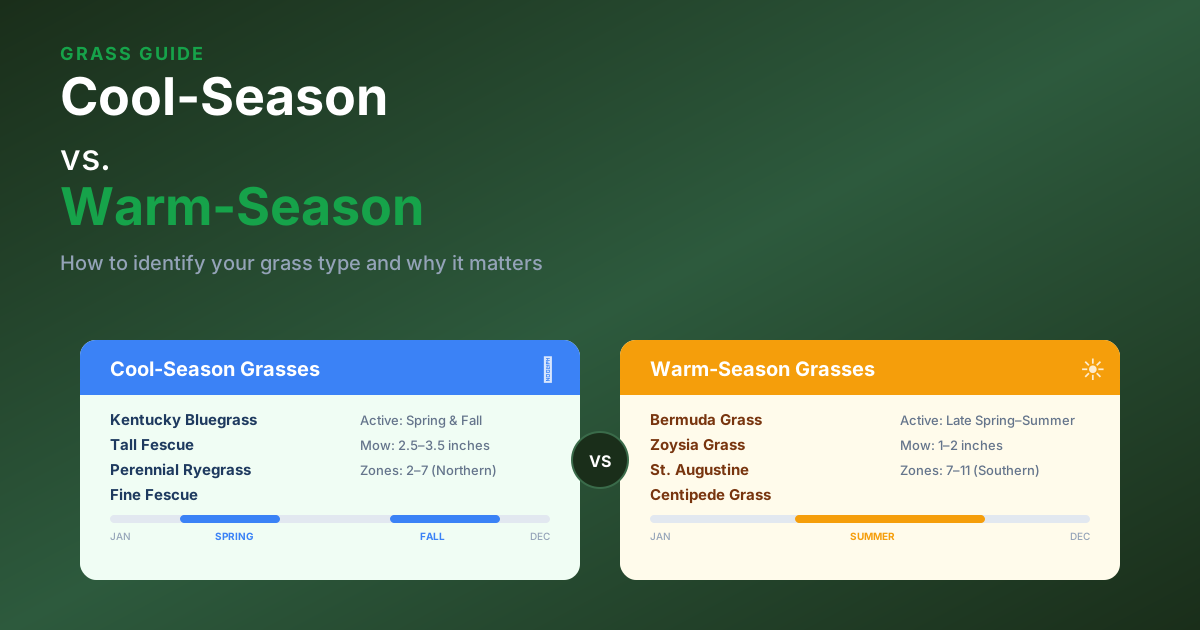
Cool-season grasses thrive when temperatures are 60–75°F. They grow most aggressively in spring and fall, slow down or go dormant in summer heat, and stay green into early winter before going dormant in the coldest months. They dominate lawns in the northern half of the United States.
The four main cool-season lawn grasses are Kentucky Bluegrass, Tall Fescue, Perennial Ryegrass, and Fine Fescue. Each has distinct characteristics, but they share that fundamental growth pattern: peak performance in cooler weather.
Warm-season grasses thrive when temperatures are 75–95°F. They grow most vigorously in summer, go dormant (turn brown) in fall when temperatures drop, and stay brown through winter until spring warmth returns. They dominate lawns in the southern half of the country.
The main warm-season lawn grasses are Bermuda, Zoysia, St. Augustine, Centipede, and Bahia. They love heat and handle drought better than cool-season varieties, but they can't survive sustained freezing temperatures.
The practical difference between these two families is dramatic in terms of what you actually do in your yard. A cool-season lawn owner in Michigan might apply fertilizer in April and September when growth peaks, but never in July — applying nitrogen during peak summer heat when the grass is already stressed would be counterproductive. A warm-season lawn owner in South Carolina does the opposite: they fertilize in May and August during the peak heat and growth period, and they skip fall feeding entirely because their grass is heading dormant. The seasonal calendar you follow literally reverses depending on which family you have.
Grass seed for this job
Pair with a starter fertilizer and the right seeding rate — measure your lawn for the exact amount.
Pennington Smart Seed Sun & Shade
Beginner friendly
Pennington Annual Ryegrass (Bulk)
Beginner friendly
Barenbrug Pensacola Bahiagrass Seed
Beginner friendlyPensacola bahiagrass from Barenbrug, the standard seeded bahia for Southern lawns.
As an Amazon Associate, Measure Lawn earns from qualifying purchases.
How Can You Identify Whether You Have Cool-Season or Warm-Season Grass?
Start With Your Location
Geography narrows the field immediately. If you're in USDA zones 2–5 (northern states), you almost certainly have cool-season grass. If you're in zones 8–11 (deep South, Gulf Coast, Southwest), you almost certainly have warm-season grass.
The tricky area is the transition zone — roughly USDA zones 6–7, running from Virginia through Tennessee, Arkansas, and into Oklahoma. Transition zone lawns can be either type, and some homeowners even have both (Tall Fescue in the front, Bermuda in the sunny backyard).
Look at the Blade
Pull a single grass blade and examine it closely.
Kentucky Bluegrass has a distinctive boat-shaped tip — the blade narrows to a point that curves like the bow of a canoe. The texture is fine and smooth, and the color is a deep blue-green. It spreads via underground rhizomes, which means it can fill in bare spots on its own.
Tall Fescue has wide, coarse blades with visible veins running lengthwise. The texture feels rough if you run your finger along the blade. It grows in clumps (bunch-type growth) rather than spreading via runners, which means bare spots don't fill in on their own.
Perennial Ryegrass has fine, shiny blades that are smooth on top and ridged underneath. It's the fastest-germinating cool-season grass (5–10 days), which is why it's popular for overseeding. It grows in bunches like Tall Fescue.
Fine Fescue has the thinnest, most needle-like blades of any cool-season grass. The texture is extremely fine, almost wire-like. It's the most shade-tolerant cool-season option and requires less fertilizer and water than its relatives.
Bermuda has fine to medium blades, grayish-green color, and aggressive spreading via both stolons (above-ground runners) and rhizomes (below-ground runners). It's the toughest warm-season grass for foot traffic and the most common in the South.
Zoysia has fine, dense blades that create a carpet-like lawn. It spreads more slowly than Bermuda but creates a thicker, more uniform turf. The texture is noticeably soft underfoot.
St. Augustine has wide, flat, coarse blades — the widest of any common lawn grass. It spreads via stolons and has excellent shade tolerance. It's primarily found in Florida, the Gulf Coast, and coastal areas of the Southeast. It's only available as sod or plugs, not seed.
Centipede has medium-width blades and a light apple-green color (rather than the dark green of Bermuda or Bluegrass). It's the lowest-maintenance warm-season grass, requiring minimal fertilizer — over-fertilizing Centipede actually causes decline.
Bahia has coarse, flat blades and a light green color. It produces tall, V-shaped seed heads that are easy to spot. It thrives in poor, sandy soils where other grasses struggle.
When in Doubt, Ask Locally
Your local garden center or university extension office can identify your grass from a small sample. Most extension offices provide this service for free. You can also check what the original builder or previous owner planted — in many neighborhoods, everyone has the same 1–2 grass types.
Many homeowners discover they have a blend rather than a pure grass type. For example, a lot originally seeded with Kentucky Bluegrass may have received a tall fescue blend to improve drought tolerance, or a "Bermuda" lawn in the transition zone might be a Bermuda-Zoysai blend. If your lawn mixes types, identify the dominant species (the one covering 60%+ of the lawn) and follow a plan tailored to that majority type. The minority species will often tolerate the schedule as a secondary component, though it may not thrive as vibrantly as if you'd optimized specifically for it.
Why Does Knowing Your Grass Type Change Everything About Lawn Care?
Mowing height varies dramatically. Bermuda thrives at 0.75–1.5 inches. Tall Fescue needs 3–4 inches. Mowing Bermuda at 3 inches weakens it; mowing Fescue at 1.5 inches scalps it. Same action, opposite outcomes.
Fertilizer timing is grass-type dependent. Fertilizing cool-season grass in July (peak summer heat) stresses an already dormant plant. Fertilizing warm-season grass in October (heading into dormancy) wastes product that won't be absorbed. Each type has specific windows when feeding actually works.
Herbicide safety depends on your grass. The herbicide 2,4-D is safe on cool-season grasses but can damage Bermuda and Zoysia. Some pre-emergent products are safe for certain grasses but toxic to others. Applying the wrong herbicide to the wrong grass type can kill your lawn.
Watering needs differ. Kentucky Bluegrass needs about 1.25 inches per week during active growth. Buffalo Grass — the most drought-tolerant option — needs only 0.5 inches. Overwatering a drought-tolerant grass promotes disease; underwatering a thirsty grass causes decline. In practice, a homeowner watering their Centipede lawn (drought-tolerant warm-season grass) on the same schedule as their neighbor's fine fescue (moisture-loving cool-season grass) will see brown patches, thatch issues, and fungal disease in their yard while the neighbor thrives.
Overseeding timing reverses between types. Cool-season grasses are best seeded in fall (August–September). Warm-season grasses establish best in late spring. And some warm-season grasses like St. Augustine aren't available as seed at all — they're sod-only. This timing difference is critical: a homeowner in the transition zone who oversees their warm-season lawn in September is likely to waste seed and money because the young grass won't have enough warm-weather growth before dormancy kicks in.
How Do You Build a Complete Lawn Care Plan That Matches Your Specific Grass Type?
Once you know your grass type, you need a plan built specifically for it — not a generic checklist that treats all lawns the same.
MeasureLawn asks you to select your grass type during setup, then builds a month-by-month plan tailored to that specific grass. Kentucky Bluegrass in the North gets different tasks, different timing, and different products than Bermuda in the South. Every recommendation — from mowing heights to product quantities to seasonal timing — is matched to what your grass actually needs.
Getting this identification step right pays dividends year after year. A homeowner who spends 10 minutes correctly identifying their grass type will make better decisions on every subsequent purchase: the right pre-emergent product, the right fertilizer ratio, the right herbicide, the right seeding season. Meanwhile, a homeowner who guesses or follows generic advice will keep throwing money at solutions that don't match their actual situation. One homeowner spends intelligently on targeted solutions; the other wastes money on shotgun approaches.
Start by measuring your lawn and telling us what's growing in it. We'll handle the rest.
Ready to measure your lawn?
Get a free, AI-customized lawn care plan with exact product quantities for your property.
Measure My Lawn — It's Free →